
MARKETMAZE ECOMMERCE TOOLS
12 Best Ecommerce Site Search, Filters & Merchandising Tools
Compare 12 ecommerce site search and product discovery tools across relevance, filters, merchandising control, integrations, implementation effort and pricing, from Shopify’s free native app to enterprise discovery platforms.
Updated 25 September 2026
What are ecommerce site search and merchandising tools?
Ecommerce search and merchandising software helps shoppers find relevant products through better query understanding, autocomplete, filters, synonyms, ranking, category ordering and recommendations. The category spans simple platform-native apps, managed discovery suites and developer-oriented search infrastructure. The right choice depends less on feature count than on catalog complexity, traffic, merchandising workflow, technical resources and how much control you need over ranking and personalization.
🧭 Jump to a tool
🏆 The quick answer
Best overall: Constructor
Best enterprise suite: Bloomreach Ecommerce Search
Best for developers: Algolia
Best unified merchandising platform: Athos Commerce
Best guided mid-market option: Luigi's Box
Best value for growing stores: Doofinder
MarketMaze take: Search tools split into three buying motions. Large retailers should compare Constructor, Bloomreach, Athos and Nosto as managed discovery systems. Technical teams building custom experiences should look closely at Algolia and Prefixbox. Shopify merchants should start by benchmarking the free native app against Fast Simon, Boost and Doofinder before paying for enterprise complexity.
📊 Tool comparison & scores
Tool | Score | Price | Best fit | Setup |
|---|---|---|---|---|
Constructor | 94/100 | Enterprise price | Enterprise | Enterprise implementation |
Bloomreach Ecommerce Search | 93/100 | Enterprise price | Enterprise | Enterprise implementation |
Algolia | 92/100 | Mid | All sizes | Developer-led |
Athos Commerce | 90/100 | Enterprise price | Mid-market–Enterprise | Enterprise implementation |
Nosto | 88/100 | Enterprise price | Mid-market–Enterprise | Specialist-led |
Luigi's Box | 86/100 | Premium | Mid-market–Enterprise | Specialist-led |
Doofinder | 84/100 | Budget | SMB–Mid-market | Low-code |
Prefixbox | 83/100 | Premium | Mid-market–Enterprise | Developer-led |
Fast Simon | 82/100 | Budget | SMB–Mid-market | Low-code |
Boost AI Search & Discovery | 81/100 | Mid | SMB–Mid-market | No-code |
Clerk.io | 79/100 | Mid | SMB–Mid-market | Low-code |
Shopify Search & Discovery | 77/100 | Free | SMB | No-code |
🧠 How the scoring works
This ranking uses MarketMaze proprietary scoring. For this category, core job performance emphasizes search relevance, typo tolerance, query understanding, filters and ranking quality.
Dimension | Weight | What we look for |
|---|---|---|
Core job performance | 30% | Relevance, query understanding, typo tolerance, filters and ranking quality |
Ecommerce fit | 20% | Catalog, merchandising, recommendations and commerce-specific workflows |
Workflow & control | 15% | Rules, synonyms, pinning, testing, analytics and operator usability |
Integrations & implementation | 15% | Platforms, APIs, data feeds, events and deployment paths |
Pricing & value | 10% | Transparency, accessibility and value for the intended buyer |
Scale & advanced capabilities | 10% | Large catalogs, traffic, personalization, multi-market and enterprise controls |
🤔 Do you even need better ecommerce search software?
Probably yes
You have a large catalog, meaningful search traffic, frequent zero-result queries or merchandisers spending time manually fixing rankings.
Maybe later
Your store is growing but native search still handles most queries and filters without obvious conversion friction.
Probably not yet
You have a small catalog, low search usage and limited merchandising complexity; improve product data and navigation first.
🥇 1. Constructor
94/100 · 💰 Enterprise price · 🧩 Advanced · 🏢 Enterprise · ⚙️ Enterprise implementation
🎯 Best for: Enterprise retailers that want search, browse, merchandising and personalization optimized around commerce behavior.
⚡ Choose Constructor if you want commerce-specific relevance and merchandising controls backed by behavioral data rather than a generic search layer.
Constructor is a commerce-native product discovery platform covering search, autosuggest, browse, recommendations and collections. Its ranking uses catalog, context and shopper behavior, while merchandisers can intervene with rules, experiments and reporting. It is strongest when search is treated as a revenue system rather than a simple keyword box, but that depth also means a structured implementation and good event data matter.
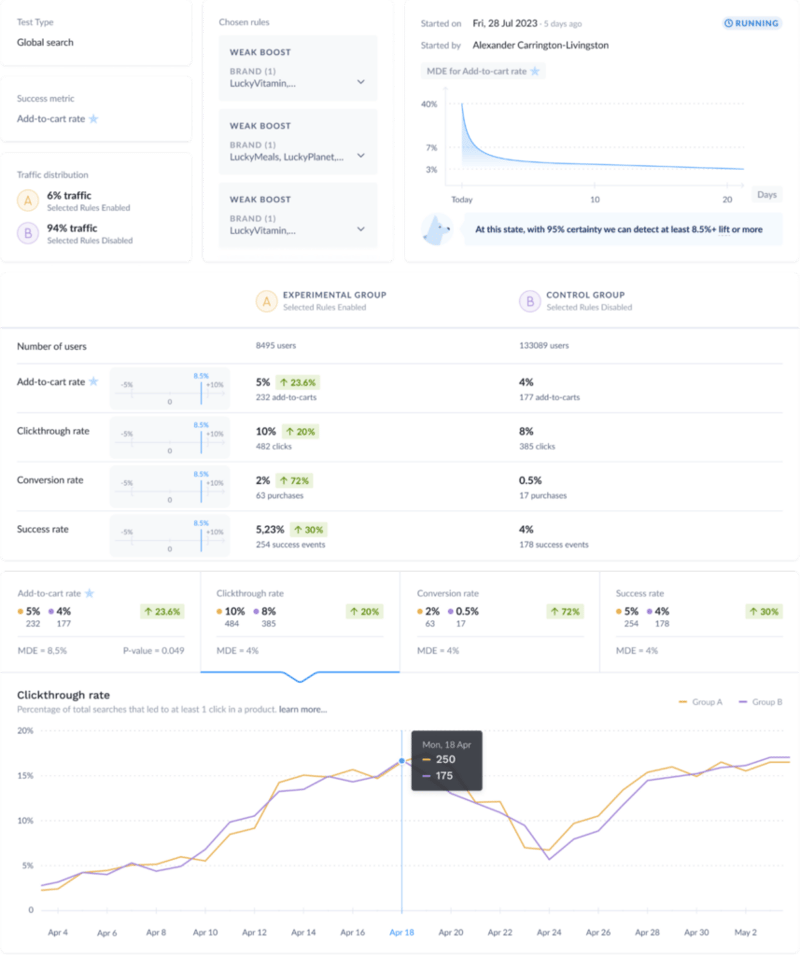
📷 Product or documentation view showing the search, merchandising or analytics workflow. Source: vendor website or documentation.
💚 What we like
Commerce-specific ranking uses shopper behavior and business signals instead of relying only on textual relevance.
Merchandising controls, analytics and experimentation sit inside the same product-discovery workflow.
Search, browse, recommendations and collections share data, reducing fragmentation across discovery surfaces.
🟠 What to know
It is built primarily for larger retailers, so buying and implementation are more involved than a Shopify app.
The value depends on clean catalog feeds and reliable behavioral tracking, which raises implementation expectations.
💡 Why this score: Constructor earns the top score for its ecommerce specialization, strong ranking controls and connected discovery suite. It loses points mainly on accessibility: pricing is sales-led, implementation is substantial and smaller stores are unlikely to need the platform’s depth.
💰 Pricing: Custom quote. Sales-led enterprise pricing; implementation and scope are tailored to the retailer.
✅ Best fit: Enterprise retailers that want search, browse, merchandising and personalization optimized around commerce behavior.
🚫 Less ideal for: Stores whose size, technical resources or discovery needs fall well outside this product’s natural buying motion.
🧩 Key capabilities
AI-driven search and autosuggest
Behavioral and contextual ranking
Searchandising and merchandising rules
Browse and collection optimization
Recommendations and personalization
Analytics, testing and merchant intelligence
🔎 Official sources: Product · Pricing · Documentation
🥈 2. Bloomreach Ecommerce Search
93/100 · 💰 Enterprise price · 🧩 Advanced · 🏢 Enterprise · ⚙️ Enterprise implementation
🎯 Best for: Large retailers that need enterprise search, merchandising, recommendations and deep operational control across complex catalogs.
⚡ Choose Bloomreach Ecommerce Search if you need enterprise search with automated relevance plus extensive merchandising, testing and insight workflows for a large catalog.
Bloomreach Ecommerce Search combines AI-driven search, merchandising, recommendations, analytics and testing in a commerce-focused platform. The current Search packaging includes AI-generated synonyms, ranking controls, autosuggest, category precision and premium AI features. It is a strong fit for teams that need both algorithmic automation and hands-on merchandising control across large catalogs, languages and markets, with enterprise onboarding and pricing to match.

📷 Product or documentation view showing the search, merchandising or analytics workflow. Source: vendor website or documentation.
💚 What we like
Search, merchandising, recommendations, testing and insights are tightly connected in one enterprise discovery environment.
Merchandisers get visual and rule-based controls while Loomi AI automates relevance and personalization.
The platform supports complex catalogs, multiple sites and sophisticated enterprise operating models.
🟠 What to know
Pricing is custom and can enter enterprise territory quickly as traffic, catalog size and modules expand.
The platform is broader and heavier than most small or mid-sized stores need for basic search and filtering.
💡 Why this score: Bloomreach scores just behind Constructor because its enterprise feature depth, merchandising workflow and scale are exceptional. The trade-off is buying complexity and cost: it is designed for substantial ecommerce teams, not merchants looking for a lightweight install-and-go search app.
💰 Pricing: Custom annual quote. Search pricing depends on capabilities, catalog size and API usage; Bloomreach says Discovery can start around $3,000/month.
✅ Best fit: Large retailers that need enterprise search, merchandising, recommendations and deep operational control across complex catalogs.
🚫 Less ideal for: Stores whose size, technical resources or discovery needs fall well outside this product’s natural buying motion.
🧩 Key capabilities
AI-driven ecommerce search
Merchandising and ranking controls
Personalized search
Recommendations and pathways
Performance analytics and insights
A/B testing and audience targeting
🔎 Official sources: Product · Pricing · Documentation
🥉 3. Algolia
92/100 · 💰 Mid · 🧩 Advanced · 🏢 All sizes · ⚙️ Developer-led
🎯 Best for: Technical teams that want flexible, fast search infrastructure and control over a custom ecommerce discovery experience.
⚡ Choose Algolia if your developers want maximum control over the frontend, ranking logic, data model and scale without buying a fully managed merchandising suite.
Algolia is a developer-oriented search platform with ecommerce search, browse, personalization, merchandising and prebuilt UI components. It offers a meaningful free tier and usage-based plans, then scales into enterprise contracts. Ecommerce teams get rules, synonyms, analytics and integrations, but most of the experience is assembled by developers, making Algolia especially attractive when a brand wants to own its frontend and product-discovery architecture.

📷 Product or documentation view showing the search, merchandising or analytics workflow. Source: vendor website or documentation.
💚 What we like
Flexible APIs and UI libraries make it possible to build highly customized search experiences across channels.
Transparent self-service pricing makes experimentation easier than with most enterprise discovery vendors.
Ecommerce integrations cover platforms including Shopify, Adobe Commerce and Salesforce Commerce Cloud.
🟠 What to know
A polished ecommerce experience still requires developer work, data modeling and ongoing tuning.
Usage-based pricing can rise materially as search volume, indexed records and advanced capabilities grow.
💡 Why this score: Algolia combines excellent search infrastructure, strong flexibility and unusually accessible pricing. It sits below the top two because ecommerce teams must assemble more of the merchandising and operational experience themselves, making implementation quality more dependent on internal technical capability.
💰 Pricing: Free tier available. Grow includes 10,000 search requests/month then $0.50 per additional 1,000; Grow Plus is $1.75 per additional 1,000 after the included amount, plus record usage.
✅ Best fit: Technical teams that want flexible, fast search infrastructure and control over a custom ecommerce discovery experience.
🚫 Less ideal for: Stores whose size, technical resources or discovery needs fall well outside this product’s natural buying motion.
🧩 Key capabilities
Keyword and AI search
Synonyms and ranking rules
Personalization
Merchandising and collections
Search analytics
APIs, SDKs and ecommerce integrations
🔎 Official sources: Product · Pricing · Documentation
4️⃣ 4. Athos Commerce
90/100 · 💰 Enterprise price · 🧩 Advanced · 🏢 Mid-market–Enterprise · ⚙️ Enterprise implementation
🎯 Best for: Mid-market and enterprise retailers wanting unified search, merchandising, personalization and product-feed capabilities.
⚡ Choose Athos Commerce if you want the combined Searchspring and Klevu capabilities in Athos’s current unified discovery platform rather than separate legacy products.
Athos Commerce is the current unified platform formed from Searchspring, Klevu and Intelligent Reach capabilities. Its Onsite Discovery offer combines search, merchandising and personalization, while broader plans add product feed management and AI assistants. The product is aimed at retailers that want strong merchant control without replacing their commerce platform, with integrations and open APIs for Shopify, BigCommerce, Salesforce Commerce Cloud, Adobe Commerce and headless stacks.

📷 Product or documentation view showing the search, merchandising or analytics workflow. Source: vendor website or documentation.
💚 What we like
Combines search, merchandising and personalization in one current platform instead of splitting legacy Searchspring and Klevu products.
Supports major commerce platforms plus open APIs for headless and custom storefronts.
Merchant-facing controls cover search, product placement, personalization, analytics and testing.
🟠 What to know
Pricing is fully sales-led, so cost comparison requires a tailored quote.
The 2025–2026 platform unification means some documentation and legacy terminology still span multiple product histories.
💡 Why this score: Athos scores highly for ecommerce fit, merchant control and broad discovery coverage. It trails the leaders because the unified platform is still relatively new, buying is quote-based and enterprise-style integration remains more involved than app-first alternatives.
💰 Pricing: Custom quote. Athos offers Onsite Discovery, Offsite Discovery and Complete Discovery plans, with custom combinations available.
✅ Best fit: Mid-market and enterprise retailers wanting unified search, merchandising, personalization and product-feed capabilities.
🚫 Less ideal for: Stores whose size, technical resources or discovery needs fall well outside this product’s natural buying motion.
🧩 Key capabilities
AI search and intent understanding
Merchandising and product placement
Personalized search
Product recommendations
Analytics and reporting
APIs and commerce integrations
🔎 Official sources: Product · Pricing · Documentation
5️⃣ 5. Nosto
88/100 · 💰 Enterprise price · 🧩 Intermediate · 🏢 Mid-market–Enterprise · ⚙️ Specialist-led
🎯 Best for: Brands that want search and merchandising tied closely to personalization, recommendations and broader onsite experience optimization.
⚡ Choose Nosto if you want search to work as part of a wider personalization and merchandising stack rather than as an isolated search engine.
Nosto combines personalized search with merchandising, recommendations and other onsite experience tools. Merchandising rules can use product attributes and performance signals, then apply across search, categories and recommendations. Pricing is modular and tied to store volume and selected products. Nosto is particularly compelling for brands that already see personalization as part of their merchandising strategy, while smaller merchants may find the broader platform more than they need.

📷 Product or documentation view showing the search, merchandising or analytics workflow. Source: vendor website or documentation.
💚 What we like
Search, categories and recommendations can share merchandising logic and personalization strategy.
Merchandisers can weight product attributes and commercial signals without rebuilding ranking logic in code.
The wider platform can reduce the need to stitch together separate personalization and recommendation tools.
🟠 What to know
Pricing is custom and depends on gross merchandise value, traffic, modules and support requirements.
Teams focused only on basic site search may pay for breadth they do not intend to use.
💡 Why this score: Nosto performs very well on ecommerce fit and workflow, especially for teams that want discovery and personalization together. It loses ground to the top enterprise vendors on search-specific depth and to app-first tools on pricing transparency and ease of adoption.
💰 Pricing: Custom quote. Pricing is modular and based on store volume, selected modules and support/scalability requirements.
✅ Best fit: Brands that want search and merchandising tied closely to personalization, recommendations and broader onsite experience optimization.
🚫 Less ideal for: Stores whose size, technical resources or discovery needs fall well outside this product’s natural buying motion.
🧩 Key capabilities
Personalized site search
Merchandising rules
Category merchandising
Product recommendations
Search analytics
A/B testing and personalization
🔎 Official sources: Product · Pricing · Documentation
6️⃣ 6. Luigi's Box
86/100 · 💰 Premium · 🧩 Intermediate · 🏢 Mid-market–Enterprise · ⚙️ Specialist-led
🎯 Best for: Growing and enterprise retailers that want strong ecommerce search with guided implementation and less engineering than API-first platforms.
⚡ Choose Luigi's Box if you want sophisticated search and product-discovery features with vendor-guided implementation instead of building the full experience yourself.
Luigi's Box offers search, recommendations, product listing, analytics and conversational discovery for ecommerce. Search can be integrated through its Search.js frontend library for a faster implementation or through an API for custom rendering and backend control. Pricing is usage-based and quote-led. It is a strong middle ground for retailers that need serious discovery capabilities but prefer more guided onboarding than a developer-first search platform.

📷 Product or documentation view showing the search, merchandising or analytics workflow. Source: vendor website or documentation.
💚 What we like
Search.js provides filters, sorting, pagination and analytics without requiring a fully custom frontend build.
API integration remains available for teams that need deeper control or server-side rendering.
Pricing is based on usage rather than domain count, useful for multi-market retailers.
🟠 What to know
Public list pricing is not available, so procurement still requires a quote.
The vendor positions the product for growing and larger retailers, not very small single-store merchants.
💡 Why this score: Luigi's Box scores strongly for ecommerce relevance, implementation flexibility and a well-balanced managed experience. It trails the enterprise leaders on breadth and the cheaper app-first products on accessibility, but is an attractive midpoint for serious retailers without huge platform teams.
💰 Pricing: Custom quote based mainly on API usage, traffic, catalog size and search volume. Growth and Enterprise plans include the chosen solution’s full feature set.
✅ Best fit: Growing and enterprise retailers that want strong ecommerce search with guided implementation and less engineering than API-first platforms.
🚫 Less ideal for: Stores whose size, technical resources or discovery needs fall well outside this product’s natural buying motion.
🧩 Key capabilities
AI-powered search
Faceted filtering and sorting
Search.js frontend library
Search API
Recommendations and product listing
Search analytics
🔎 Official sources: Product · Pricing · Documentation
7️⃣ 7. Doofinder
84/100 · 💰 Budget · 🧩 Beginner · 🏢 SMB–Mid-market · ⚙️ Low-code
🎯 Best for: Small and mid-sized retailers that want capable search, recommendations and discovery with clear pricing and relatively quick setup.
⚡ Choose Doofinder if you want a practical plug-and-play search upgrade with public pricing and less implementation effort than enterprise discovery platforms.
Doofinder packages AI search, product recommendations and quiz-based discovery into plans designed for growing ecommerce stores. The Basic plan starts at $49/month, with Pro and Advanced tiers adding higher request limits and deeper features. Installation is designed to be plug-and-play on common platforms, while enterprise options exist for more complex stacks. It is one of the easiest ways to move beyond default store search without committing to a major implementation.

📷 Product or documentation view showing the search, merchandising or analytics workflow. Source: vendor website or documentation.
💚 What we like
Public pricing makes initial budgeting much easier than with most enterprise search vendors.
Search, recommendations and quiz functionality are bundled rather than sold as entirely separate starting products.
Common ecommerce integrations support a comparatively fast path to launch.
🟠 What to know
Request limits can push larger stores into more expensive tiers as traffic grows.
The platform offers less deep enterprise control than the top managed discovery suites.
💡 Why this score: Doofinder scores well because it combines solid ecommerce functionality, transparent pricing and approachable implementation. It gives up some advanced scale, experimentation and merchandising depth compared with enterprise leaders, but its value proposition is unusually clear for smaller teams.
💰 Pricing: Starts at $49/month monthly, or $44/month billed annually, for up to 10,000 requests per product; higher tiers add more usage and advanced features.
✅ Best fit: Small and mid-sized retailers that want capable search, recommendations and discovery with clear pricing and relatively quick setup.
🚫 Less ideal for: Stores whose size, technical resources or discovery needs fall well outside this product’s natural buying motion.
🧩 Key capabilities
AI search and autocomplete
Synonyms and voice search
Product recommendations
Search analytics
Quiz-based product discovery
Multi-platform ecommerce integrations
🔎 Official sources: Product · Pricing · Documentation
8️⃣ 8. Prefixbox
83/100 · 💰 Premium · 🧩 Advanced · 🏢 Mid-market–Enterprise · ⚙️ Developer-led
🎯 Best for: Mid-market and enterprise retailers that want managed AI search with API flexibility and explicit request-based pricing.
⚡ Choose Prefixbox if you need AI search, navigation and recommendations with transparent enterprise-style starting prices and strong technical integration options.
Prefixbox focuses on ecommerce search, navigation and recommendations, with managed plans priced by monthly API requests. AI Search starts at €1,250/month for the Grow+ tier, while navigation and recommendation modules can be added separately or bundled. The product suits retailers with meaningful search volume and technical resources, especially those that want experimentation and relevance tooling without moving into the very largest enterprise platform contracts.

📷 Product or documentation view showing the search, merchandising or analytics workflow. Source: vendor website or documentation.
💚 What we like
Published managed pricing is rare in this segment and makes commercial comparison easier.
Search, navigation and recommendations can be bought separately or as a combined discovery suite.
Experimentation and relevance measurement are included in the managed offering.
🟠 What to know
The starting price is high for small stores and the request model requires careful volume estimation.
Advanced integrations are more technical than app-first Shopify alternatives.
💡 Why this score: Prefixbox scores highly on search specialization, experimentation and transparent enterprise pricing. It falls slightly behind broader leaders because its ecosystem and managed merchandising breadth are narrower, while the price point places it firmly above entry-level tools.
💰 Pricing: Managed AI Search starts at €1,250/month for Grow+; AI Navigation and AI Recommend are €550/month add-ons. Product Discovery bundles start from €2,115/month at the quoted discounted bundle price.
✅ Best fit: Mid-market and enterprise retailers that want managed AI search with API flexibility and explicit request-based pricing.
🚫 Less ideal for: Stores whose size, technical resources or discovery needs fall well outside this product’s natural buying motion.
🧩 Key capabilities
AI search
AI navigation
AI recommendations
Autocomplete and query understanding
A/B testing
Relevance measurement and analytics
🔎 Official sources: Product · Pricing · Documentation
9️⃣ 9. Fast Simon
82/100 · 💰 Budget · 🧩 Intermediate · 🏢 SMB–Mid-market · ⚙️ Low-code
🎯 Best for: Shopify and growing ecommerce brands that want search, filters, merchandising and personalization in an app-led deployment.
⚡ Choose Fast Simon if you want a Shopify-friendly search and merchandising layer with clear entry pricing and a broad set of conversion features.
Fast Simon combines AI search, filters, collection merchandising, personalization, recommendations and analytics. On Shopify it has a free plan and paid tiers beginning at $39.99/month, while larger deployments can use broader platform plans. The product offers more merchandising and personalization depth than most lightweight search apps, making it useful for brands that want to improve discovery without immediately adopting an enterprise implementation model.

📷 Product or documentation view showing the search, merchandising or analytics workflow. Source: vendor website or documentation.
💚 What we like
Entry pricing is clear and accessible for Shopify merchants testing an upgraded discovery experience.
Search, collection merchandising, recommendations and personalization live in one product family.
No-code controls reduce reliance on developers for many merchandising changes.
🟠 What to know
Plan limits and features vary substantially by traffic and tier, so growing stores need to model future cost.
Its strongest self-service story remains Shopify-centric compared with infrastructure-first multi-platform tools.
💡 Why this score: Fast Simon balances ecommerce fit, functionality and price well for growth brands. It scores below Doofinder and Prefixbox because advanced control and cross-platform implementation can become more complex, but it remains one of the stronger app-led options for Shopify-heavy teams.
💰 Pricing: Free plan available on Shopify. Paid Shopify plans start at $39.99/month for Starter, $99.99/month for Essential and $299.99/month for Top Pro.
✅ Best fit: Shopify and growing ecommerce brands that want search, filters, merchandising and personalization in an app-led deployment.
🚫 Less ideal for: Stores whose size, technical resources or discovery needs fall well outside this product’s natural buying motion.
🧩 Key capabilities
AI search and autocomplete
Search and collection filters
Visual merchandising
Personalization
Recommendations and upsells
Business-impact analytics
🔎 Official sources: Product · Pricing · Documentation
🔟 10. Boost AI Search & Discovery
81/100 · 💰 Mid · 🧩 Beginner · 🏢 SMB–Mid-market · ⚙️ No-code
🎯 Best for: Shopify merchants that want a no-code search, filtering and merchandising upgrade with ecommerce-specific onboarding.
⚡ Choose Boost AI Search & Discovery if you run Shopify and want search and filtering that merchants can configure without a developer-led implementation.
Boost AI Search & Discovery is a Shopify-focused search, filter and merchandising app. In 2026 it moved to gross merchandise value based pricing, with Launch, Convert and Accelerate packages and Enterprise for very high-volume stores. The app emphasizes merchant-friendly onboarding, AI search, filters, merchandising and recommendations. It is a practical option for Shopify teams that need more control than the native app but do not want a large enterprise discovery project.

📷 Product or documentation view showing the search, merchandising or analytics workflow. Source: vendor website or documentation.
💚 What we like
Shopify-native onboarding makes it easier for merchants to launch without a full engineering project.
Search, filters, merchandising and recommendation features cover the main discovery workflow.
The 21-day trial lets merchants validate the product before committing to a paid tier.
🟠 What to know
Gross merchandise value based pricing is less predictable to compare from a public price table.
The strongest fit is Shopify, so multi-platform groups may prefer a vendor with broader native coverage.
💡 Why this score: Boost performs well for ease of use and Shopify fit, with enough merchandising depth for many growing stores. It ranks below Fast Simon because public pricing is less transparent under the new GMV model and broader cross-platform coverage is more limited.
💰 Pricing: Current plans are based on store gross merchandise value, with Launch, Convert and Accelerate packages plus Enterprise. A 21-day free trial is available; final price is shown in onboarding based on store GMV.
✅ Best fit: Shopify merchants that want a no-code search, filtering and merchandising upgrade with ecommerce-specific onboarding.
🚫 Less ideal for: Stores whose size, technical resources or discovery needs fall well outside this product’s natural buying motion.
🧩 Key capabilities
AI search
Product filters
Merchandising rules
Product recommendations
Search analytics
Shopify-focused no-code setup
🔎 Official sources: Product · Pricing · Documentation
1️⃣1️⃣ 11. Clerk.io
79/100 · 💰 Mid · 🧩 Intermediate · 🏢 SMB–Mid-market · ⚙️ Low-code
🎯 Best for: Ecommerce teams that want modular search and recommendations with many platform-specific integration paths and usage pricing.
⚡ Choose Clerk.io if you want search and recommendations priced by actual usage and prefer a modular product rather than a broad enterprise suite.
Clerk.io provides ecommerce search, recommendations, email and audience tools with modular usage-based pricing. Its Search product includes instant search, a full search page with faceted filtering and an Omnisearch overlay. Integrations are documented across common ecommerce platforms, while custom shops can embed Clerk.js elements or use APIs. It fits teams that want a capable commerce-focused engine without enterprise procurement or a fully developer-owned search stack.

📷 Product or documentation view showing the search, merchandising or analytics workflow. Source: vendor website or documentation.
💚 What we like
Modular pricing lets merchants buy search separately and add recommendations or other products later.
Search supports instant results, faceted search pages and an overlay experience from the same platform.
Integration guides cover many ecommerce systems as well as custom storefronts.
🟠 What to know
Pricing depends on usage selections in the calculator, so there is no single representative monthly figure.
Custom designs and non-standard storefronts can still require Liquid, JavaScript or API work.
💡 Why this score: Clerk.io offers a strong mid-market balance of ecommerce specialization, modularity and integrations. It scores lower than the leaders because search sophistication and enterprise merchandising depth are more modest, while setup can still become technical on custom storefronts.
💰 Pricing: Usage-based modular pricing. Clerk provides an online calculator for monthly searches, recommendations, chat, email and audience usage.
✅ Best fit: Ecommerce teams that want modular search and recommendations with many platform-specific integration paths and usage pricing.
🚫 Less ideal for: Stores whose size, technical resources or discovery needs fall well outside this product’s natural buying motion.
🧩 Key capabilities
Instant search
Faceted search pages
Omnisearch overlay
Behavior-based ranking
Recommendations
Platform integrations and APIs
🔎 Official sources: Product · Pricing · Documentation

1️⃣2️⃣ 12. Shopify Search & Discovery
77/100 · 💰 Free · 🧩 Beginner · 🏢 SMB · ⚙️ No-code
🎯 Best for: Shopify stores that need a free native baseline for filters, synonyms, boosts and product recommendations.
⚡ Choose Shopify Search & Discovery if you want to improve Shopify search and filters at no extra software cost before adopting a specialist discovery platform.
Shopify Search & Discovery is Shopify’s free native app for storefront search, collection and search filters, synonym groups, product boosts, recommendations and discovery analytics. Setup is directly inside Shopify Admin and works with compatible themes or storefront APIs. It is the obvious baseline for many Shopify merchants because it is free and native, but teams needing deeper relevance tuning, personalization, experimentation or advanced merchandising may outgrow it.

📷 Product or documentation view showing the search, merchandising or analytics workflow. Source: vendor website or documentation.
💚 What we like
It is free and maintained by Shopify, making it the lowest-friction baseline for Shopify stores.
Native filters, synonyms, boosts and product recommendations cover many common merchant requirements.
Setup happens inside Shopify Admin with no separate enterprise implementation process.
🟠 What to know
Capabilities are materially narrower than specialist search and merchandising platforms.
Shopify-only scope makes it irrelevant for retailers running other commerce platforms or complex multi-stack environments.
💡 Why this score: Shopify Search & Discovery wins on price, native fit and simplicity but gives up advanced relevance, merchandising and scale. Its score reflects that trade-off: an excellent first step for Shopify merchants, but not a direct feature match for the specialist platforms above it.
💰 Pricing: Free for Shopify merchants.
✅ Best fit: Shopify stores that need a free native baseline for filters, synonyms, boosts and product recommendations.
🚫 Less ideal for: Stores whose size, technical resources or discovery needs fall well outside this product’s natural buying motion.
🧩 Key capabilities
Search and collection filters
Synonym groups
Product boosts
Related product recommendations
Complementary product recommendations
Search and discovery analytics
🔎 Official sources: Product · Pricing · Documentation
🎯 Which tools should you actually shortlist?
If you are a large retailer and search is a revenue-critical system, shortlist Constructor and Bloomreach first.
If you need a unified merchant platform spanning search, merchandising and personalization, compare Athos Commerce with Nosto.
If your developers want to own the interface and architecture, Algolia is the clearest API-first shortlist candidate.
If you want a managed mid-market deployment with meaningful search depth, compare Luigi’s Box, Doofinder and Prefixbox.
If you run Shopify and want faster implementation, compare Fast Simon and Boost against Shopify Search & Discovery as the free baseline.
If you prefer modular usage pricing and many ecommerce integration guides, keep Clerk.io on the shortlist.
🧪 Run this test before you buy
Collect your 50–100 highest-volume search queries.
Add 20 difficult misspellings and synonym-heavy queries.
Include long-tail natural-language searches customers actually use.
Test zero-result handling and query recovery.
Check whether filters preserve sensible result counts and values.
Create three merchandising rules and measure how quickly an operator can manage them.
Test ranking for out-of-stock, low-margin and newly launched products.
Compare mobile autocomplete and search-results usability.
Measure page speed and search latency on representative traffic.
Record conversion, add-to-cart, click-through and no-results metrics consistently across vendors.
Record the same things for every vendor: result quality, zero-result rate, filter behavior, merchandiser effort, implementation work, latency and total expected annual cost.
🧾 10 questions to ask in every demo
How do you measure and improve search relevance for our catalog?
Which signals influence ranking, and which can our merchandisers control?
How do synonyms, typo tolerance and natural-language queries work?
What happens when a query produces weak or zero results?
How are filters generated, managed and localized?
Can we test ranking or merchandising changes against a control group?
Which events and data feeds are required for personalization?
What is the realistic implementation timeline for our stack?
How does pricing change with traffic, catalog size, requests or gross merchandise value?
Which analytics should we use to prove incremental revenue impact?
❓ Frequently asked questions
What is ecommerce site search software?
It improves how shoppers search, filter and discover products using better relevance, synonyms, ranking, merchandising controls and analytics than a basic keyword search box.
What is the difference between search and merchandising?
Search decides which products match a shopper query. Merchandising lets the business influence how those products are ordered, promoted, pinned, hidden or personalized.
Is Shopify Search & Discovery enough?
For smaller Shopify stores it can be. Specialist tools become more valuable when you need deeper relevance, personalization, testing, catalog scale or more complex merchandising rules.
How should I compare search vendors?
Use your own catalog and real query set. Measure relevance, zero-result handling, filter quality, operator effort, implementation requirements, latency and total cost.
Do I need AI search?
Not automatically. AI can improve intent understanding and long-tail queries, but clean catalog data, strong analytics and sensible merchandising controls often matter just as much.
How long does implementation take?
App-based Shopify tools may launch quickly, while managed enterprise platforms can require data mapping, event tracking, integrations, QA and staged rollout over weeks or months.
🔍 About this research
Research checked 25 September 2026 using current first-party product, pricing and documentation sources. MarketMaze scores are proprietary editorial scores based on the six-dimension framework above. Pricing can change and custom quotes vary by traffic, catalog, modules and implementation. MarketMaze may use affiliate links where available; commercial relationships do not determine the ranking.
