
MARKETMAZE · ECOMMERCE TOOLS · RESEARCH
9 Best Product Feed Management & Shopping Channel Tools (2026)
Product feed software cleans, enriches and distributes catalog data to Google Shopping, social platforms, comparison engines and marketplaces. We compared nine tools on channel coverage, feed rules, diagnostics, refresh speed, catalog scale and the balance between self-service control and managed support.
Updated 25 September 2026 · Pricing and product claims checked against official vendor sources.
👋 New to this category?
A product feed is a structured catalog of titles, prices, images, availability and attributes that shopping and advertising channels consume. Feed-management software sits between your store, product information management system or enterprise resource planning system and those destinations. It helps transform attributes, fix rejected items, enrich missing fields and keep prices or stock current. This page focuses on feed quality and distribution. Inventory synchronization and marketplace order routing are separate buying decisions.
🧭 Jump to a tool
🏆 The quick answer
🏆 Best overall
Feedonomics
🌱 Best for getting started
Simprosys
💸 Best value
DataFeedWatch
🏢 Best for larger teams / enterprise
Productsup
🧠 Best for advanced or technical users
Channel Pilot Pro
📣 Best for performance marketing teams
Channable
MarketMaze take
Start by deciding whether you want software your team owns day to day or an operating partner that helps manage feeds for you. That choice separates Feedonomics and other service-heavy enterprise options from self-service products such as DataFeedWatch, Channable, GoDataFeed and Simprosys. Then compare the exact destinations, catalog size, update frequency and error-handling workflow you need.
📊 Tool comparison & scores
Rank | Tool | Score | Best for | Pricing |
|---|---|---|---|---|
1 | Feedonomics | 94/100 | Brands and retailers that want high-touch feed operations across many channels | Custom quote |
2 | DataFeedWatch | 92/100 | Merchants and agencies that want flexible rules, transparent pricing and fast self-service | Shop starts at $64/month, Merchant at $84/month and Agency at $239/month on current monthly pricing; Enterprise is custom |
3 | Channable | 91/100 | Teams that want feed management, marketplaces and paid advertising in one workspace | For a 5,000-item package, Core Standard is €59/month, Core Plus €79/month and Core Pro €89/month |
4 | Productsup | 90/100 | Large global organizations with complex product data and many distribution endpoints | Custom quote |
5 | GoDataFeed | 87/100 | Merchants that want transparent feed pricing and channel-by-channel expansion | Current calculator recommends Plus at $99/month for a 1,000-SKU example |
6 | Lengow | 86/100 | European and international brands combining feed execution with broader channel expansion | Quote-based |
7 | Centric Shoppingfeed | 84/100 | Multichannel sellers that value hands-on setup and wide marketplace connectivity | Custom quote based on catalog size and channel needs |
8 | Channel Pilot Pro | 83/100 | European retailers combining feed management, marketplace integrations and dynamic pricing | Custom quote based on data setup, channel mix, integration depth and process complexity |
9 | Simprosys | 81/100 | Shopify or WooCommerce merchants focused on Google Shopping and adjacent channels | Shopify pricing currently starts at $4 |
Prices are vendor-published list prices where available. Custom-quote platforms should be compared on a like-for-like scope that includes channels, catalog size, onboarding, support and service level.
🧠 How the scoring works
This ranking uses MarketMaze proprietary scoring.
Dimension | Weight | What we look for |
|---|---|---|
Core job performance | 30% | Feed transformation depth, diagnostics, update reliability and destination readiness. |
Ecommerce fit | 20% | Shopping-channel coverage, commerce integrations and catalog-specific workflows. |
Workflow & control | 15% | Rules, bulk edits, monitoring, governance and day-to-day usability. |
Integrations & implementation | 15% | Source connections, channel templates, APIs, onboarding and implementation effort. |
Pricing & value | 10% | Price transparency, accessibility and value at realistic catalog and channel sizes. |
Scale & advanced capabilities | 10% | Large-catalog performance, enterprise support, automation and advanced enrichment. |
Scores are comparative, not absolute. A lower-ranked product can still be the better fit when your main constraint is price, service level, platform compatibility or a specific destination.
🤔 Do you even need product feed management software?
Probably yes ✅
You sell on several shopping or ad channels, regularly fix rejected products, or need different titles, categories, images and attributes by destination.
Maybe 🟡
You have one or two important channels, but native store feeds are creating recurring errors or limiting optimization. A focused self-service tool may be enough.
Probably not yet ⏳
You have a small catalog, one primary shopping destination and a native integration that stays accurate without manual fixes or custom rules.
🥇 1. Feedonomics
94/100 · 💰 Premium · 🧩 Intermediate · 🏢 Mid-market–Enterprise · ⚙️ Managed + self-service
🎯 Best for: Brands and retailers that want high-touch feed operations across many channels.
⚡ Choose Feedonomics if you want a managed feed team plus enterprise-grade transformation and distribution.
Feedonomics combines a powerful feed engine with hands-on service. It can ingest messy catalog data, standardize it, optimize channel-specific attributes and distribute products across advertising and commerce destinations. The biggest differentiator is operational support: teams that do not want to own every mapping, rule and error-resolution workflow internally can lean on Feedonomics specialists.
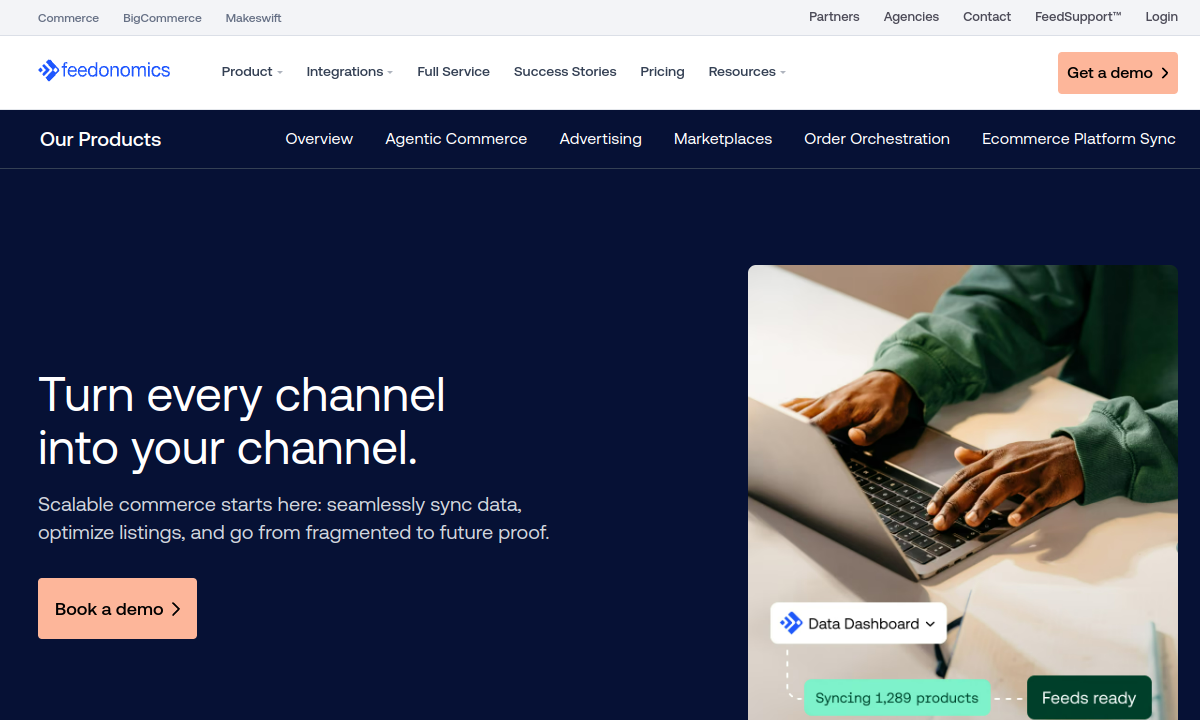
📷 Feedonomics product experience. Source: official vendor website.
💚 What we like
Strong managed-service model for teams that want execution support, not just software.
Flexible data transformation and channel-specific optimization for complex catalogs.
Custom onboarding and 24/7 support are designed for business-critical feed operations.
🟠 What to know
Pricing is custom, so budget comparison requires a sales conversation.
The service-heavy model can be more than a small catalog or simple Google feed needs.
💡 Why this score: The strongest all-around option when feed quality, scale and ongoing operational support matter. It scores especially well for transformation depth and managed execution, while custom pricing reduces transparency for smaller buyers.
💰 Pricing: Custom quote. Feedonomics says pricing varies by SKU count, channel type, number of channels and service level; it does not charge a percentage of revenue.
✅ Best fit: Multi-channel brands, retailers and agencies with large or messy catalogs that need dependable feed operations and expert support.
🚫 Less ideal for: Small merchants that mainly need a basic Google or Meta feed at a low fixed monthly price.
🧩 Key capabilities
Multi-source feed ingestion
Attribute standardization and channel rules
Feed error resolution
Catalog enrichment
Channel distribution
Managed feed operations
🔎 Official sources: Product · Pricing · Documentation
🥈 2. DataFeedWatch
92/100 · 💰 Mid · 🧩 Easy–Intermediate · 🏢 SMB–Agency · ⚙️ Self-service + managed option
🎯 Best for: Merchants and agencies that want flexible rules, transparent pricing and fast self-service.
⚡ Choose DataFeedWatch if you want a mature feed tool that is easy to buy and flexible enough to scale.
DataFeedWatch is built around practical feed mapping, rules and channel distribution with a relatively approachable self-service workflow. It supports merchants and agencies, offers AI-assisted feed improvements and also sells a managed-service add-on. Its published tiers make it unusually easy to estimate cost before a sales call.
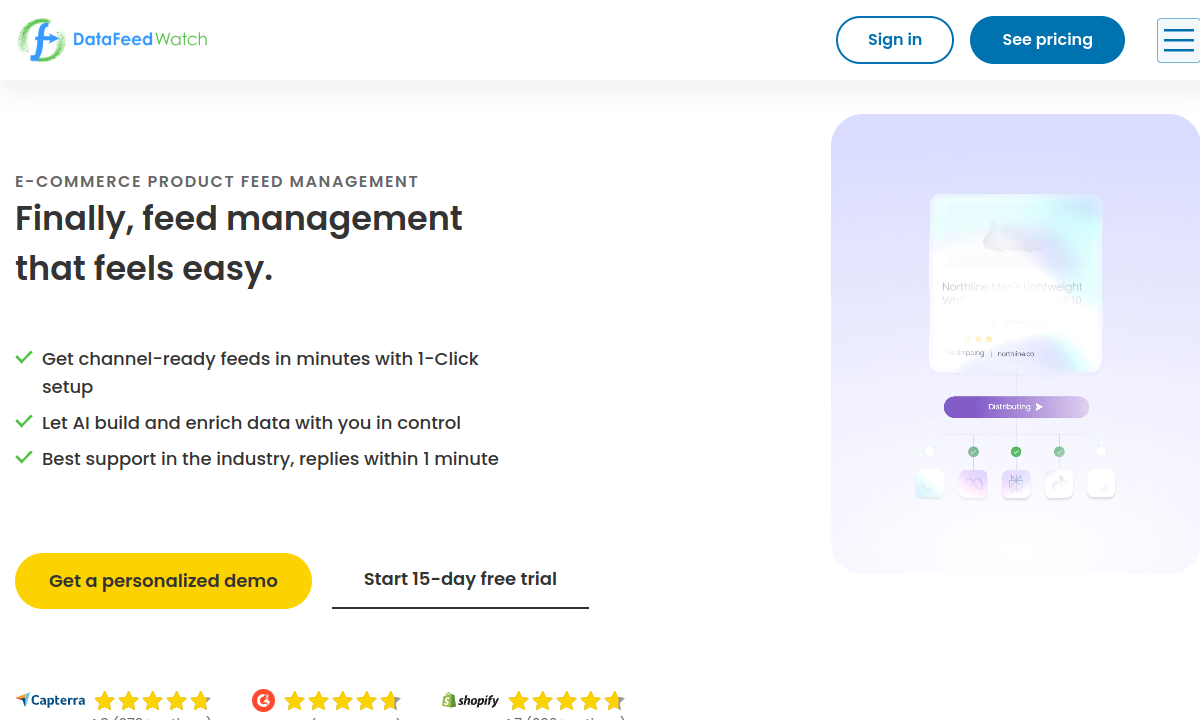
📷 DataFeedWatch product experience. Source: official vendor website.
💚 What we like
Published pricing makes initial budgeting much easier than enterprise-only quote models.
Rule-based mapping and feed modifications are accessible without heavy engineering.
Agency plan supports many feeds, unlimited shops and dedicated support.
🟠 What to know
Catalog and feed limits vary by plan, so costs can rise as scale increases.
Advanced managed service starts separately from the core subscription.
💡 Why this score: A very balanced choice for teams that want control without enterprise procurement. It earns high marks for self-service usability, transparent pricing and agency support, with somewhat less emphasis on ultra-complex enterprise data architecture.
💰 Pricing: Shop starts at $64/month, Merchant at $84/month and Agency at $239/month on current monthly pricing; Enterprise is custom. A 15-day trial is offered.
✅ Best fit: Growing ecommerce teams and agencies that need several channel feeds, rule-based transformations and predictable entry pricing.
🚫 Less ideal for: Organizations that want a deeply managed enterprise program with bespoke data architecture from day one.
🧩 Key capabilities
Feed mapping and transformation
AI-assisted title and category optimization
Multi-shop management
Automated feed updates
Feed diagnostics and cleanup
Managed service add-on
🔎 Official sources: Product · Pricing · Documentation
🥉 3. Channable
91/100 · 💰 Mid · 🧩 Intermediate · 🏢 SMB–Mid-market · ⚙️ Self-service
🎯 Best for: Teams that want feed management, marketplaces and paid advertising in one workspace.
⚡ Choose Channable if you want strong feed rules plus optional marketplace and PPC automation in the same platform.
Channable centralizes product data, applies channel-specific rules and distributes listings to thousands of templates. It adds AI-assisted setup, quality checks, enrichment and different synchronization frequencies by plan. Optional marketplace and advertising modules make it attractive when feed work sits close to performance marketing.

📷 Channable product experience. Source: official vendor website.
💚 What we like
2,500+ pre-built feed templates reduce manual channel setup.
Clear rule logic and proactive quality checks support day-to-day feed optimization.
Published packages make it possible to scale sync frequency and add modules deliberately.
🟠 What to know
Pricing depends on item, project and channel limits, so the headline plan price is only a starting point.
Marketplace order connections and repricing are additional modules.
💡 Why this score: Excellent feed tooling with a strong balance of usability, automation and channel breadth. It narrowly trails the top two because costs become more modular as projects, channels and add-ons increase.
💰 Pricing: For a 5,000-item package, Core Standard is €59/month, Core Plus €79/month and Core Pro €89/month. Final pricing depends on items, projects and channels; add-ons cost extra.
✅ Best fit: Performance marketing and ecommerce teams that want frequent feed updates, rules, AI enrichment and optional PPC or marketplace workflows.
🚫 Less ideal for: Buyers who need a fully managed feed operation and prefer to outsource most ongoing optimization.
🧩 Key capabilities
2,500+ feed templates
If/then transformation rules
AI setup and enrichment
Feed quality checks
Up to 24 daily syncs on Pro
Marketplace and PPC add-ons
🔎 Official sources: Product · Pricing · Documentation
4️⃣ 4. Productsup
90/100 · 💰 Premium · 🧩 Advanced · 🏢 Enterprise · ⚙️ Self-service + services
🎯 Best for: Large global organizations with complex product data and many distribution endpoints.
⚡ Choose Productsup if you need enterprise-scale product data transformation across thousands of destinations and markets.
Productsup is an enterprise product-to-consumer data platform with deep feed management capabilities. It can import from many sources, optimize and enrich product content, and export to more than 2,500 channels. Its positioning is especially strong for very large catalogs, global operations and teams that need formal governance around product-data workflows.
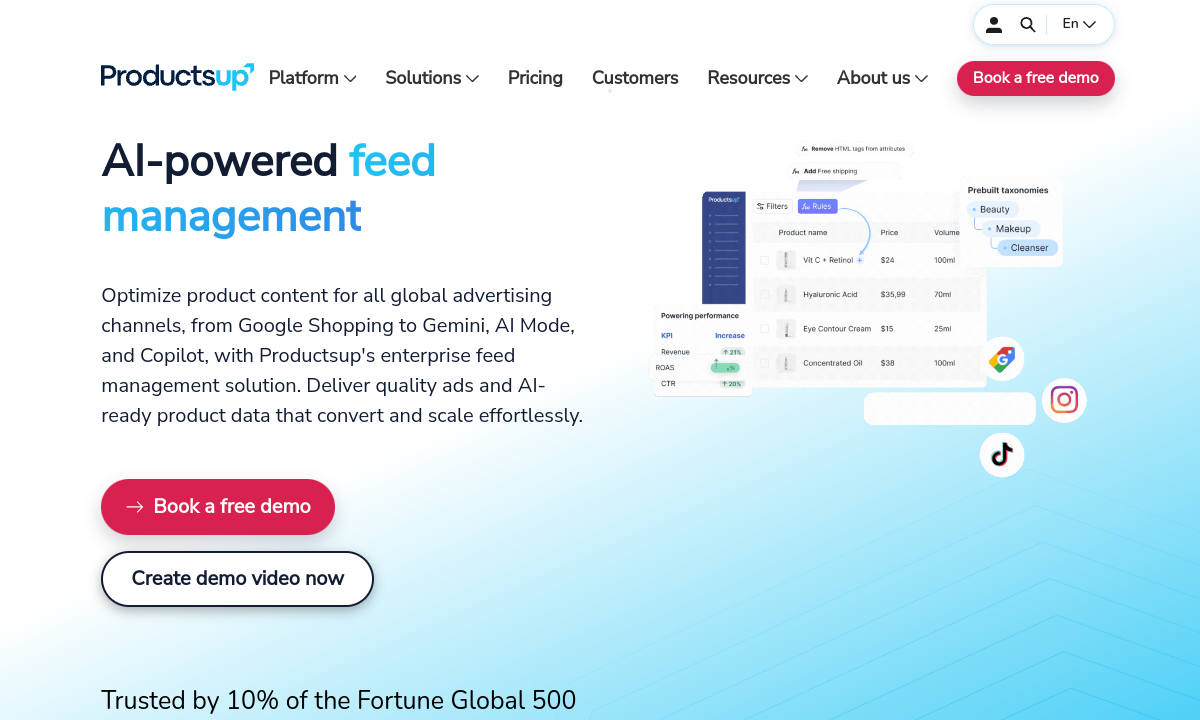
📷 Productsup product experience. Source: official vendor website.
💚 What we like
Built for very large catalogs and complicated data workflows.
2,500+ channel integrations and broad global-market coverage.
Advanced enrichment, automation and monitoring capabilities suit enterprise teams.
🟠 What to know
Pricing is quote-based and procurement is more enterprise-oriented.
The platform can be more complex than necessary for a small store with a few feeds.
💡 Why this score: Productsup scores exceptionally well on scale, transformation depth and enterprise fit. It sits just below the top three because smaller buyers face a steeper implementation and pricing path than with more self-service options.
💰 Pricing: Custom quote. Productsup directs buyers to request pricing based on their setup and use case.
✅ Best fit: Enterprise retailers, brands and agencies with complex catalogs, many markets and sophisticated data-governance requirements.
🚫 Less ideal for: Small or early-stage sellers that mainly need a few standard shopping feeds with minimal configuration.
🧩 Key capabilities
Import from varied sources
2,500+ export channels
Advanced data transformation
AI enrichment
Monitoring and workflow controls
Managed services
🔎 Official sources: Product · Pricing · Documentation
5️⃣ 5. GoDataFeed
87/100 · 💰 Mid · 🧩 Intermediate · 🏢 SMB–Mid-market · ⚙️ Self-service + onboarding
🎯 Best for: Merchants that want transparent feed pricing and channel-by-channel expansion.
⚡ Choose GoDataFeed if you want clear SKU and channel pricing with guided onboarding and flexible expansion.
GoDataFeed provides feed mapping, optimization and distribution with a plan structure tied to catalog size and selected channels. It combines self-service controls with expert onboarding, making it a practical middle ground for merchants that have outgrown basic platform feeds but do not need a large enterprise program.
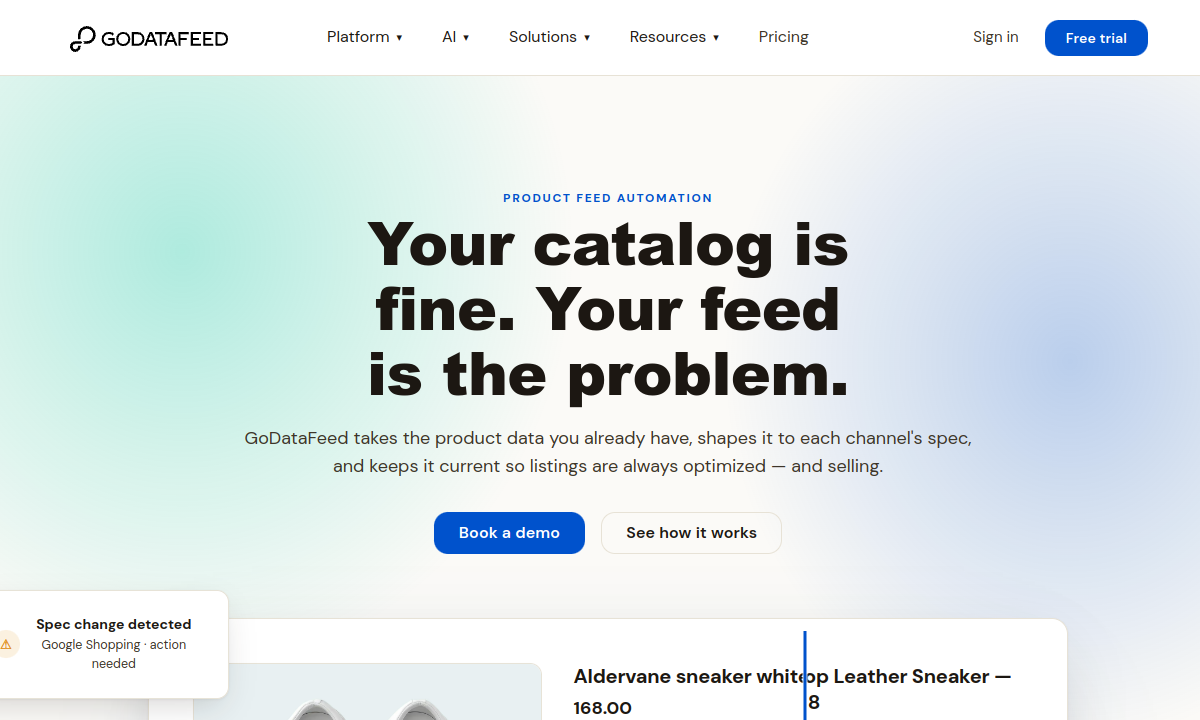
📷 GoDataFeed product experience. Source: official vendor website.
💚 What we like
Transparent SKU and channel pricing makes expansion easier to model.
14-day trial and expert onboarding lower switching risk.
Supports both PPC destinations and marketplace connections.
🟠 What to know
Extra paid channels and marketplaces add to the monthly bill.
The interface and service model are less enterprise-heavy than the top managed platforms.
💡 Why this score: A strong practical choice for growing merchants because pricing is understandable and onboarding is included. It gives up some enterprise depth and global service coverage compared with the highest-ranked platforms.
💰 Pricing: Current calculator recommends Plus at $99/month for a 1,000-SKU example. Extra PPC channels are $29/month and marketplace channels beyond plan allotments are $99/month; pricing scales with catalog and channel mix.
✅ Best fit: Growing stores and small teams that need several feeds, predictable costs and support getting mappings live.
🚫 Less ideal for: Global enterprise catalogs requiring complex governance, extensive managed operations or very large-scale data transformation.
🧩 Key capabilities
Feed mapping
SKU-based scaling
PPC channel distribution
Marketplace feeds
Rule-based optimization
Expert onboarding
🔎 Official sources: Product · Pricing · Documentation
6️⃣ 6. Lengow
86/100 · 💰 Premium · 🧩 Intermediate–Advanced · 🏢 Mid-market–Enterprise · ⚙️ Guided
🎯 Best for: European and international brands combining feed execution with broader channel expansion.
⚡ Choose Lengow if you want modular feed distribution across marketplaces and advertising channels with guided services.
Lengow’s Product Suite combines channel execution with optional market-intelligence modules. Feed management sits inside a broader multichannel stack, with plans for different growth stages and service levels. It is particularly relevant to brands expanding across European and international marketplaces while also managing advertising feeds.
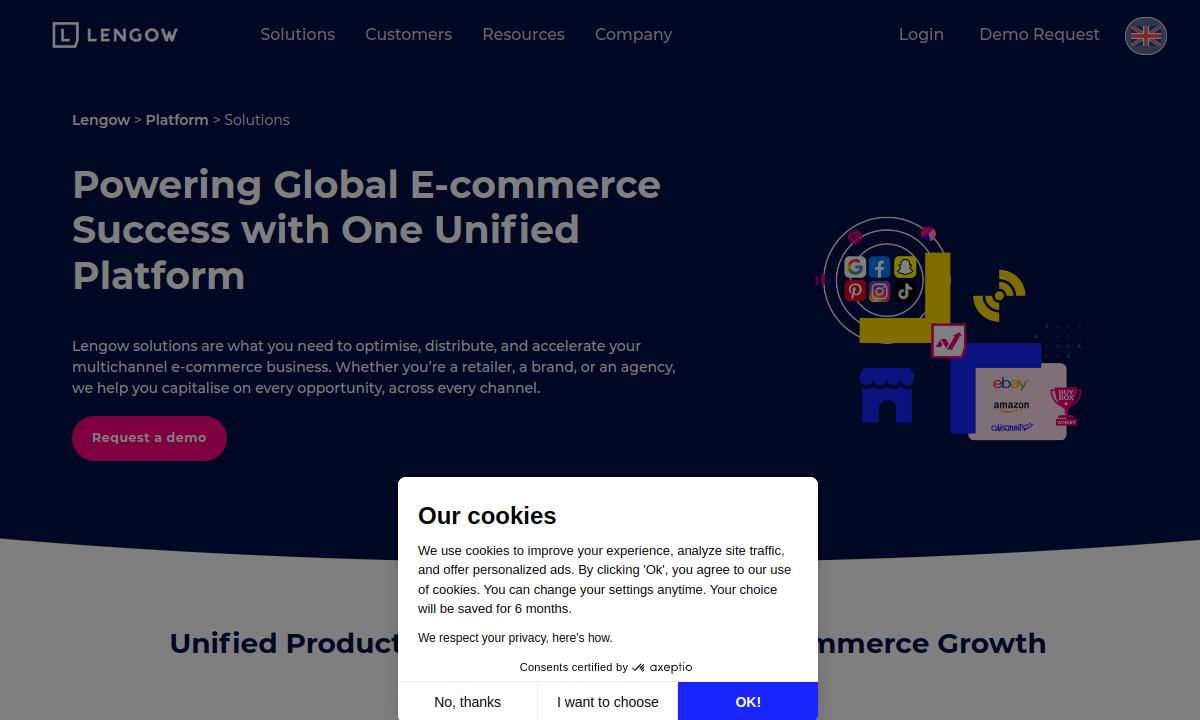
📷 Lengow product experience. Source: official vendor website.
💚 What we like
Modular Channel Execution supports advertising feeds and marketplaces.
Essential, Pro and Scale tiers align service levels with growth stage.
Onboarding, training and multilingual support are built into the commercial model.
🟠 What to know
Public pages describe plan structure but not fixed euro prices.
The wider suite can exceed the needs of a team that only wants feed transformation.
💡 Why this score: Lengow is a strong multichannel platform with good service depth and international fit. Its feed capabilities are solid, but quote-based modular pricing and broader marketplace positioning make it slightly less direct for feed-only buyers.
💰 Pricing: Quote-based. Lengow offers Essential, Pro and Scale core licences, then prices Channel Execution and Market Intelligence modules by usage.
✅ Best fit: Brands and retailers expanding across multiple countries that want feed execution plus marketplace and market-intelligence modules.
🚫 Less ideal for: Teams seeking a simple low-cost feed utility with fixed monthly pricing and minimal onboarding.
🧩 Key capabilities
Advertising feed distribution
Marketplace channel execution
Catalog optimization
Modular plans
Onboarding and training
Market intelligence add-ons
🔎 Official sources: Product · Pricing · Documentation
7️⃣ 7. Centric Shoppingfeed
84/100 · 💰 Premium · 🧩 Intermediate · 🏢 Mid-market–Enterprise · ⚙️ Guided
🎯 Best for: Multichannel sellers that value hands-on setup and wide marketplace connectivity.
⚡ Choose Centric Shoppingfeed if you want feed distribution plus marketplace operations and dedicated account support.
Centric Shoppingfeed combines feed enrichment and distribution with broader marketplace operations. The platform advertises access to more than 1,000 channels, frequent price and inventory updates, API connectivity and dedicated account support. It fits teams that view feed management as part of a broader multichannel operating model.
📷 Centric Shoppingfeed product experience. Source: official vendor website.
💚 What we like
Broad channel network with product listing and synchronization workflows.
Frequent price and inventory updates support active catalogs.
Service includes feed setup and dedicated account guidance.
🟠 What to know
Commercial pricing is tailored rather than transparently self-serve.
Marketplace and order-management depth can be unnecessary for feed-only use cases.
💡 Why this score: A capable, service-oriented multichannel option with strong connectivity. It ranks lower for a feed-specific buying decision because much of the value extends into marketplace operations and pricing is custom.
💰 Pricing: Custom quote based on catalog size and channel needs. Shoppingfeed positions setup, channel integrations and account management as part of the service.
✅ Best fit: Retailers and brands that need shopping feeds, marketplace publishing and operational support in one platform.
🚫 Less ideal for: Small merchants that only need a lightweight feed formatter for a handful of advertising channels.
🧩 Key capabilities
1,000+ channels
Feed enrichment rules
Listing synchronization
Frequent stock and price updates
API connectivity
Dedicated account support
🔎 Official sources: Product · Pricing · Documentation
8️⃣ 8. Channel Pilot Pro
83/100 · 💰 Premium · 🧩 Advanced · 🏢 Mid-market–Enterprise · ⚙️ Guided
🎯 Best for: European retailers combining feed management, marketplace integrations and dynamic pricing.
⚡ Choose Channel Pilot Pro if you want feed operations tied closely to marketplace connectivity and dynamic pricing.
Channel Pilot Pro brings feed management, marketplace integrations and dynamic pricing into one central system. It emphasizes large catalog scale, AI-assisted product-data optimization and support for thousands of channels. For merchants already operating multiple marketplaces, the combined model can simplify the tool stack.
📷 Channel Pilot Pro product experience. Source: official vendor website.
💚 What we like
Supports 2,500+ sales channels and 180+ marketplace integrations.
Built to process very large catalogs with rule-based feed logic.
AI-assisted categorization and product-data optimization reduce repetitive work.
🟠 What to know
Pricing is based on setup and scope rather than a simple public list price.
Feed-only buyers may pay for a broader multichannel platform than they need.
💡 Why this score: Strong technical scale and a broad multichannel feature set make Channel Pilot Pro compelling for complex retailers. It scores slightly lower in this feed-specific comparison because purchasing and implementation are more consultative.
💰 Pricing: Custom quote based on data setup, channel mix, integration depth and process complexity. Feed management, marketplace integrations and dynamic pricing are packaged according to scope.
✅ Best fit: Established European retailers with large catalogs that want feeds, marketplaces and pricing automation in one stack.
🚫 Less ideal for: Smaller stores seeking a fast self-service feed app with public pricing and minimal implementation work.
🧩 Key capabilities
2,500+ sales channels
180+ marketplace integrations
AI data enrichment
Rule-based feed management
Dynamic pricing
Large-catalog API support
🔎 Official sources: Product · Pricing · Documentation
9️⃣ 9. Simprosys
81/100 · 💰 Low · 🧩 Easy · 🏢 SMB · ⚙️ App install
🎯 Best for: Shopify or WooCommerce merchants focused on Google Shopping and adjacent channels.
⚡ Choose Simprosys if you need a low-cost feed app that is quick to install and tailored to ecommerce platforms.
Simprosys focuses on app-based product-feed workflows for ecommerce platforms, especially Google Shopping. Its pricing is based on published product counts rather than variants, with free trials and inexpensive entry tiers. It is a strong fit for smaller merchants that need dependable shopping-feed submission without a full enterprise syndication platform.
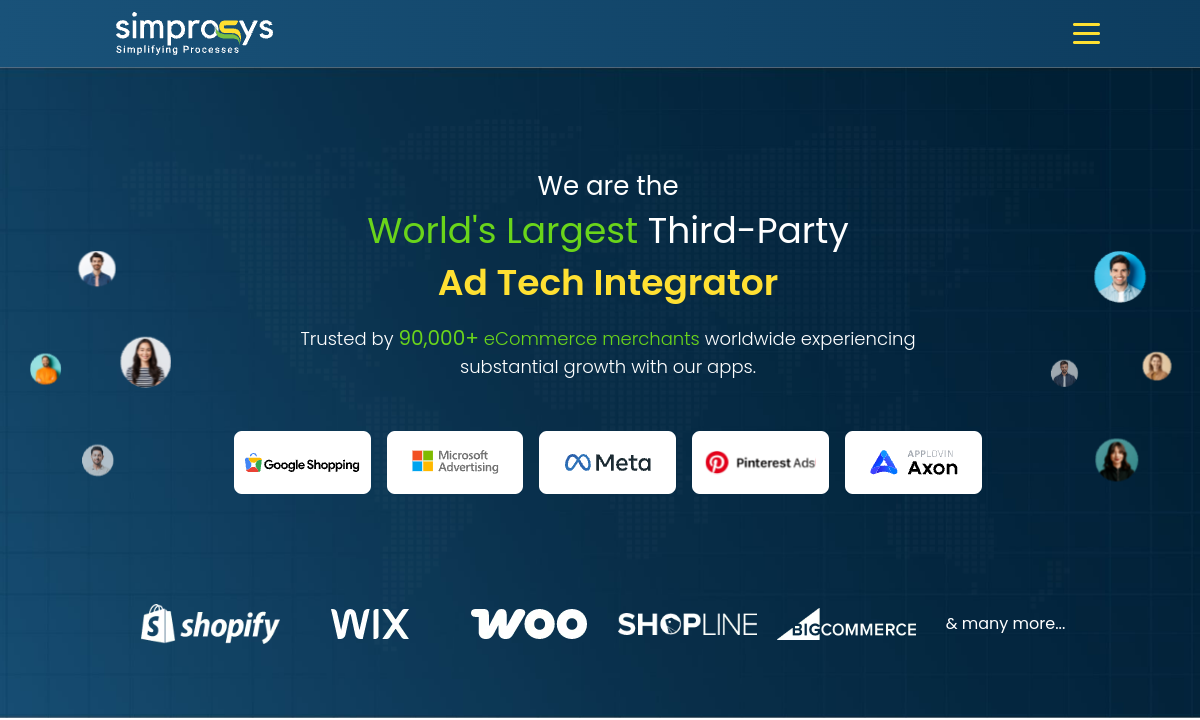
📷 Simprosys product experience. Source: official vendor website.
💚 What we like
Very low entry price compared with enterprise feed platforms.
Pricing is based on product count rather than variants in supported plans.
Quick app-based setup is accessible to smaller merchants.
🟠 What to know
The product is more specialized than broad enterprise feed-syndication suites.
Advanced cross-channel governance and service depth are more limited.
💡 Why this score: Simprosys wins on affordability and simplicity for platform-based merchants. Its narrower scope and lighter enterprise controls keep it below the more comprehensive feed-management platforms.
💰 Pricing: Shopify pricing currently starts at $4.99/month for up to 500 products, with a 21-day free trial. Pricing rises by product-count bands; annual subscriptions receive a 10% discount.
✅ Best fit: Smaller Shopify and WooCommerce stores that mainly need Google Shopping feed submission and straightforward catalog synchronization.
🚫 Less ideal for: Large international retailers requiring many custom destinations, advanced governance and managed feed operations.
🧩 Key capabilities
Google Shopping feed submission
Product-count pricing
Shopify and WooCommerce apps
Catalog synchronization
Optional XML feed generation
AI feed optimization add-on
🔎 Official sources: Product · Pricing · Documentation
🎯 Which tools should you actually shortlist?
If you want a managed operating partner: start with Feedonomics, then compare Productsup if enterprise data complexity is the bigger issue.
If you want self-service control with transparent pricing: start with DataFeedWatch and Channable.
If budget is tight and your stack is simple: start with Simprosys, then GoDataFeed if you need more channels.
If marketplace expansion is central: compare Lengow, Centric Shoppingfeed and Channel Pilot Pro alongside their feed features.
If your catalog is huge or globally distributed: evaluate Feedonomics and Productsup first, then Channel Pilot Pro for a combined multichannel stack.
If performance marketing owns the workflow: Channable and DataFeedWatch are the clearest first demos because feed rules sit close to ad operations.
🧪 Run this test before you buy
Do not decide from a polished demo alone. Take the same representative slice of your catalog through every shortlisted platform. Include clean products, products with missing attributes, variants, promotions and problem SKUs. Build the same destinations and measure how much manual work is required to get a healthy feed live.
Import 500–1,000 representative SKUs from your real source.
Map every required field for two priority channels.
Create rules for titles, categories, exclusions and custom labels.
Fix a deliberate set of missing or malformed attributes.
Measure how quickly price and inventory changes reach each destination.
Review feed diagnostics and how clearly errors are prioritized.
Test bulk changes across multiple destinations without duplicating work.
Add a new channel and record the setup effort from start to publish.
Invite a second user and test permissions, approvals or shared workflows.
Estimate the full monthly cost at your real SKU, shop and channel counts.
Capture setup time, unresolved errors, update latency, number of manual interventions and total monthly cost. Those observations usually matter more than the longest feature list.
🧾 10 questions to ask in every demo
How many of our required destinations have maintained native templates today?
How are channel specification changes monitored and rolled out?
What are the normal and maximum feed refresh frequencies?
Can rules be reused across shops, markets and channels?
How do you surface rejected products and prioritize the most important errors?
What happens when our source data is incomplete or inconsistent?
Which AI enrichment features are production-ready, and how can we review outputs before publishing?
What support is included versus sold as a managed-service add-on?
How does pricing change as SKUs, shops, countries and channels grow?
What data export, API and migration options do we have if we leave?
❓ Frequently asked questions
What is product feed management software?
It is software that imports catalog data, transforms it to match each destination’s requirements, validates the output and distributes it to shopping, advertising, comparison and marketplace channels.
What is the difference between feed management and product information management?
Product information management, often shortened to PIM, is the central system for creating and governing product information. Feed management focuses on adapting and distributing that information to external destinations with channel-specific rules.
Do I need a feed tool for Google Shopping?
Not always. Small stores can often start with a native platform connector. A dedicated feed tool becomes more useful when you need advanced title rules, custom labels, multi-country feeds, frequent error fixes or several advertising destinations.
How much does product feed management software cost?
Entry-level apps can start below $10 per month, while self-service multichannel platforms often start around tens to low hundreds per month. Enterprise platforms commonly use custom pricing based on catalog size, destinations and service level.
How often should product feeds update?
It depends on how often price, stock and promotions change. Stable catalogs may tolerate daily updates, while fast-moving inventory or pricing can justify multiple refreshes per day or near-real-time integrations.
What should I test before switching feed platforms?
Test real data quality, destination mapping, rule reuse, diagnostics, refresh speed, onboarding effort and full cost at your actual SKU and channel counts. Also confirm export options so you are not locked into one workflow.
🔍 About this research
MarketMaze researches and scores each tool using its proprietary scoring methodology. Product details and pricing were checked against official vendor sources on 25 September 2026. Screenshots are captures of official vendor product pages and are used to illustrate the products being reviewed. Pricing can change, and quote-based vendors may vary by catalog size, channel count and service level.
