
MARKETMAZE · ECOMMERCE TOOLS · RESEARCH
10 Best Print-on-Demand Platforms for Ecommerce Sellers (2026)
We compared 10 print-on-demand platforms for product range, production geography, store integrations, brand control and landed economics. The goal is practical: identify which production-and-fulfillment partner best fits the way your ecommerce business actually sells.
Updated 26 September 2026 · Pricing and product claims checked against official vendor sources.
👋 New to this category?
Print on demand, or POD, lets you sell custom products without buying inventory upfront. Your platform receives an order, produces the item, packs it and ships it to the customer. The important differences are not just catalog size. Look at where items are produced, whether the same SKU is available in your main markets, what branding can be added, how well your store connects, and the full landed cost after printing, shipping and fees.
🧭 Jump to a tool
🏆 The quick answer
🏆 Best overall: Printful
🌱 Best for getting started: Printify
💸 Best value: CustomCat
🏢 Best for larger teams: Prodigi
🧠 Best for advanced / technical workflows: Prodigi
🌍 Best for international local production: Gelato
MarketMaze take: There is no universal cheapest or fastest print-on-demand platform because landed economics change by SKU, destination and production site. Printful is the safest all-round starting point, Printify gives more provider choice, and Gelato is strongest when international local production matters. Specialist sellers should look harder at Prodigi for technical breadth, Apliiq for branded apparel and Contrado for premium design-led products.
📊 Tool comparison & scores
Rank | Tool | Score | Best for | Pricing |
|---|---|---|---|---|
1 | Printful | 91/100 | Sellers wanting the strongest all-round mix of integrations, branding and fulfillment control | Free + $24.99/mo Growth |
2 | Printify | 89/100 | Sellers prioritizing catalog breadth, provider choice and competitive production pricing | Free + $39/mo Premium |
3 | Gelato | 88/100 | International sellers wanting local production close to customers across many markets | Free + $29.99/mo Gelato+ |
4 | Prodigi | 84/100 | Sellers and developers needing global print coverage, many products and API-led fulfillment | Free + optional Pro |
5 | Gooten | 82/100 | Growing brands that want a curated network, broad catalog and account support | Free to use |
6 | CustomCat | 80/100 | US-focused sellers prioritizing straightforward setup, competitive product costs and fast domestic production | Free + $30/mo Pro |
7 | Apliiq | 79/100 | Fashion-led brands needing private labels, embroidery and deeper apparel customization | Free to start |
8 | Spreadconnect | 77/100 | Merch sellers wanting simple product creation and fast in-house production without subscription fees | Free to use |
9 | teelaunch | 75/100 | Shopify sellers who want a simple catalog-to-fulfillment workflow with no platform subscription | Free to install |
10 | Contrado | 73/100 | Design-led sellers wanting distinctive premium products and in-house production under their own brand | Free to install |
🧠 How the scoring works
This ranking uses MarketMaze proprietary scoring.
Each platform is scored on Core job performance (30%), Ecommerce fit (20%), Workflow & control (15%), Integrations & implementation (15%), Pricing & value (10%), and Scale & advanced capabilities (10%). Ties are resolved by Ecommerce fit, then Core job performance. We do not use G2, Capterra or other review-site ratings as scoring inputs.
🤔 Do you even need print-on-demand software?
Probably yes ✅
You want to launch custom products without inventory, automate production after checkout, or test designs before committing cash to stock.
Maybe 🟡
You already hold some inventory but want POD for long-tail designs, international expansion, personalized products or low-risk assortment tests.
Probably not yet ⏳
You need very low unit costs at high volume, strict factory-level quality control, or custom manufacturing that is not available in POD catalogs.

🥇 1. Printful
91/100 · 💰 Free + $24.99/mo Growth · 🧩 Moderate · 🏢 All sizes · ⚙️ Plug-and-play
🎯 Best for
Sellers wanting the strongest all-round mix of integrations, branding and fulfillment control.
⚡ Choose Printful if ...
Choose Printful if you want one mature platform to handle design, store sync, production, branding and shipping.
Printful is the most balanced option here for sellers who want broad ecommerce connectivity without giving up meaningful brand control. Its catalog covers apparel, accessories, home goods and wall art, while built-in design tools, mockups, white-label fulfillment and multiple sourcing locations reduce operational friction. The trade-off is economics: base product costs are not always the lowest, so margins need to be modeled SKU by SKU.

Printful’s design and mockup workflow for creating products. Source: official Shopify app listing.
💚 What we like
Broad ecommerce integrations and mature seller workflow
Useful branding options including pack-ins and custom packaging
Global fulfillment footprint with direct seller controls
🟠 What to know
Base costs can be higher than lower-cost provider networks
Catalog economics vary by product and production location
💡 Why this score
Printful scores highest because it combines strong core fulfillment, wide ecommerce fit, solid control and dependable implementation. It gives up some points on raw unit economics, but the overall operating package is unusually complete for both new and established ecommerce teams.
💰 Pricing
Free plan; Growth is $24.99/month and can become free after $12,000 in annual sales. Product, fulfillment and shipping charges apply per order.
✅ Best fit
Brands that value dependable integrations, brand presentation and a single operational system across multiple sales channels.
🚫 Less ideal for
Ultra-price-sensitive sellers willing to manage more provider variation to chase the lowest landed cost.
🧩 Key capabilities
Design Maker
Mockup generator
Store integrations
White-label fulfillment
Custom branding
Global fulfillment
🔎 Official sources

🥈 2. Printify
89/100 · 💰 Free + $39/mo Premium · 🧩 Moderate · 🏢 SMB to scale · ⚙️ Plug-and-play
🎯 Best for
Sellers prioritizing catalog breadth, provider choice and competitive production pricing.
⚡ Choose Printify if ...
Choose Printify if provider choice and a very broad product catalog matter more than having one production network.
Printify operates as a marketplace of print providers, giving sellers unusual choice across products, production locations and price points. The catalog is very broad, the Product Creator is approachable, and integrations cover major stores and marketplaces. That flexibility can improve margins and resilience, but it also means quality, production times and shipping economics can vary by provider, so disciplined sample testing is essential.

Printify’s custom mockup workflow. Source: official Shopify app listing.
💚 What we like
Very broad product selection across many providers
Strong price competition and provider-level choice
Good integrations for major ecommerce and marketplace channels
🟠 What to know
Quality and fulfillment consistency depend on the selected provider
Provider switching adds operational choices sellers must actively manage
💡 Why this score
Printify earns near-top marks for ecommerce fit, value and selection. Its provider network can produce excellent economics and range, but the platform model puts more responsibility on the seller to test suppliers and maintain quality consistency across locations.
💰 Pricing
Free plan with up to 5 stores; Premium is $39/month or $24.99/month billed yearly, with product discounts. Product and shipping costs are charged when orders are placed.
✅ Best fit
Growth-focused sellers comfortable comparing providers, samples and shipping routes to optimize assortment and margin.
🚫 Less ideal for
Teams that want a single tightly controlled production standard with minimal supplier-level decision making.
🧩 Key capabilities
Provider marketplace
Product Creator
Mockup tools
Multi-store management
Order routing
Marketplace integrations
🔎 Official sources

🥉 3. Gelato
88/100 · 💰 Free + $29.99/mo Gelato+ · 🧩 Moderate · 🏢 Global sellers · ⚙️ Plug-and-play
🎯 Best for
International sellers wanting local production close to customers across many markets.
⚡ Choose Gelato if ...
Choose Gelato if local production geography and international delivery economics are central to your growth plan.
Gelato’s differentiator is its distributed production network. It connects ecommerce sellers to more than 140 production hubs across 32 countries, which can shorten shipping distances and improve international delivery economics. The platform supports major ecommerce integrations, personalization tools and growing automation features. Catalog depth varies by region, so sellers should validate each target country rather than assuming every SKU is locally available everywhere.

Gelato’s Magic Mockups and product-launch workflow. Source: official Shopify app listing.
💚 What we like
Large distributed production network across 32 countries
Strong international ecommerce integrations
Useful personalization, mockup and product migration tools
🟠 What to know
Product availability and economics can differ by production region
Best savings and some advanced tools sit behind Gelato+
💡 Why this score
Gelato scores especially well on ecommerce fit and scale because its local-production model is purpose-built for cross-border selling. Its workflow is strong, though sellers still need region-by-region product checks and paid features can matter for higher-volume economics.
💰 Pricing
Gelato Free is pay-as-you-print; Gelato+ is $29.99/month or $239.88/year and includes discounts and additional tools. Production and shipping are charged per order.
✅ Best fit
Brands selling into multiple countries that want to reduce shipping distance while keeping one connected production platform.
🚫 Less ideal for
Sellers focused on a narrow domestic market where the distributed network provides little incremental benefit.
🧩 Key capabilities
Local production network
Store integrations
Magic Mockups
Personalization
Product migration
Global fulfillment
🔎 Official sources
4️⃣ 4. Prodigi
84/100 · 💰 Free + optional Pro · 🧩 Advanced · 🏢 Scale & API · ⚙️ Guided setup
🎯 Best for
Sellers and developers needing global print coverage, many products and API-led fulfillment.
⚡ Choose Prodigi if ...
Choose Prodigi if you need a broad print network, API options and strong support for art-heavy product catalogs.
Prodigi combines a large print catalog with global production, direct ecommerce integrations and a print application programming interface, or API, for more technical workflows. Its strength is breadth: wall art, stationery, books, apparel and other product types can be managed from one platform. The core service is free to use, while optional Pro pricing improves discounts. Configuration is more operational than the simplest plug-ins, especially at scale.
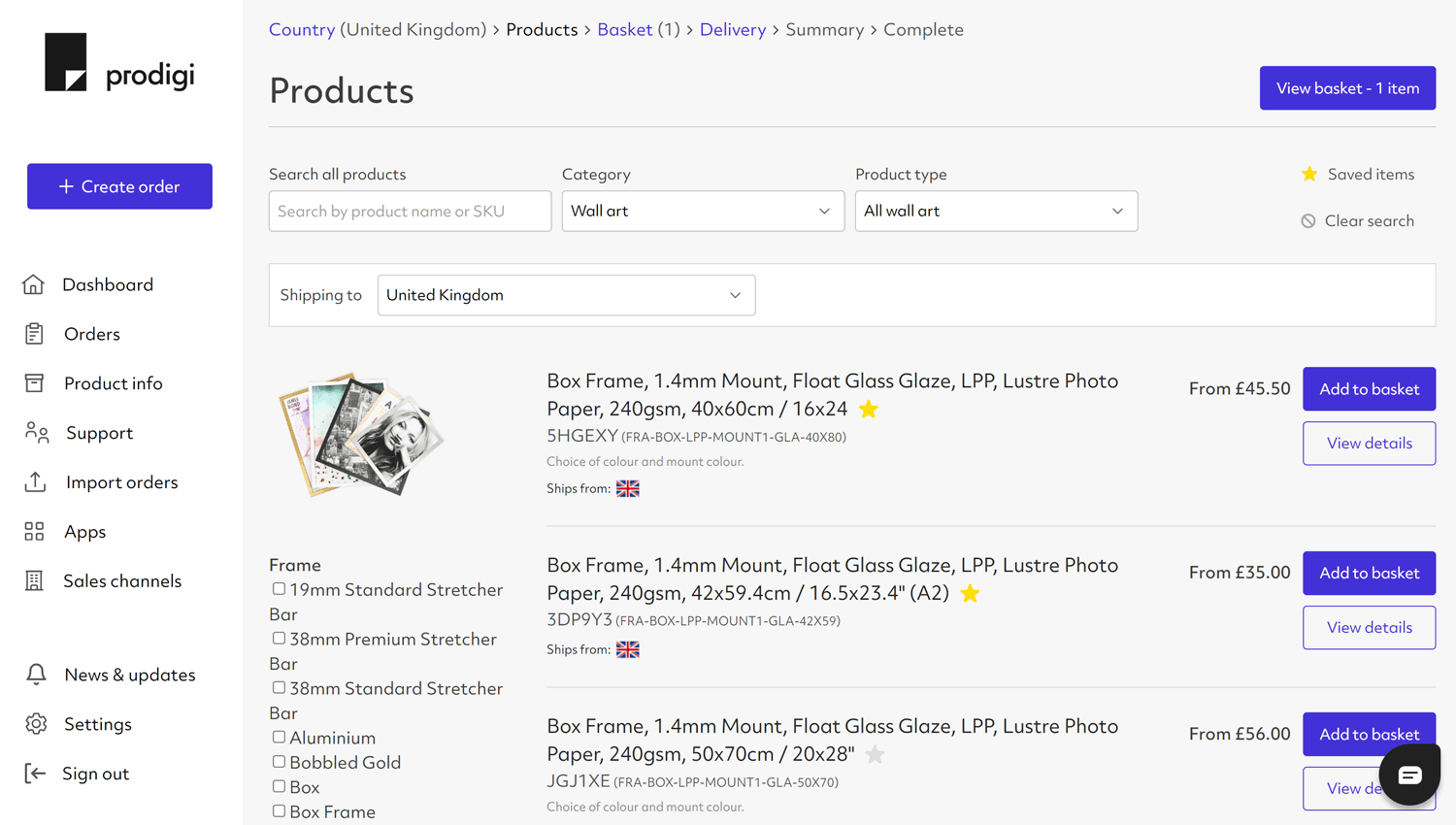
Prodigi’s dashboard for managing and saving products. Source: official Prodigi website.
💚 What we like
Very broad product catalog and global print network
Useful API and ecommerce integration options
No mandatory setup fee or monthly subscription
🟠 What to know
Some advanced workflows require more configuration than simple app installs
Exact delivered economics require product and destination-level checks
💡 Why this score
Prodigi ranks highly for product breadth, scale and technical flexibility. It loses a few points on setup simplicity versus the top three, but it is compelling for teams that need API access, extensive print formats and international production options.
💰 Pricing
Core platform is free with no mandatory setup fee or monthly subscription. Optional Prodigi Pro is £40/month, or £35/month when billed annually, plus production and shipping.
✅ Best fit
Established sellers, creative platforms and technical teams that need a broad catalog plus API-driven fulfillment options.
🚫 Less ideal for
Very small sellers wanting the most guided, lowest-decision setup with a single simple product workflow.
🧩 Key capabilities
Print API
Ecommerce integrations
500k+ products
Image library
Global print network
Branded inserts
🔎 Official sources

5️⃣ 5. Gooten
82/100 · 💰 Free to use · 🧩 Moderate · 🏢 Growth teams · ⚙️ Guided setup
🎯 Best for
Growing brands that want a curated network, broad catalog and account support.
⚡ Choose Gooten if ...
Choose Gooten if you want managed fulfillment orchestration and a catalog designed for brands scaling order volume.
Gooten positions itself as a print-on-demand network for brands moving beyond the earliest stage. The Product Hub supports catalog selection, artwork setup and publishing, while integrations cover Shopify, Etsy, WooCommerce, BigCommerce and custom workflows. There is no membership fee, and sellers pay production plus shipping. Its strengths are breadth and managed support; the key diligence area is validating quality and shipping performance for your priority SKUs.

Gooten’s Product Hub catalog. Source: official Shopify app listing.
💚 What we like
Broad product catalog with global fulfillment options
No membership or hidden platform fee
Good fit for brands needing account-level support as they scale
🟠 What to know
Production is distributed across a network, so sampling remains important
Less beginner-oriented than the most polished all-in-one options
💡 Why this score
Gooten performs well on core fulfillment, ecommerce fit and workflow control. It is particularly credible for growing brands, but its network model and implementation depth mean sellers should invest more in sample testing and operating discipline than with simpler entry-level tools.
💰 Pricing
No membership or hidden fees. Sellers pay product production costs plus shipping when orders are processed.
✅ Best fit
Brands with repeat volume that want a managed print network and broad assortment without a fixed platform fee.
🚫 Less ideal for
First-time sellers who want the simplest possible product builder and minimal supplier-quality diligence.
🧩 Key capabilities
Product Hub
Global network
Store integrations
Mockup workflow
Custom packaging
Account services
🔎 Official sources

6️⃣ 6. CustomCat
80/100 · 💰 Free + $30/mo Pro · 🧩 Moderate · 🏢 US-focused SMB · ⚙️ Plug-and-play
🎯 Best for
US-focused sellers prioritizing straightforward setup, competitive product costs and fast domestic production.
⚡ Choose CustomCat if ...
Choose CustomCat if US production speed and discounted unit costs matter more than a large international production footprint.
CustomCat is a practical US-centered print-on-demand option with its own seller dashboard, Shopify connectivity and additional integrations for marketplaces and ecommerce platforms. Lite is free, while Pro lowers product costs by 20–40%. The platform emphasizes direct production and fast fulfillment. It is particularly attractive when your demand is concentrated in the United States, though global sellers should compare international shipping against more geographically distributed networks.

CustomCat’s product-design workflow. Source: official Shopify app listing.
💚 What we like
Competitive free and paid pricing structure
US-based production with direct fulfillment controls
Useful product publishing and design management tools
🟠 What to know
International production coverage is narrower than global network leaders
Pro value depends on enough order volume to offset the subscription
💡 Why this score
CustomCat scores strongly on value and domestic ecommerce fit. Its US production model and Pro discounts can create attractive margins, while a smaller international footprint and less sophisticated global routing keep it below the broader network platforms.
💰 Pricing
Lite is free. Pro is $30/month or $300/year and offers 20–40% catalog discounts. Enterprise pricing is custom; production and shipping are charged per order.
✅ Best fit
US-heavy ecommerce brands that want simple print-on-demand operations and can benefit from discounted Pro product pricing.
🚫 Less ideal for
Brands whose primary requirement is localized production across many international markets and regions.
🧩 Key capabilities
DIGISOFT printing
Product creator
Mockup generator
Store sync
Bulk publishing
US fulfillment
🔎 Official sources

7️⃣ 7. Apliiq
79/100 · 💰 Free to start · 🧩 Advanced · 🏢 Apparel brands · ⚙️ Guided setup
🎯 Best for
Fashion-led brands needing private labels, embroidery and deeper apparel customization.
⚡ Choose Apliiq if ...
Choose Apliiq if the product must feel like your apparel brand, not generic merchandise with a print added.
Apliiq is the specialist choice in this group for branded apparel. Beyond standard printing, it supports private labels, neck prints, embroidery, patches and other garment customization that can make products feel more like a real clothing line. Dropshipping has no setup or monthly fee, but pricing includes the blank garment, decoration services, fulfillment and shipping. The richer customization also makes setup and margin modeling more involved.

Apliiq’s apparel branding and mockup workflow. Source: official Shopify app listing.
💚 What we like
Strong private-label and apparel branding options
No mandatory monthly fee for dropshipping
Useful embroidery, label, patch and garment customization services
🟠 What to know
More apparel-specialized than broad general merchandise platforms
Multiple decoration elements can raise unit cost quickly
💡 Why this score
Apliiq earns high marks for core performance and advanced apparel capabilities. Its specialization is a strength for fashion brands but reduces general-category breadth, and the richer product configuration requires more margin discipline than basic print-on-demand setups.
💰 Pricing
Free to start with no setup or monthly dropshipping fee. Decoration is priced per service, plus blank garment, a $1 per-item fulfillment fee and shipping; for example, digital prints start at $7.49 each.
✅ Best fit
Apparel brands that care about private labels, embroidery and brand presentation more than maximum cross-category breadth.
🚫 Less ideal for
Sellers mainly building mugs, wall art, stationery or other broad non-apparel assortments.
🧩 Key capabilities
Private labels
Embroidery
Neck prints
Custom patches
Store publishing
Distributed production
🔎 Official sources

8️⃣ 8. Spreadconnect
77/100 · 💰 Free to use · 🧩 Basic · 🏢 Merch sellers · ⚙️ Plug-and-play
🎯 Best for
Merch sellers wanting simple product creation and fast in-house production without subscription fees.
⚡ Choose Spreadconnect if ...
Choose Spreadconnect if fast merchandising and a simple no-subscription workflow are more important than maximum catalog depth.
Spreadconnect, previously known as SPOD, is a straightforward merchandising-focused print-on-demand service. It is free to use and charges only when orders are fulfilled. Its Shopify listing highlights more than 350 products, in-house production and a 48-hour print target, with integrations also available through marketplaces and Order Desk. The simplicity is appealing, though the assortment and advanced seller tooling are narrower than the top-ranked platforms.

Spreadconnect’s product-creation interface. Source: official Shopify app listing.
💚 What we like
No platform subscription fee
Simple product creation for merchandise stores
In-house production model with fast stated print turnaround
🟠 What to know
Smaller assortment than the largest provider networks
Advanced workflow and brand-control options are less extensive
💡 Why this score
Spreadconnect scores well for value and setup simplicity. It is a strong practical choice for straightforward merchandise stores, while its narrower catalog and lighter advanced tooling make it less flexible for complex multi-market product strategies.
💰 Pricing
Free to use. Sellers pay only when orders are fulfilled, including product and shipping costs.
✅ Best fit
Creators and smaller ecommerce brands selling straightforward merchandise and prioritizing simple operations and quick production.
🚫 Less ideal for
Teams needing the broadest global catalog, complex automation or extensive branded packaging choices.
🧩 Key capabilities
350+ products
Product creator
In-house production
Store integrations
Global shipping
Personalization
🔎 Official sources

9️⃣ 9. teelaunch
75/100 · 💰 Free to install · 🧩 Basic · 🏢 Shopify SMB · ⚙️ Plug-and-play
🎯 Best for
Shopify sellers who want a simple catalog-to-fulfillment workflow with no platform subscription.
⚡ Choose teelaunch if ...
Choose teelaunch if your store runs on Shopify and you want a straightforward product creation and fulfillment loop.
teelaunch keeps the workflow intentionally simple: create products, publish them to Shopify, then let the service handle production, packing, shipping and tracking. The current app supports apparel, drinkware, wall art, home decor, accessories, stationery and gifts, with integrations including Customily and Etsy. It is free to install, making it easy to test, but it has fewer advanced network and automation features than the leading platforms.

teelaunch’s current product catalog interface. Source: official Shopify app listing.
💚 What we like
Simple Shopify-first product workflow
Free-to-install model with no inventory requirement
Useful range across apparel, drinkware and home categories
🟠 What to know
Less advanced global routing and automation than larger networks
Best fit is strongest for Shopify-centric sellers
💡 Why this score
teelaunch performs well on simplicity and value, with enough product breadth for many smaller stores. It ranks lower on scale and advanced capabilities because its operating model is more focused than the global networks and API-heavy platforms above it.
💰 Pricing
Free to install; product, production and shipping charges apply when orders are fulfilled.
✅ Best fit
Small and mid-sized Shopify stores seeking a low-friction way to test and sell custom merchandise.
🚫 Less ideal for
Large multi-channel sellers requiring sophisticated routing, deep APIs or extensive international production choices.
🧩 Key capabilities
Product catalog
Shopify publishing
Mockup workflow
Order automation
Tracking
Etsy connection
🔎 Official sources

🔟 10. Contrado
73/100 · 💰 Free to install · 🧩 Moderate · 🏢 Premium creatives · ⚙️ Guided setup
🎯 Best for
Design-led sellers wanting distinctive premium products and in-house production under their own brand.
⚡ Choose Contrado if ...
Choose Contrado if unusual premium products and brand presentation matter more than the broadest ecommerce integration set.
Contrado stands out for a large catalog of design-led products produced in-house, with white-label options and extensive customization. Its model suits artists and premium creative brands that want more distinctive merchandise than standard blank apparel. The main constraint is ecommerce connectivity: Contrado’s current documentation centers on Shopify rather than the wide integration matrices offered by several competitors. That makes it specialized rather than universal.

Contrado’s premium made-to-order product presentation. Source: official Shopify app listing.
💚 What we like
Distinctive premium product range beyond standard merchandise
In-house production with white-label brand options
Strong fit for artists and design-led collections
🟠 What to know
Store integration coverage is notably narrower than category leaders
Premium product economics can require higher retail price points
💡 Why this score
Contrado scores well on product differentiation and advanced creative capabilities but loses points on ecommerce integration breadth and general workflow flexibility. It is a compelling specialist when product uniqueness matters more than operating across many storefront platforms.
💰 Pricing
Free service / app installation; sellers pay product and fulfillment costs when orders are placed. Product prices vary by item and selected customization.
✅ Best fit
Artists, designers and premium creative brands that want distinctive products and strong brand presentation on Shopify.
🚫 Less ideal for
Multi-platform sellers that need broad marketplace integrations, provider choice and advanced fulfillment routing.
🧩 Key capabilities
450+ products
In-house production
Design tools
White labeling
Branding options
Shopify integration
🔎 Official sources
🎯 Which tools should you actually shortlist?
Printful if you want the strongest all-round operating package.
Printify if provider choice, catalog breadth and price competition matter most.
Gelato if you sell internationally and want local production close to customers.
Prodigi if you need extensive print formats, integrations or an API-led workflow.
Apliiq if you are building a branded apparel line rather than generic merchandise.
CustomCat if your volume is US-heavy and product economics are the main priority.
🧪 Run this test before you buy
Do not choose a print-on-demand partner from catalog screenshots alone. Build the same small test assortment with every finalist, send samples to the markets that matter, and compare the complete path from product setup to customer delivery. The goal is to expose real trade-offs in print quality, shipping, branding and margin before your store depends on them.
Create the same three products in every platform.
Order samples in your two highest-volume colors and sizes.
Ship one order to your home market and one to a key international market.
Compare print alignment, color, garment feel and packaging.
Measure production time separately from carrier transit time.
Calculate landed cost including product, printing, shipping, fees and tax.
Test a stock-out or unavailable-variant scenario.
Check how quickly tracking returns to your storefront.
Run a replacement or damaged-order support case.
Review whether branding and inserts match the experience you want.
📏 Record the same things for every vendor: sample quality, production time, transit time, landed cost, packaging, branding, integration behavior, support response and the exact margin on your real retail price.
🧾 10 questions to ask in every demo
Which of my priority products are produced locally in each target country?
Who chooses the production facility, and can I control or override it?
How are orders rerouted if a product or facility is unavailable?
Which branding options are available at my expected order volume?
What costs sit outside the displayed base product price?
How are shipping rates calculated for multi-item orders?
What happens when an order is late, damaged or misprinted?
Can I automate personalized products without manual review?
Which store and marketplace integrations support full automatic fulfillment?
What changes at higher volume: pricing, support, service levels or production access?
❓ Frequently asked questions
What is the best print-on-demand platform for ecommerce?
The best option depends on where you sell, which products matter and how much brand control you need. Printful is the strongest all-rounder in this comparison, while Printify gives more provider choice and Gelato emphasizes distributed local production. Apparel-first brands should also test Apliiq, and technical or art-heavy sellers should look closely at Prodigi.
Which print-on-demand platform is cheapest?
There is no universal cheapest platform because the real cost combines the blank product, print method, production location, shipping, subscription discounts and destination. Printify, CustomCat, Spreadconnect and several free-to-use platforms can look attractive on base price, but you should compare landed cost for the exact SKU and customer geography you expect to sell.
Do I need to pay a monthly fee for print on demand?
No. Most platforms in this list let you start without a mandatory monthly subscription and charge when an order is produced. Paid plans such as Printful Growth, Printify Premium, Gelato+ and CustomCat Pro typically trade a recurring fee for product discounts or extra features. The right choice depends on whether your volume makes those savings exceed the subscription cost.
How should I compare print quality?
Order the same design on comparable products from every finalist. Use both dark and light garments, include fine detail and solid color, and order from the production locations likely to serve your customers. Check alignment, color, wash performance, material feel and packaging. One sample from one facility is not enough to prove network-wide consistency.
Does local production always mean faster shipping?
Not always. Local production can reduce transport distance, but total delivery time also depends on stock availability, print queue, production method, carrier handoff and the exact product. A locally produced item can still be slower than a well-routed regional order elsewhere. Measure production time and transit time separately during your sample test.
When should I move from print on demand to inventory?
Consider stocked inventory when a stable bestseller reaches enough volume that bulk production materially lowers unit cost, when you need packaging or manufacturing options POD cannot provide, or when strict batch-level quality control matters. Many brands use a hybrid model: inventory for proven core products and print on demand for new designs, personalization and long-tail assortment.
🔍 About this research
MarketMaze evaluates ecommerce tools against the job they are hired to do. We reviewed current vendor product pages, pricing, documentation, integration material and first-party product imagery, then applied the same weighted 100-point model across every assigned platform. Prices, capabilities and availability can change, so verify the final commercial terms for your products and regions before committing.
Last research check: 26 September 2026.
