
MARKETMAZE · ECOMMERCE TOOLS · RESEARCH
10 Best Price Monitoring & Repricing Tools for Ecommerce (2026)
Price monitoring software tracks competitor prices and market changes; repricing software can also change prices inside rules you define. Ecommerce teams use these tools to replace manual checks, protect margin floors and react more consistently without confusing “being cheapest” with having a pricing strategy.
Updated 26 September 2026 · Pricing and product claims checked against official vendor sources.
👋 New to this category? Think of three separate jobs. Product matching decides which competitor listing is truly comparable to yours. Price monitoring collects competitor prices, availability, promotions and history. Repricing actually changes your selling price, usually inside a minimum, maximum or margin rule. A store selling the same coffee machine as five retailers may need web monitoring; an Amazon seller competing for the Buy Box needs marketplace repricing. Some platforms cover both. Others deliberately do one job. The most important buying mistake is assuming a monitoring dashboard automatically executes price changes, or that an Amazon repricer can crawl any competitor website.
🧭 Jump to a tool
🏆 The quick answer
🏆 Best overall
PriceShape
🌱 Best for getting started
Prisync
💸 Best value
BQool
🏢 Best for enterprise pricing teams
Competera
🧠 Best for pricing-data depth
Intelligence Node
🛒 Best marketplace repricer
Repricer
MarketMaze take: The category is really two markets sharing one spreadsheet-shaped problem. Web-price intelligence is about matching products and collecting trustworthy market data; marketplace repricing is about executing prices safely inside Amazon, eBay or Walmart competition. Compare vendors on your actual channel first, then on matching quality, refresh cadence, margin guardrails and write-back workflow. A cheap repricer is not a bargain if you need competitor websites it cannot see; a perfect monitor is not automation if a human still changes every price.
📊 Tool comparison & scores
Rank | Tool | Score | Best for | Pricing |
|---|---|---|---|---|
1 | 93/100 | Mid-market retailers combining competitor monitoring with guarded price automation | From €599/month; 14-day free trial; Enterprise custom | |
2 | 92/100 | SMBs needing competitor monitoring and accessible dynamic pricing | URL-based from $99/month; 14-day free trial | |
3 | 91/100 | Enterprise retailers optimizing prices across large assortments and channels | Custom quote | |
4 | 90/100 | Enterprise teams needing product matching, market data and APIs | Custom quote; minimum project size starts at $5,000/month | |
5 | 89/100 | Retailers needing price and catalog intelligence across markets | Custom quote | |
6 | 88/100 | Retail teams needing high-frequency competitor price execution data | Custom quote | |
7 | 87/100 | Marketplace sellers automating Amazon, eBay and multichannel prices | From $99/month; 14-day free trial | |
8 | 86/100 | Teams needing broad website monitoring with optional repricing | Custom quote; Starter, Basic and Premium; 14-day free trial | |
9 | 85/100 | Amazon and Walmart sellers prioritizing algorithmic repricing | Starter $100/month paid annually; Accelerator $250/month; Standard $500/month | |
10 | 84/100 | Budget-conscious Amazon sellers needing configurable AI and rule repricing | From $25/month; annual billing saves 10%; 14-day free trial |
🧠 How the scoring works
This ranking uses MarketMaze proprietary scoring.
Dimension | Weight | What we look for |
|---|---|---|
Core job performance | 30% | Matching accuracy, coverage, monitoring cadence, repricing quality and margin-rule execution. |
Ecommerce fit | 20% | Fit for web stores, marketplaces, catalogs, promotions, Buy Box competition and pricing teams. |
Workflow & control | 15% | Rules, overrides, approval paths, floors, alerts, reporting and day-to-day operator usability. |
Integrations & implementation | 15% | Catalog ingestion, APIs, commerce connections, data delivery and effort to put prices into production. |
Pricing & value | 10% | Transparency, entry cost, included scale and value for the product’s natural buyer. |
Scale & advanced capabilities | 10% | Large catalogs, markets, refresh speed, governance, optimization and advanced automation. |
🤔 Do you even need price monitoring or repricing software?
Probably yes ✅
You manage hundreds or thousands of products, competitors move prices frequently, margin floors matter, or marketplace Buy Box changes force the team to react more often than a human can check reliably.
Maybe 🟡
Your assortment is smaller but price-sensitive. Start by proving that competitor movements actually change your decisions; monitoring may be valuable before any automated repricing is justified.
Probably not yet ⏳
You sell a tiny differentiated catalog, rarely change prices, face little direct comparison, or still lack reliable costs and minimum-margin rules. Fix pricing inputs before automating reactions.
1. PriceShape
93/100 · 💰 Premium · 🧩 Intermediate · 🏢 Mid-market–Enterprise · ⚙️ Specialist-led
🎯 Best for: Mid-market retailers combining competitor monitoring with guarded price automation
⚡ Choose PriceShape if you want market monitoring and automatic price changes to live inside the same rules-driven workflow.
PriceShape combines competitor price monitoring with pricing analysis and dynamic pricing. It tracks competitor prices, stock and product details, then lets teams build rules around market position, inventory and margin floors. The important operational point is control: automation applies only to selected products and within the parameters you define. That makes PriceShape useful when pricing teams want to move beyond monitoring without handing the algorithm an unrestricted company credit card.

📷 PriceShape interface brings competitor pricing and retail decision data into one operating view. Source: official vendor website/documentation.
💚 What we like
Monitoring and dynamic pricing sit in one workflow, reducing the handoff between market intelligence and price execution.
Margin floors, competitor position and stock can all become explicit constraints inside automated pricing rules.
Public entry pricing and a 14-day trial make the buying motion clearer than most enterprise-oriented pricing platforms.
🟠 What to know
The €599 starting point is materially above SMB monitoring tools, and final pricing depends on assortment size and markets.
Daily market scraping suits many retailers, but buyers needing near-real-time data should test required refresh cadence explicitly.
💡 Why this score: PriceShape scores highest because it balances accurate monitoring, practical rule control and genuine price execution without becoming an enterprise transformation project. Its public pricing and operator-friendly workflow add value. The main deductions are a higher entry cost than SMB tools and less extreme real-time data depth than specialist enterprise platforms.
💰 Pricing: Growth starts at €599/month; final cost depends on assortment and markets. A 14-day trial is available; Enterprise is custom priced.
✅ Best fit: Retailers with thousands of products, active competitive pricing and a pricing owner who can define safe rules, floors and exceptions.
🚫 Less ideal for: Very small catalogs needing simple alerts, or enterprises whose main requirement is ultra-high-frequency competitive data rather than execution workflow.
🧩 Key capabilities
Competitor monitoring
Dynamic pricing rules
Margin floors
Stock-aware pricing
Price history
Market positioning
🔎 Official sources: Product · Pricing · Documentation
2. Prisync
92/100 · 💰 Mid · 🧩 Intermediate · 🏢 SMB–Mid-market · ⚙️ No-code
🎯 Best for: SMBs needing competitor monitoring and accessible dynamic pricing
⚡ Choose Prisync if you want a self-service monitor with clear plans, multiple matching modes and an upgrade path into dynamic pricing.
Prisync tracks competitor prices and stock through three models: manually supplied product URLs, automatic channel matching through Google Shopping or Amazon, or a hybrid of both. URL-based products can refresh up to three times per day while channel-based matches refresh daily. Higher plans add dynamic pricing and broader controls. For ecommerce operators, its advantage is a fairly direct setup and transparent buying model compared with enterprise price-intelligence suites.
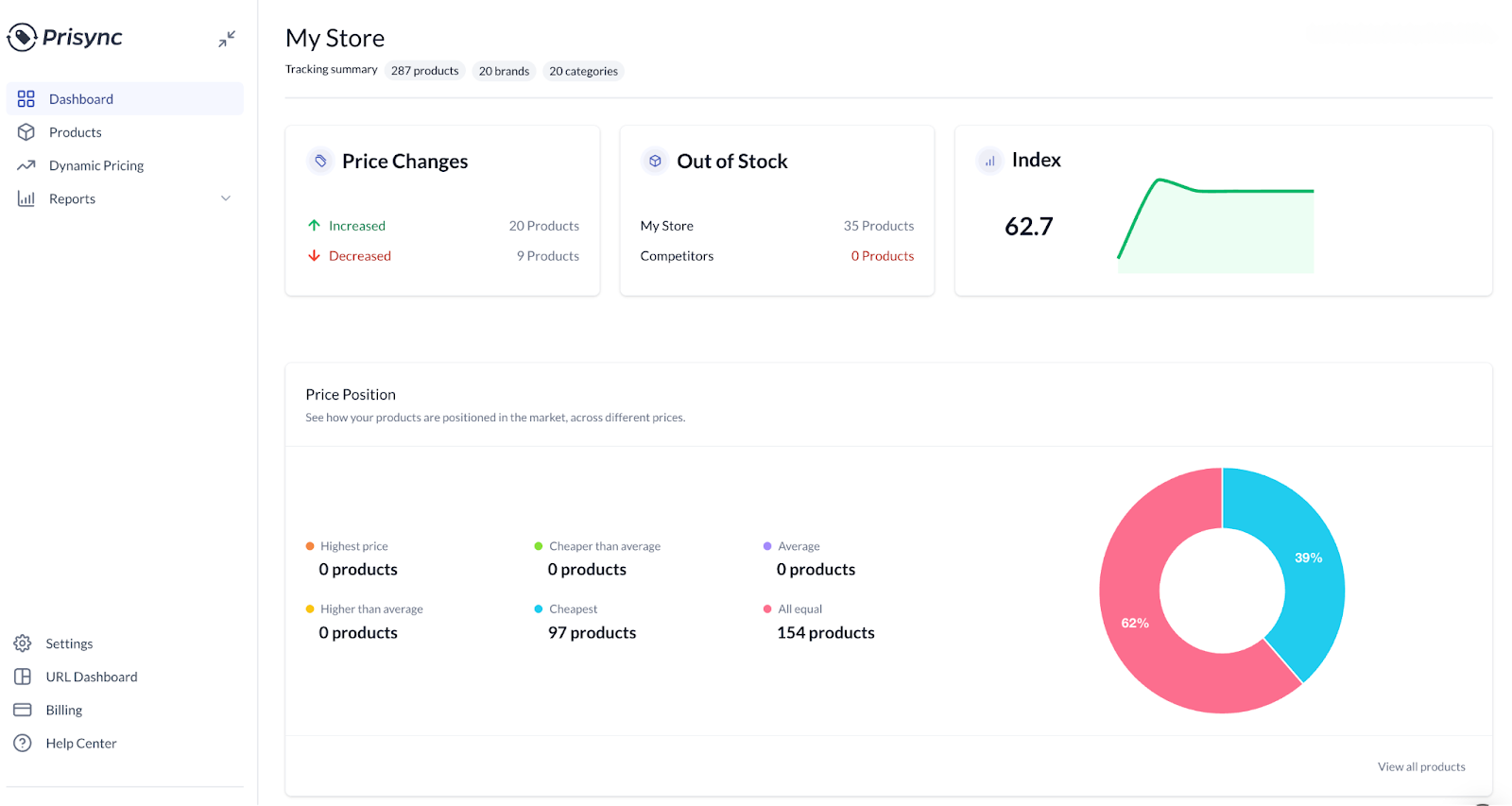
📷 Prisync dashboard shows competitive price positioning and product-level monitoring in a merchant-friendly workspace. Source: official vendor website/documentation.
💚 What we like
URL, channel and hybrid monitoring let teams trade manual match control against faster catalog onboarding as their needs change.
Published pricing and a 14-day trial make budget planning easier than sales-led competitive-intelligence platforms.
Dynamic pricing can sit on top of the same competitor data, avoiding a separate monitoring-to-execution handoff.
🟠 What to know
Refresh cadence differs by monitoring model: manual URLs can update three times daily while channel matching is normally daily.
Application programming interface (API) access is a paid add-on, so deeper integrations raise the effective monthly cost.
💡 Why this score: Prisync earns a near-top score because it is unusually ecommerce-specific, accessible to smaller teams and operationally clear. Product matching options and dynamic pricing cover the core workflow well. It trails PriceShape mainly on larger-scale workflow depth and advanced pricing controls, while remaining stronger on transparency and ease of adoption.
💰 Pricing: URL-based Professional starts at $99/month with a 14-day trial. Channel and Hybrid plans cost more; API access adds 20% to subscription cost.
✅ Best fit: Small and mid-market online retailers with defined competitors, manageable catalogs and a need to move from spreadsheets into repeatable monitoring and rules.
🚫 Less ideal for: Large global retailers needing sub-hour market data, complex price optimization models or enterprise governance across many business units.
🧩 Key capabilities
URL price tracking
Channel auto-matching
Hybrid monitoring
Dynamic pricing
Stock monitoring
Price alerts
🔎 Official sources: Product · Pricing · Documentation
3. Competera
91/100 · 💰 Enterprise price · 🧩 Advanced · 🏢 Enterprise · ⚙️ Enterprise implementation
🎯 Best for: Enterprise retailers optimizing prices across large assortments and channels
⚡ Choose Competera if your pricing problem is portfolio optimization and governed execution, not merely watching competitor product pages.
Competera is an enterprise pricing platform that combines competitive data, product matching, rules, demand modeling and price execution. Pricing teams can define margin floors and positioning targets, run what-if scenarios, route recommendations through approvals and push approved prices to channels. It is designed for retailers managing tens of thousands of stock keeping units (SKUs), where pricing decisions interact across categories, stores and channels rather than operating as isolated competitor-price reactions.
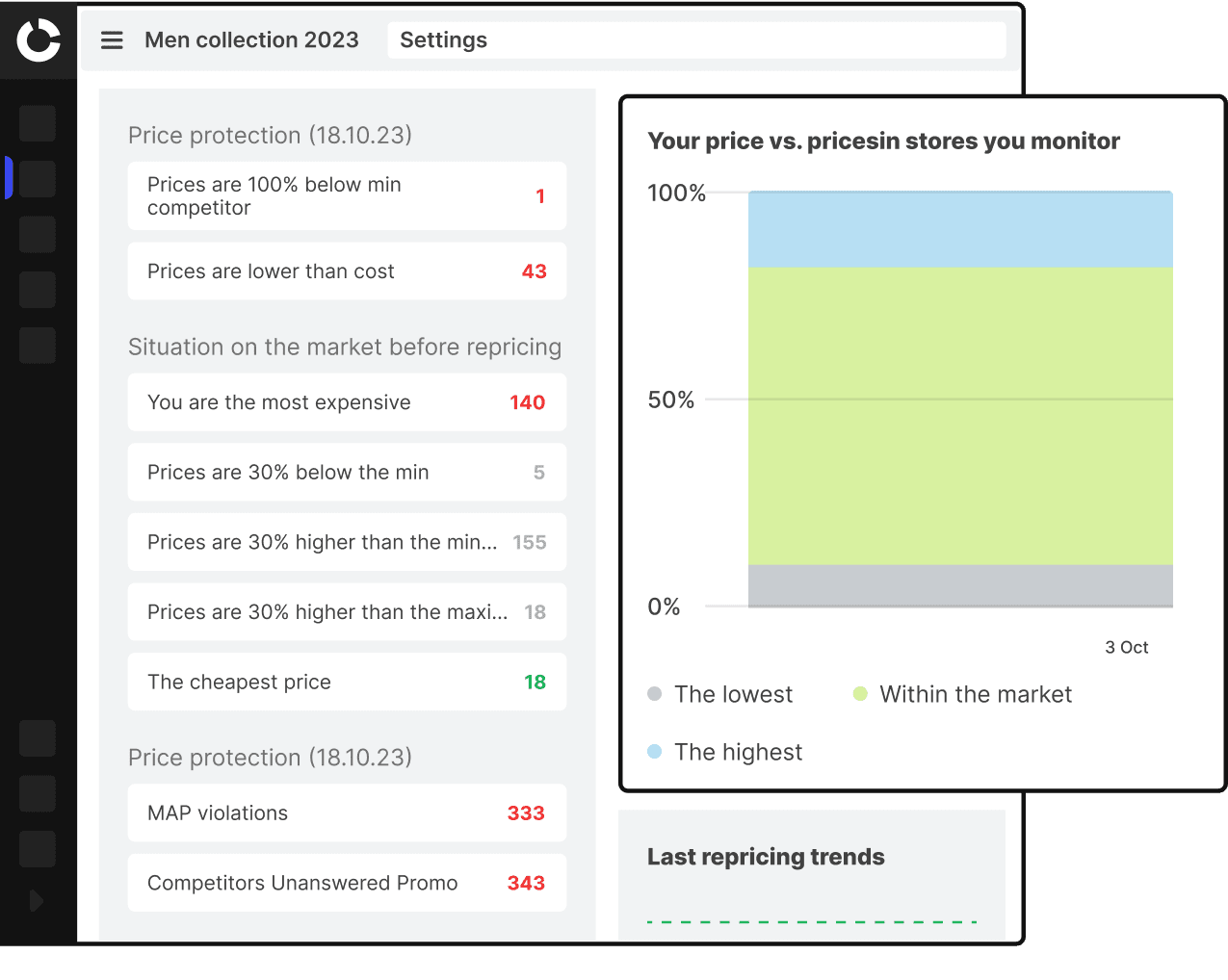
📷 Competera pricing workspace shows market-position controls and repricing decisions at an operator level. Source: official vendor website/documentation.
💚 What we like
Competitive data, optimization, governance and execution are designed as one enterprise pricing workflow instead of disconnected modules.
Rules, margin floors, positioning targets and approval processes give pricing teams explicit control over automated recommendations.
Enterprise integrations cover resource planning, product data and business intelligence systems as part of the deployment model.
🟠 What to know
Pricing is sales-led, so buyers need a scoped quote before they can compare total cost with other enterprise platforms.
Implementation depends on data quality, integrations and organizational pricing processes; this is not a weekend self-service setup.
💡 Why this score: Competera has the strongest enterprise pricing depth in the set, with product matching, optimization, governance and execution at portfolio scale. It loses points primarily on price transparency and implementation weight. For a large retailer those trade-offs may be acceptable, but they make it inappropriate to rank as the universal choice for smaller ecommerce teams.
💰 Pricing: Custom quote. Pricing is scoped around the selected Competitive Data, Pricing Platform and combined solution requirements.
✅ Best fit: Enterprise retailers with dedicated pricing teams, large catalogs, multiple channels and enough historical and competitive data to support advanced optimization.
🚫 Less ideal for: SMBs that mainly want competitor alerts, a simple Amazon repricer or a predictable low monthly subscription.
🧩 Key capabilities
AI price optimization
Competitive data
Product matching
Margin guardrails
Scenario simulation
Cross-channel execution
🔎 Official sources: Product · Pricing · Documentation
4. Intelligence Node
90/100 · 💰 Enterprise price · 🧩 Advanced · 🏢 Enterprise · ⚙️ Enterprise implementation
🎯 Best for: Enterprise teams needing product matching, market data and APIs
⚡ Choose Intelligence Node if competitive-data freshness and matching quality matter more than low entry price or a lightweight self-service workflow.
Intelligence Node is a competitive retail data platform built around product matching, price intelligence and high-frequency crawling. It can match exact, similar and variant products across websites and marketplaces, deliver data through dashboards or application programming interfaces, and support refresh rates down to seconds for contracted use cases. Its strength is the data layer: large retailers can feed market signals into internal pricing and merchandising systems instead of relying on a closed repricing workflow.
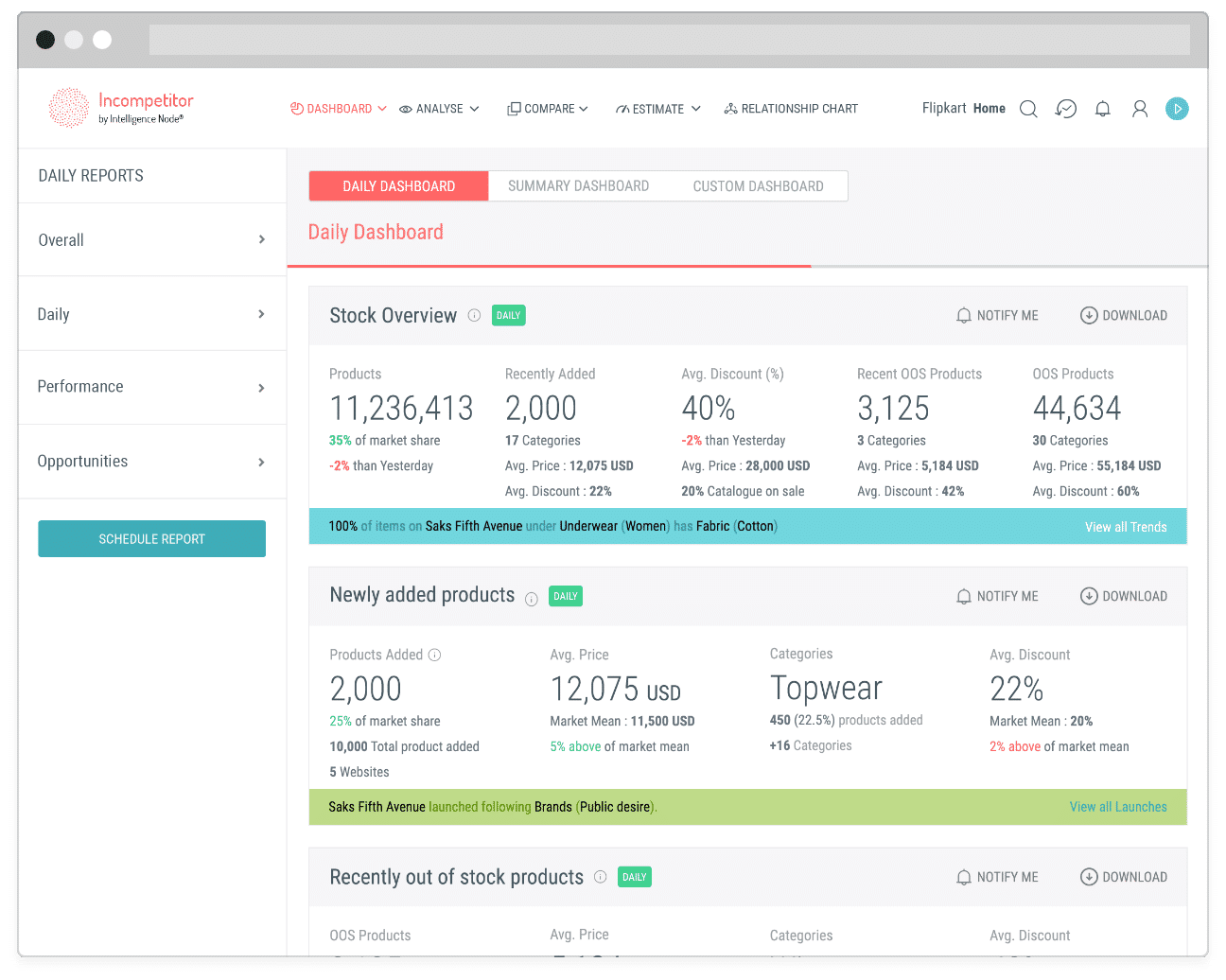
📷 Intelligence Node dashboard visualizes competitor price intelligence and market positioning across a retail assortment. Source: official vendor website/documentation.
💚 What we like
Exact, similar and variant matching is central to the product rather than an afterthought layered onto basic URL tracking.
Data can be delivered through dashboards, files and APIs, making the platform useful inside larger pricing architectures.
Refresh options extend to near-real-time use cases where daily competitor checks would be too slow for the category.
🟠 What to know
The official minimum project size starts at $5,000 per month, which immediately narrows the realistic buyer pool.
Teams still need a pricing process or downstream execution layer; strong intelligence does not automatically mean every price is written back.
💡 Why this score: Intelligence Node scores exceptionally on matching, data freshness, global coverage and integration depth. Its enterprise data layer can support demanding pricing programs, but the high minimum project size and heavier implementation reduce accessibility and value scores. It is strongest when competitive data quality is itself a strategic capability.
💰 Pricing: Custom subscription; official pricing says minimum project size starts at $5,000/month, with annual or multi-year terms and scope-based variation.
✅ Best fit: Enterprise retailers and brands that need reliable matching across large catalogs and want competitive pricing data delivered into broader analytics or pricing systems.
🚫 Less ideal for: Teams seeking an inexpensive dashboard, a simple marketplace repricer or a self-service tool with month-to-month entry pricing.
🧩 Key capabilities
Real-time price data
Exact product matching
Similar product matching
Global market coverage
Pricing APIs
MAP monitoring
🔎 Official sources: Product · Pricing · Documentation
5. Minderest
89/100 · 💰 Enterprise price · 🧩 Advanced · 🏢 Mid-market–Enterprise · ⚙️ Enterprise implementation
🎯 Best for: Retailers needing price and catalog intelligence across markets
⚡ Choose Minderest if you need broad competitor, assortment and promotion intelligence rather than a narrow single-marketplace repricing engine.
Minderest focuses on competitive price and catalog intelligence for retailers and brands. It monitors prices, promotions, stock and shipping across retailer sites, marketplaces and comparison engines, using automatic and manual matching for identical, similar and private-label products. Its dashboards and alerts are designed to support pricing decisions across large assortments. Buyers should distinguish this intelligence layer from the vendor’s separate Reactev positioning around AI-driven dynamic pricing automation.
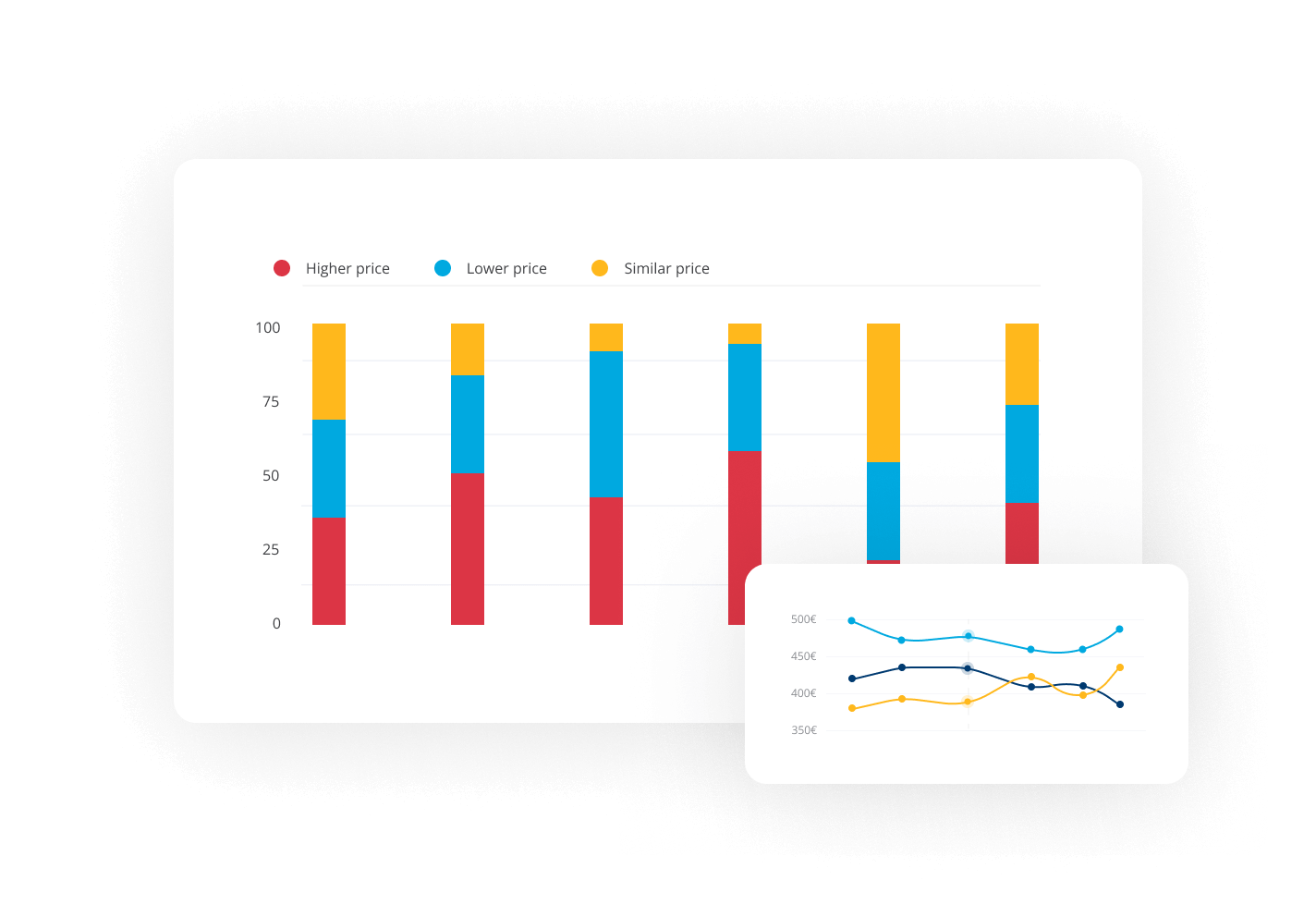
📷 Minderest visualization compares price-index positioning across competitors and monitored assortment groups. Source: official vendor website/documentation.
💚 What we like
Price, promotion, stock and assortment intelligence are covered together, giving pricing teams context beyond the headline shelf price.
Matching supports identical, similar and private-label products, which matters in categories where universal product codes are incomplete.
Multi-country, multi-language and marketplace coverage fits retailers that cannot define the market as five competitor URLs.
🟠 What to know
Public numeric pricing is not available, so total cost requires a sales conversation and scope definition.
Minderest intelligence and Reactev automation are distinct vendor propositions; confirm the exact product responsible for execution before contracting.
💡 Why this score: Minderest scores highly for broad market intelligence, matching and enterprise retail relevance. Its ability to combine price, promotion, stock and catalog context is valuable for complex assortments. It loses ground on public pricing and because buyers must be precise about where intelligence ends and separate dynamic-pricing automation begins.
💰 Pricing: Custom quote. The vendor asks buyers to contact pricing experts for a scoped proposal.
✅ Best fit: Retailers and manufacturers monitoring large assortments across countries, marketplaces and competitors where price context and catalog intelligence matter together.
🚫 Less ideal for: Small merchants wanting a low-cost self-service tracker or marketplace sellers whose only job is winning a Buy Box automatically.
🧩 Key capabilities
Price intelligence
Catalog intelligence
Promotion tracking
Stock monitoring
Product matching
Custom alerts
🔎 Official sources: Product · Pricing · Documentation
6. Wiser
88/100 · 💰 Enterprise price · 🧩 Intermediate · 🏢 Mid-market–Enterprise · ⚙️ Enterprise implementation
🎯 Best for: Retail teams needing high-frequency competitor price execution data
⚡ Choose Wiser if you want frequent market-price signals, automated matching and several ways to deliver them into existing retail workflows.
Wiser Price Intelligence tracks competitor prices and availability, automatically matches products and surfaces pricing gaps through dashboards and alerts. The vendor states refreshes can run as often as every 15 minutes, with delivery through CSV files, plugins and a Live Prices application programming interface. Wiser is therefore more useful as a managed competitive-data layer than as a simple ecommerce plug-in. Teams can configure rules and recommendations while retaining role-based access and enterprise governance.
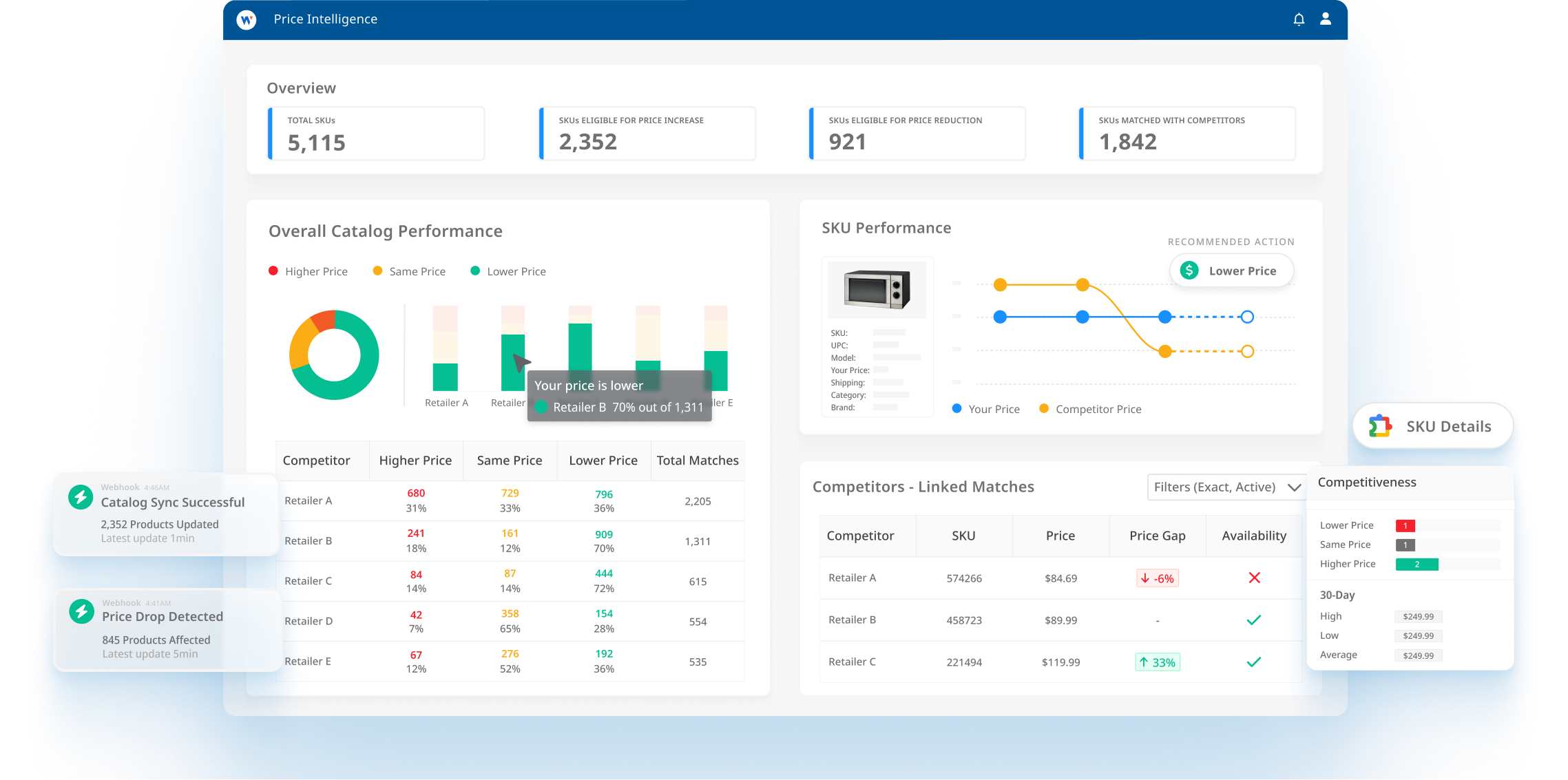
📷 Wiser Price Intelligence dashboard brings competitor price gaps and market movement into a retail decision view. Source: official vendor website/documentation.
💚 What we like
High-frequency tracking can suit categories where a daily scrape leaves pricing teams reacting after the market has already moved.
Automated product matching reduces manual mapping work when catalogs and competitor assortments change frequently.
Dashboards, CSV, APIs, plugins and browser tools give enterprises several practical ways to consume the same pricing data.
🟠 What to know
No public self-service price is shown for Price Intelligence, so buyers cannot benchmark total cost without speaking to sales.
The product emphasizes intelligence and recommendations; validate exactly how approved price changes reach your commerce or resource-planning systems.
💡 Why this score: Wiser scores well on monitoring frequency, matching and enterprise data delivery, especially for teams that want price intelligence inside existing workflows. Its deductions come from opaque pricing and a less self-contained execution story than dedicated dynamic-pricing platforms. The result is a strong enterprise shortlist option, not a universal repricer.
💰 Pricing: Custom quote. The Price Intelligence product uses a sales-led buying motion rather than public self-service plan pricing.
✅ Best fit: Retail pricing teams that need frequent competitive signals, flexible data delivery and governance while keeping their existing execution systems in place.
🚫 Less ideal for: Small merchants that want transparent monthly pricing or a marketplace-native repricer they can connect and configure in an afternoon.
🧩 Key capabilities
Price monitoring
Automated matching
Historical trends
Live Prices API
Real-time alerts
Role-based access
🔎 Official sources: Product · Pricing · Documentation
7. Repricer
87/100 · 💰 Mid · 🧩 Intermediate · 🏢 SMB–Mid-market · ⚙️ Specialist-led
🎯 Best for: Marketplace sellers automating Amazon, eBay and multichannel prices
⚡ Choose Repricer if your real pricing battleground is the marketplace Buy Box and you need automated rules rather than competitor-website research.
Repricer is a marketplace pricing engine centered on Amazon and eBay competition, with additional multichannel connections. It reacts to marketplace competitors, applies automated strategies and scales from 3,000 stock keeping units on Core to much larger catalogs on higher tiers. Premium adds net-margin repricing, stock-level logic and application programming interface integrations. Its Shopify and Walmart connections can replicate marketplace prices, but this is not the same job as crawling arbitrary competitor web stores.
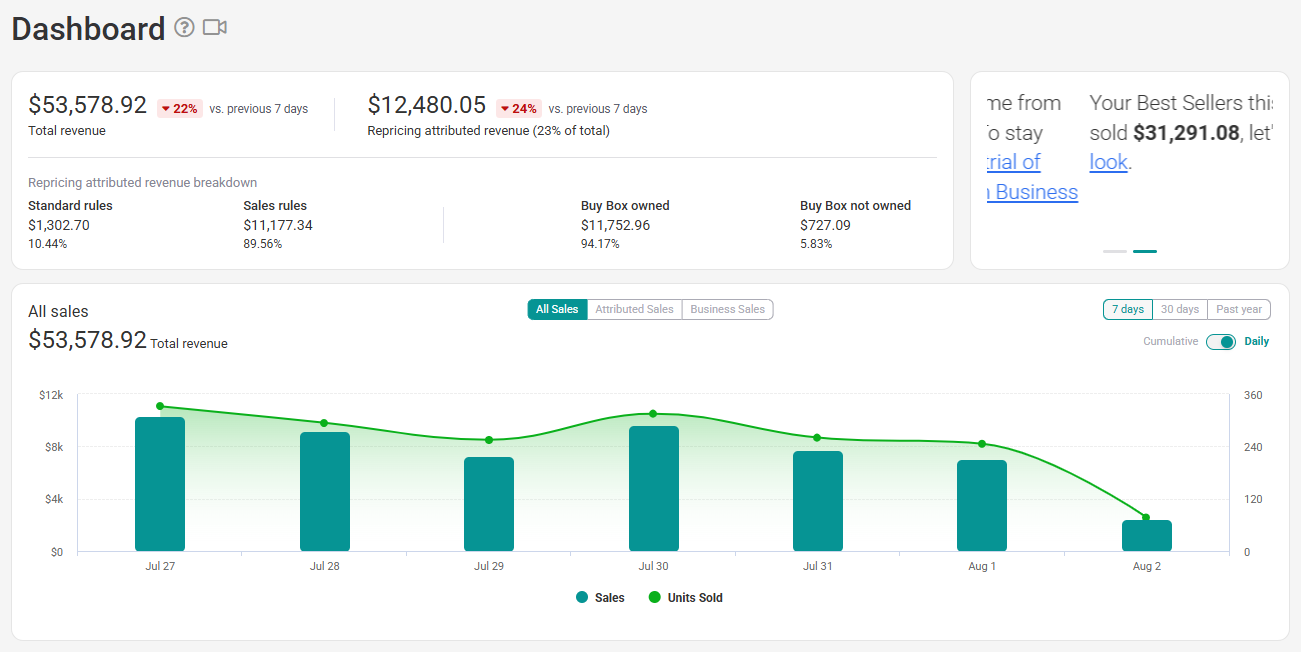
📷 Repricer dashboard exposes marketplace listing status and repricing controls used to manage competitive price changes. Source: official vendor website/documentation.
💚 What we like
Marketplace repricing is the core product job, so Buy Box strategies and competitor reactions are not buried inside a generic analytics suite.
Published Core, Scale and Premium plans make it possible to map price against catalog size before talking to sales.
Higher tiers add net-margin and stock-level repricing, helping sellers protect economics instead of simply chasing the lowest offer.
🟠 What to know
Shopify and Walmart functionality primarily extends or replicates marketplace pricing; it does not turn Repricer into general web price intelligence.
Advanced margin, API and large-catalog capabilities sit on higher plans, so the $99 entry price is not the full cost for every seller.
💡 Why this score: Repricer ranks strongly for marketplace sellers because execution, strategy controls and published scale tiers are tightly aligned with that operating job. It scores lower than the web-price leaders in this mixed category because it is intentionally marketplace-centric and cannot substitute for broad competitor-site intelligence. Within its lane, it is a serious specialist.
💰 Pricing: Core $99/month for up to 3,000 SKUs and three channels; Scale $299/month; Premium $499/month; Custom above that. 14-day trial.
✅ Best fit: Amazon and eBay sellers that need continuous marketplace repricing and want clearer rules, margin logic and catalog scaling than manual seller-console updates.
🚫 Less ideal for: Retailers whose primary requirement is matching and monitoring prices across arbitrary competitor websites, brands or comparison-shopping engines.
🧩 Key capabilities
Real-time repricing
Buy Box strategies
Net-margin rules
Stock-level repricing
Marketplace integrations
API integrations
🔎 Official sources: Product · Pricing · Documentation
8. Price2Spy
86/100 · 💰 Mid · 🧩 Intermediate · 🏢 SMB–Mid-market · ⚙️ Low-code
🎯 Best for: Teams needing broad website monitoring with optional repricing
⚡ Choose Price2Spy if you need flexible URL monitoring, historical analysis and integrations, and you want repricing to remain an explicit add-on decision.
Price2Spy is a long-running competitor price-monitoring platform for retailers and brands. It can track prices across websites, marketplaces and currencies, keep price history, trigger alerts and produce reports. Monitoring frequency can rise to eight checks per day on higher configurations, while its application programming interface supports product and URL management plus downstream data access. Automated repricing exists as an additional module, which is important: monitoring does not silently become price execution.
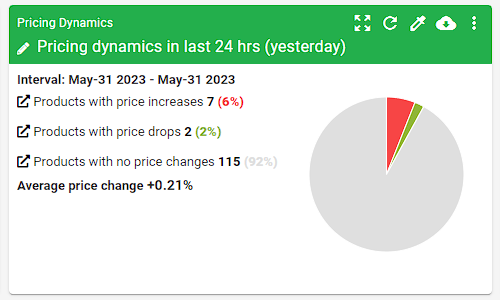
📷 Price2Spy Pricing Dynamics widget visualizes how monitored prices move relative to competing offers over time. Source: official vendor website/documentation.
💚 What we like
Website monitoring is flexible across languages, currencies and competitor URLs instead of being tied to one marketplace ecosystem.
Historical reports, alerts, marketplace monitoring and integration options make the product useful beyond a simple price-change email.
Repricing is modular, so teams can keep monitoring and execution deliberately separate until governance and rules are ready.
🟠 What to know
Current pricing tiers are published by name and features, but numeric Starter and Basic prices were not exposed in the checked public page.
The interface and configuration model are more utilitarian than newer pricing suites, especially when many custom workflows are added.
💡 Why this score: Price2Spy earns a strong score for broad monitoring coverage, configurable frequency, reporting and integration depth. It is particularly useful when buyers want a monitoring system first and execution second. Pricing opacity in the current public page and a more modular, less unified automation experience keep it below the leaders.
💰 Pricing: Custom quote in the current public presentation; Starter, Basic and Premium tiers are listed, with a 14-day free trial. Repricing is a separate paid module.
✅ Best fit: Retailers and brands that want configurable monitoring across many websites and need reports, alerts or API access without committing immediately to full automation.
🚫 Less ideal for: Buyers who want a highly polished all-in-one optimizer with transparent numerical plan pricing and automatic execution included by default.
🧩 Key capabilities
Website monitoring
Marketplace monitoring
Price history
Instant alerts
Pricing reports
REST API
🔎 Official sources: Product · Pricing · Documentation
9. Seller Snap
85/100 · 💰 Mid · 🧩 Intermediate · 🏢 SMB–Mid-market · ⚙️ Specialist-led
🎯 Best for: Amazon and Walmart sellers prioritizing algorithmic repricing
⚡ Choose Seller Snap if you want marketplace repricing driven by profit-first game-theory logic rather than a long list of manually tuned competitor rules.
Seller Snap is a marketplace repricer for Amazon and Walmart built around game-theory-based automation, custom strategies and seller analytics. Its engine is positioned to avoid reflexive price wars by changing behavior according to competitive conditions rather than always undercutting. The current plans scale by stock keeping units, marketplaces, revenue and support level. It is a specialist marketplace product, so it belongs on a shortlist for Buy Box economics, not for crawling rival ecommerce websites.

📷 Seller Snap interface presents repricing performance and marketplace seller data in one operational dashboard. Source: official vendor website/documentation.
💚 What we like
The repricing engine is explicitly profit-oriented rather than built around the simplistic goal of always being the cheapest seller.
Amazon and Walmart support now spans plans above Starter, with analytics and integrations included across the buying path.
Public plan limits make SKU, marketplace, revenue and support trade-offs visible before an evaluation call.
🟠 What to know
Starter is annual-only in the current pricing display, while Walmart access and onboarding support begin on higher-priced plans.
The product is designed for marketplace competition, so it cannot replace a web-store price intelligence platform for direct-retailer monitoring.
💡 Why this score: Seller Snap scores well as a sophisticated marketplace repricer with strong ecommerce fit and a clear profit-first strategy. It ranks below Repricer in this mixed category because its starting economics are less flexible and integrations are narrower. It remains compelling when Amazon repricing logic matters more than broad competitive web intelligence.
💰 Pricing: Starter $100/month paid annually for 1,000 SKUs and one marketplace; Accelerator $250/month; Standard $500/month; Enterprise custom. 15-day trial.
✅ Best fit: Amazon-first sellers with meaningful Buy Box competition that want automated strategy, analytics and a repricer designed to protect profit rather than chase every price drop.
🚫 Less ideal for: Retailers comparing their own web-store prices with multiple competitor sites, or very small sellers prioritizing the lowest possible monthly software cost.
🧩 Key capabilities
Game Theory repricing
Amazon repricing
Walmart repricing
Min/max prices
Seller analytics
Custom strategies
🔎 Official sources: Product · Pricing · Documentation
10. BQool
84/100 · 💰 Budget · 🧩 Intermediate · 🏢 SMB–Mid-market · ⚙️ Specialist-led
🎯 Best for: Budget-conscious Amazon sellers needing configurable AI and rule repricing
⚡ Choose BQool if you need Amazon repricing at a low entry price and want to combine AI rules, conditional logic and classic custom rules.
BQool AI Repricer is an Amazon-focused repricing product with AI strategies, conditional repricing and conventional rule-based logic. Plans start at $25 per month and scale by AI/conditional listings, rule-based listings and users. Conditional rules can incorporate inventory age, sell-through and days of supply, while dashboards track sales, orders and Buy Box performance. Its appeal is value and configurability, but its scope remains Amazon rather than broad competitor-web price intelligence.
📷 BQool Repricing Central dashboard summarizes AI performance, repricer analytics and listing status for Amazon sellers. Source: official vendor website/documentation.
💚 What we like
The $25 entry plan is unusually accessible for sellers that need automated repricing without a large fixed software commitment.
AI, conditional and rule-based methods let sellers graduate from simple strategies without replacing the platform.
Inventory age, sell-through and days-of-supply conditions connect pricing behavior to operational inventory goals.
🟠 What to know
BQool is Amazon-focused, and marketplace regions are priced separately, so it is not a substitute for broad web-store monitoring.
Advanced AI and conditional listing capacity increases by plan, meaning the cheapest tier is not representative for larger catalogs.
💡 Why this score: BQool’s value is excellent: public pricing starts low and the product offers several repricing modes plus useful seller analytics. It ranks tenth because this page also evaluates broad price intelligence, matching and enterprise scale, where BQool is intentionally narrower. For an Amazon-only SMB, that category-wide ranking can understate its practical fit.
💰 Pricing: Basic $25/month; AI Deluxe $50; AI Premium $100; AI Ultimate $200; AI Enterprise $300. Annual billing saves 10%; 14-day free trial.
✅ Best fit: Small and growing Amazon sellers that want automated pricing with minimum/maximum guardrails and more strategy flexibility than manual Seller Central updates.
🚫 Less ideal for: Retailers needing competitor-site crawling, cross-market product matching or enterprise price optimization across owned web stores and physical channels.
🧩 Key capabilities
AI repricing
Conditional repricing
Rule-based repricing
Inventory conditions
Buy Box analytics
Profit calculator
🔎 Official sources: Product · Pricing · Documentation
🎯 Which tools should you actually shortlist?
If you are a first-time web-price buyer: start with Prisync and Price2Spy. Both make competitor monitoring understandable before you commit to a large pricing-transformation program.
If you want monitoring plus automated price changes: test PriceShape and Prisync with the same margin-floor scenarios and approval requirements, not just the same competitor URLs.
If pricing is an enterprise capability: shortlist Competera, Intelligence Node and Wiser, then decide whether optimization workflow or competitive-data depth is the harder problem.
If assortment and market intelligence matter as much as price: add Minderest, especially when promotions, stock, comparable products and international catalog context affect decisions.
If Amazon or eBay competition is the operating job: start with Repricer; add Seller Snap when profit-first algorithmic behavior and Amazon/Walmart analytics deserve deeper evaluation.
If Amazon budget is tight: BQool is the practical value test. Compare it with premium repricers on your own listings before paying for sophistication you may not use.
🧪 Run this test before you buy
Do not let every vendor demonstrate its easiest catalog and best-behaved competitors. Build one small pricing test pack and force every shortlisted product through the same messy cases. Include exact branded products, variants, bundles, private-label items, out-of-stock competitors and one product where your cost structure makes aggressive repricing dangerous. For marketplace repricers, use the same live listings and minimum/maximum constraints. For web monitoring platforms, use the same competitor domains. The goal is to compare what happens when data is imperfect and prices move, not how polished the dashboard looks.
Load the same 25 products, including exact matches, variants, bundles and one private-label item.
Track the same five competitor sites or the same marketplace listings and record how each tool establishes comparable products.
Deliberately include one incorrect potential match and see how the platform flags, rejects or lets you override it.
Create an out-of-stock competitor case and check whether availability changes the recommendation or repricing behavior appropriately.
Measure the time from a competitor price change to the new data appearing in the platform.
Create a minimum price and margin floor, then force a competitor below it and verify the system refuses an unsafe price.
Test an upward price opportunity where you are materially cheaper than the market, not only a downward competitive response.
Apply a manual override or product lock and confirm automation respects it until the operator releases it.
Export the data or send it through the available API/integration, then verify fields, identifiers, timestamps and price context survive.
Reverse the test: disable automation, restore the original price set and confirm you can audit what changed, when and why.
📏 Record the same things for every vendor: correct matches, false matches, missing matches, refresh delay, price-floor breaches, manual interventions, upward-price opportunities, execution failures, export completeness, setup hours and the real monthly cost at your catalog size.
🧾 10 questions to ask in every demo
What exactly is billable: products, competitor matches, websites, marketplaces, users, refresh frequency, channels, API volume or revenue?
How do you match exact products, variants, bundles and private-label equivalents, and how can our team correct a bad match?
What is the guaranteed or typical refresh cadence for our markets, and which events can trigger a faster price check?
Which price changes can the platform execute automatically, and which require approval or a separate module?
How are minimum prices, landed cost, margin floors, taxes, shipping and marketplace fees represented inside repricing rules?
What happens when a competitor goes out of stock, changes pack size, runs a promotion or shows a personalized/in-cart price?
Who owns implementation across our ecommerce platform, marketplace accounts, enterprise resource planning system and product-information feeds?
Can we export raw observations, product matches, recommendations, rule history and execution logs without buying a separate data product?
What onboarding, support and pricing-operations expertise is included at our plan, and who owns an incident when automation behaves unexpectedly?
If we leave, how do we export match mappings, price history, rules and audit logs, and what stops working immediately after contract end?
❓ Frequently asked questions
What is the difference between price monitoring and repricing?
Price monitoring collects competitor prices, availability, promotions and history so a team can see how the market is moving. Repricing goes one step further and changes your own selling price according to rules, optimization models or marketplace conditions. Some products do both, while others require a separate module or downstream execution system.
Can an Amazon repricer monitor competitor ecommerce websites?
Usually not in the same sense as a web-price intelligence platform. Amazon repricers primarily react to sellers and offers inside supported marketplaces. Some connect to Shopify, Walmart or other channels for price replication, but that does not mean they crawl arbitrary competitor stores. If off-marketplace competitors matter, test web monitoring separately.
How often should competitor prices be checked?
It depends on how quickly your category moves and how often you are willing to act. Daily data may be enough for slower catalogs, while high-velocity retail or marketplace competition can justify multiple checks per day or near-real-time feeds. Pay for frequency only when faster data changes a real pricing decision.
Does dynamic pricing always mean lowering prices?
No. Good dynamic pricing can raise prices when you are unnecessarily cheap, hold a price when competitors fall below your margin floor, react to stock conditions, or change only selected products. A useful evaluation should include upward-price and no-change scenarios, not only demonstrations of undercutting competitors.
Why is product matching so important?
A pricing system is only as trustworthy as the comparison behind it. A wrong pack size, model variant or private-label substitute can create a false price gap and trigger a bad decision. For large catalogs, ask how the vendor handles confidence, human review, exact versus similar matches and rematching when competitor listings change.
How much does ecommerce price monitoring or repricing software cost?
The range is wide. Amazon repricers in this set start around $25 per month, general web monitoring can start around $99, and enterprise competitive-intelligence platforms are often custom priced. Intelligence Node states a $5,000 monthly minimum project size. Compare cost at your actual SKU count, competitors, channels and refresh frequency.
🔍 About this research
MarketMaze researches and scores each tool using its proprietary scoring methodology. Product details and pricing are checked against official vendor sources. Screenshots are from vendor websites, documentation, official demos, or MarketMaze product captures and are used to illustrate the products being reviewed.
Last research check: 26 September 2026.
