
MARKETMAZE · ECOMMERCE TOOLS · RESEARCH
10 Best Influencer & Creator Marketing Platforms for Ecommerce (2026)
Creator marketing software now spans discovery, audience vetting, gifting, relationship management, affiliate sales, content approvals and paid amplification. We compared ten platforms for ecommerce teams, with current pricing and product claims checked against official vendor sources.
Updated 25 September 2026 · Pricing and product claims checked against official vendor sources.
👋 New to this category?
Influencer and creator marketing platforms help brands find suitable creators, evaluate audience fit, organize outreach, manage gifting and briefs, track content, pay partners and measure commercial results. The right choice depends on whether you mainly need discovery, a creator relationship system, an affiliate engine, a UGC marketplace or an enterprise program layer. For ecommerce, the biggest differentiators are store integrations, product seeding, sales attribution and how easily creator activity connects back to orders and revenue.
🧭 Jump to a tool
🥇 1. GRIN
🏆 The quick answer
🏆 Best overall
GRIN
🌱 Best for getting started
Shopify Collabs
💸 Best value
Shopify Collabs
🏢 Best for larger teams / enterprise
CreatorIQ
🧠 Best for advanced or technical users
Traackr
🛍️ Best Shopify-first alternative
Modash
MarketMaze take
For most ecommerce teams, prioritize commerce connection and operating workflow before raw creator-database size. GRIN, Aspire and Modash offer the strongest overall combinations of discovery and program execution, while Shopify Collabs is hard to beat for value if you already run on Shopify. CreatorIQ and Traackr make more sense when creator marketing is a global, governed function rather than a small growth experiment.
📊 Tool comparison & scores
Rank | Tool | Score | Best for | Pricing |
|---|---|---|---|---|
1 | GRIN | 94/100 | End-to-end creator programs with strong ecommerce operations and automation | $0–$1,500/mo |
2 | Aspire | 92/100 | Creator discovery plus mature relationship and campaign management workflows | Custom quote |
3 | Modash | 91/100 | Shopify-first discovery, creator CRM, tracking and payments with transparent pricing | From $199/mo |
4 | Shopify Collabs | 90/100 | Shopify merchants that want creator affiliate, gifting and payout workflows inside Shopify | Free + 2.9% fee |
5 | Upfluence | 89/100 | Commerce-connected influencer and affiliate programs with strong sales attribution | Custom quote |
6 | CreatorIQ | 88/100 | Global enterprise creator programs needing governance, safety, workflows and reporting | Custom quote |
7 | Traackr | 87/100 | Data-heavy global creator strategy, benchmarking and program measurement | Custom quote |
8 | Captiv8 | 86/100 | Creator discovery and campaign management with deep data, measurement and paid amplification | Custom quote |
9 | Insense | 84/100 | UGC and influencer campaigns with a vetted creator marketplace and ad-ready content | From $500/mo |
10 | SARAL | 82/100 | DTC influencer seeding, outreach, creator CRM and affiliate tracking in one system | From $12k/yr |
Scores reflect MarketMaze’s proprietary evaluation of core creator-marketing performance, ecommerce fit, workflow control, integrations, pricing/value and ability to scale.
🧠 How the scoring works
This ranking uses MarketMaze proprietary scoring.
Dimension | Weight | What we look for |
|---|---|---|
Core job performance | 30% | Discovery quality, creator evaluation, campaign execution and measurement depth. |
Ecommerce fit | 20% | Gifting, store integrations, affiliate attribution and revenue visibility. |
Workflow & control | 15% | CRM, approvals, outreach, permissions and repeatable campaign operations. |
Integrations & implementation | 15% | Commerce connections, setup burden, APIs and operational fit. |
Pricing & value | 10% | Public pricing, buying friction, contract flexibility and feature value. |
Scale & advanced capabilities | 10% | Global governance, AI, benchmarking, safety and enterprise reporting. |
Scores use current public product evidence and buying information, not third-party review-site ratings.
🤔 Do you even need creator marketing software?
Probably yes ✅
You work with dozens of creators, send products repeatedly, need approvals or payments, or want to connect creator activity to affiliate sales and revenue.
Maybe 🟡
You run occasional campaigns with a small roster. A lighter tool or Shopify-native workflow may be enough until volume and coordination become painful.
Probably not yet ⏳
You have only a handful of one-off creator relationships. A spreadsheet, email and tracked discount codes may still be cheaper and simpler.
🥇 1. GRIN
94/100 · 💰 Mid–Enterprise · 🧩 Intermediate · 🏢 SMB–Enterprise · ⚙️ No-code + integrations
🎯 Best for: End-to-end creator programs with strong ecommerce operations and automation
⚡ Choose GRIN if you want discovery, outreach, gifting, affiliates, payments and reporting in one operating system.
GRIN combines creator discovery and relationship management with Gia, its AI operator for sourcing, outreach and ongoing program work. The platform covers campaign workflows, product seeding, affiliate tracking, content, payments and reporting, with Shopify connectivity and a free entry plan.

📷 GRIN’s AI creator search interface for matching prospects to campaign criteria. Source: vendor website/documentation.
💚 What we like
Broad workflow from creator sourcing through payouts and reporting.
Public, self-serve pricing makes budgeting easier than most enterprise competitors.
Strong commerce orientation with affiliate tracking, gifting and Shopify support.
🟠 What to know
Credits govern Gia automation capacity, so usage needs monitoring at scale.
GRIN Classic active-creator limits begin on Growth and rise by plan.
💡 Why this score: GRIN combines broad creator operations, strong ecommerce workflows, transparent pricing and a low-friction entry point. The main trade-off is that its newest AI-led workflow uses credits, so high-touch programs should model consumption carefully.
💰 Pricing: Free $0; Starter $200/month; Growth $500/month; Scale $1,000/month; Complete $1,500/month. Paid overage is $0.10 per credit; plans are month-to-month.
✅ Best fit: Brands wanting one system for discovery, campaigns, gifting, affiliate sales, payments and reporting without starting with an enterprise contract.
🚫 Less ideal for: Teams that only need lightweight discovery and do not need creator CRM or program operations.
🧩 Key capabilities
Creator discovery and matching
Creator CRM and outreach
Campaign briefs and approvals
Product seeding and ecommerce integrations
Affiliate links, codes and GMV tracking
Payments, analytics and reporting
🔎 Official sources: Product · Pricing · Documentation
🥈 2. Aspire
92/100 · 💰 Enterprise · 🧩 Intermediate · 🏢 Mid-market–Enterprise · ⚙️ No-code
🎯 Best for: Creator discovery plus mature relationship and campaign management workflows
⚡ Choose Aspire if you want a large creator marketplace plus structured discovery, campaign management and measurement.
Aspire is an all-in-one creator marketing platform spanning discovery, inbound marketplace applications, relationship management, gifting, content workflows, affiliate activity and reporting. Its discovery suite combines AI search, filters and platform-verified data, while its marketplace gives brands an inbound source of interested creators.

📷 Aspire creator discovery interface showing audience filters and creator profiles. Source: Aspire.
💚 What we like
Strong blend of outbound discovery and inbound creator marketplace workflows.
Rich campaign operations including briefs, gifting, content and relationship context.
Good fit for brands that want creator marketing and affiliate programs under one roof.
🟠 What to know
Brand pricing is sales-led rather than transparently published.
The breadth can be more than a small occasional-campaign team needs.
💡 Why this score: Aspire ranks near the top for breadth, creator sourcing options and the depth of its campaign workflow. Its main drawback versus the leaders is buying friction: brands need a sales process to understand price and packaging.
💰 Pricing: Custom quote for brands; creator marketplace participation is free for creators and Aspire states the marketplace takes no creator cut.
✅ Best fit: Mid-market and enterprise teams running recurring creator campaigns that need both discovery and a structured system for long-term creator relationships.
🚫 Less ideal for: Small teams that want public monthly pricing and only a simple creator search tool.
🧩 Key capabilities
AI creator discovery
Creator marketplace
Campaign and relationship management
Product seeding and gifting
Affiliate and ad workflows
Measurement and content hub
🔎 Official sources: Product · Pricing · Documentation
🥉 3. Modash
91/100 · 💰 Mid · 🧩 Easy–Intermediate · 🏢 SMB–Mid-market · ⚙️ No-code
🎯 Best for: Shopify-first discovery, creator CRM, tracking and payments with transparent pricing
⚡ Choose Modash if you want strong creator data and campaign operations without an enterprise sales process.
Modash is a Shopify-first influencer marketing platform for discovery, creator relationship management, email, content tracking, gifting, affiliate management and payments. It emphasizes a large open creator dataset and low creator friction because creators do not need to register to be discovered or tracked.

📷 Modash product interface for managing creator and Shopify-connected campaign activity. Source: Modash.
💚 What we like
Transparent pricing and a 14-day free trial make evaluation straightforward.
Strong creator discovery with hundreds of millions of public profiles and audience insights.
Deep Shopify fit for gifting, discount codes, affiliate attribution and reporting.
🟠 What to know
Usage limits apply to profile opens, email unlocks and tracked creators.
Affiliate management and higher payment allowances sit on higher plans.
💡 Why this score: Modash scores very well on data coverage, usability, ecommerce fit and buying transparency. It trails the top two mainly on breadth for complex global governance and enterprise workflows, but for many Shopify brands it is the more practical purchase.
💰 Pricing: Essentials starts at $199/month on annual billing ($299 monthly); Performance starts at $499/month annual ($599 monthly); Enterprise starts at $14,700/year.
✅ Best fit: Shopify brands that want strong discovery plus creator CRM, gifting, tracking and payouts with visible pricing and quick implementation.
🚫 Less ideal for: Large global organizations that need highly customized governance across many business units.
🧩 Key capabilities
380M+ creator discovery dataset
AI and image search
Creator CRM and inbox integration
Automatic content tracking
Shopify gifting and affiliate workflows
Creator payments
🔎 Official sources: Product · Pricing · Documentation

4️⃣ 4. Shopify Collabs
90/100 · 💰 Value · 🧩 Easy · 🏢 Shopify merchants · ⚙️ Native Shopify
🎯 Best for: Shopify merchants that want creator affiliate, gifting and payout workflows inside Shopify
⚡ Choose Shopify Collabs if your store runs on Shopify and you want the lowest-friction path to creator affiliate programs.
Shopify Collabs is built directly into Shopify for recruiting creators, sending gifts, creating affiliate links and codes, tracking attributed sales and paying commissions through Shopify billing. Merchants can invite creators directly, accept applications or use open-access commission offers.

📷 Shopify Collabs commerce reporting visual with affiliate sales, orders and payouts. Source: vendor website/documentation.
💚 What we like
Native Shopify data and workflows reduce integration and attribution work.
Free to install, with costs tied mainly to commission payment processing.
Strong for gifting, affiliate links, discount codes and automatic payouts.
🟠 What to know
It is only relevant to Shopify merchants and is narrower than full enterprise creator suites.
Shopify notes Collabs is not accepting new general creator signups, though merchants can still invite and accept creators.
💡 Why this score: Shopify Collabs scores highly because its ecommerce fit and value are exceptional for Shopify merchants. It ranks below broader suites because discovery, governance and cross-platform campaign operations are less comprehensive.
💰 Pricing: Free to install for eligible Shopify merchants; automatic commission payments carry a 2.9% processing fee. Shopify subscription costs are separate.
✅ Best fit: Shopify brands starting or scaling creator affiliate and gifting programs that want native order attribution and automatic commission handling.
🚫 Less ideal for: Non-Shopify merchants or complex global creator programs requiring advanced cross-market governance.
🧩 Key capabilities
Creator applications and direct invites
Open-access commission programs
Product gifting
Affiliate links and discount codes
Sales attribution
Automatic commission payments
🔎 Official sources: Product · Pricing · Documentation
5️⃣ 5. Upfluence
89/100 · 💰 Enterprise · 🧩 Intermediate · 🏢 Mid-market–Enterprise · ⚙️ No-code + integrations
🎯 Best for: Commerce-connected influencer and affiliate programs with strong sales attribution
⚡ Choose Upfluence if you want creator discovery tied closely to ecommerce, affiliates, gifting and revenue reporting.
Upfluence combines creator discovery, campaign management, affiliate workflows, product gifting, creator payments and revenue attribution. It connects with Shopify, WooCommerce, Magento, BigCommerce and Amazon, and positions Jaice as an AI assistant for campaign creation and outreach.
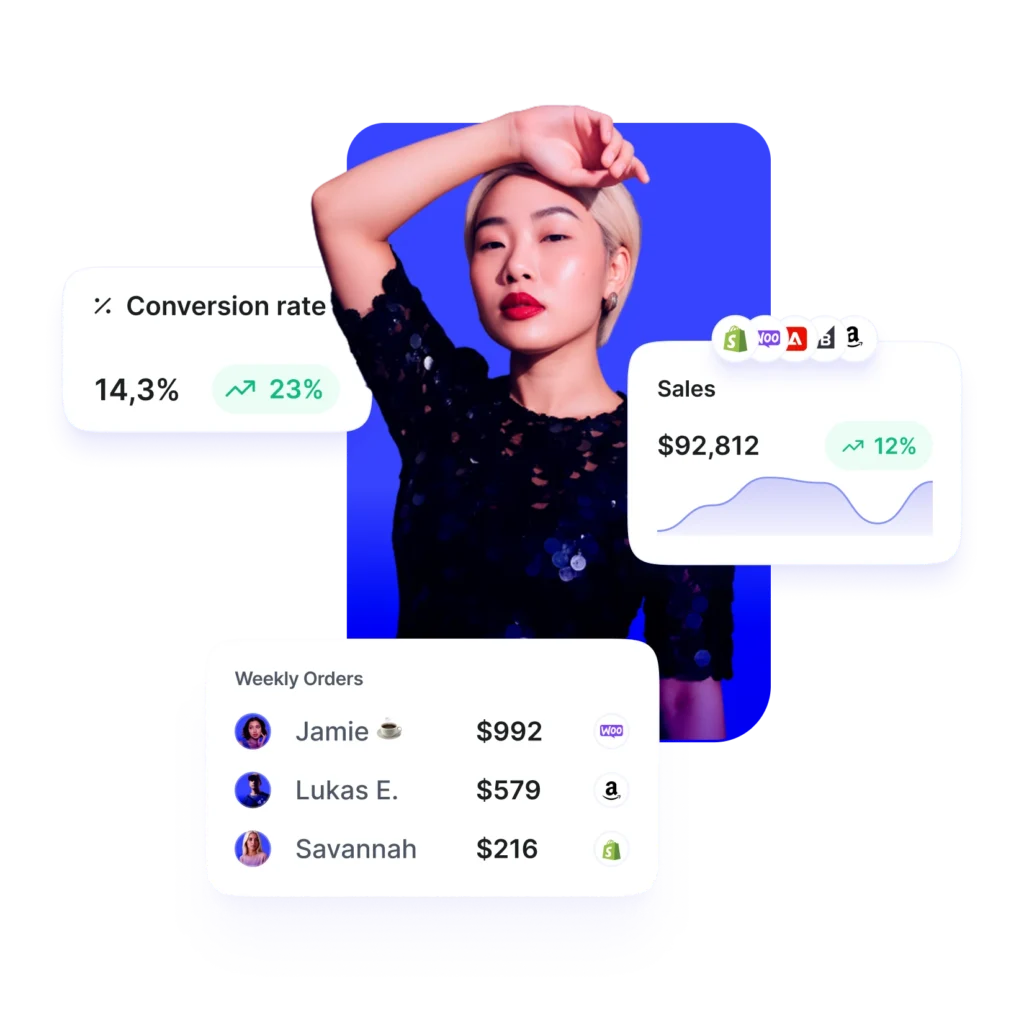
📷 Upfluence sales reporting visual tying creator activity to conversions and revenue. Source: vendor website/documentation.
💚 What we like
Strong commerce stack with sales attribution, promo codes and product shipment workflows.
Creator discovery, marketplace, outreach and relationship management are connected.
Built-in payment and compliance capabilities support scaled programs.
🟠 What to know
Pricing is modular and custom-quoted rather than public.
Upfluence states a 12-month minimum contract, raising commitment for smaller teams.
💡 Why this score: Upfluence scores strongly for ecommerce integrations, revenue attribution and broad creator program operations. The main drag is commercial flexibility: custom pricing and a minimum annual commitment make it less accessible than self-serve alternatives.
💰 Pricing: Custom modular quote. Upfluence says its minimum contract is 12 months; a configured free trial is available after an initial call.
✅ Best fit: Established ecommerce teams that want creator and affiliate activity tied directly to sales across multiple commerce platforms.
🚫 Less ideal for: Early-stage teams that need transparent month-to-month pricing or a simple discovery-only product.
🧩 Key capabilities
Creator discovery and marketplace
Bulk outreach and AI assistance
Campaign and creator CRM
Ecommerce integrations and gifting
Affiliate attribution and discount codes
Creator payments and sales analytics
🔎 Official sources: Product · Pricing · Documentation
6️⃣ 6. CreatorIQ
88/100 · 💰 Enterprise · 🧩 Advanced · 🏢 Enterprise · ⚙️ Guided
🎯 Best for: Global enterprise creator programs needing governance, safety, workflows and reporting
⚡ Choose CreatorIQ if you operate creator marketing across markets, teams and agencies and need enterprise control.
CreatorIQ is an enterprise creator marketing operating system focused on AI-powered discovery, program management, reporting, brand safety, compliance and enterprise integrations. It is designed for complex organizations that need centralized creator data and workflows across teams and regions.
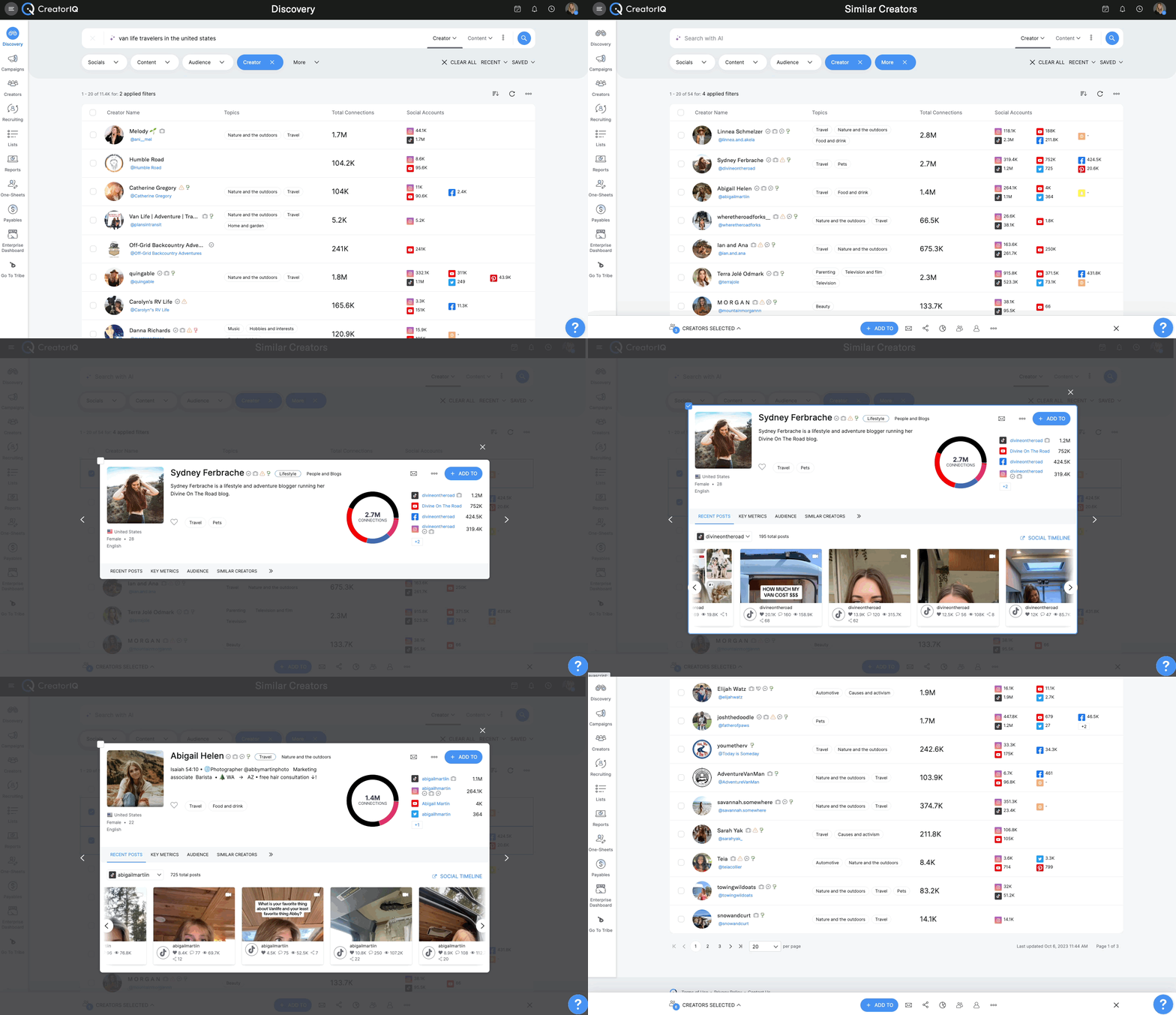
📷 CreatorIQ discovery interface illustrating AI-assisted similar-creator recommendations. Source: vendor website/documentation.
💚 What we like
Deep enterprise governance and workflow capabilities for complex organizations.
Strong discovery, reporting, competitive benchmarking and brand-safety positioning.
Built to connect creator programs with broader enterprise systems and paid media workflows.
🟠 What to know
Pricing is not publicly listed and requires sales engagement.
The platform is likely excessive for a small ecommerce team running occasional campaigns.
💡 Why this score: CreatorIQ scores highly on enterprise depth, governance and measurement, but its buying motion and complexity reduce its value for smaller ecommerce teams. It is strongest when creator marketing is already a global operating function.
💰 Pricing: Custom enterprise quote; pricing is handled through sales.
✅ Best fit: Global brands and agencies coordinating creator programs across markets, teams and business units with governance and compliance requirements.
🚫 Less ideal for: Smaller ecommerce brands that prioritize quick setup, transparent pricing and simpler workflows.
🧩 Key capabilities
AI creator discovery
Creator management and campaign execution
Brand safety and compliance
Enterprise governance
Reporting and benchmarking
Enterprise integrations
🔎 Official sources: Product · Pricing · Documentation
7️⃣ 7. Traackr
87/100 · 💰 Enterprise · 🧩 Advanced · 🏢 Enterprise · ⚙️ Guided
🎯 Best for: Data-heavy global creator strategy, benchmarking and program measurement
⚡ Choose Traackr if your team prioritizes market intelligence, creator analytics and cross-market measurement.
Traackr combines influencer intelligence with creator discovery, activation and measurement. Its current platform centers on Abigail, an AI creator marketing strategist, alongside competitive benchmarking, audience quality analysis, brand safety, social listening and global market data.
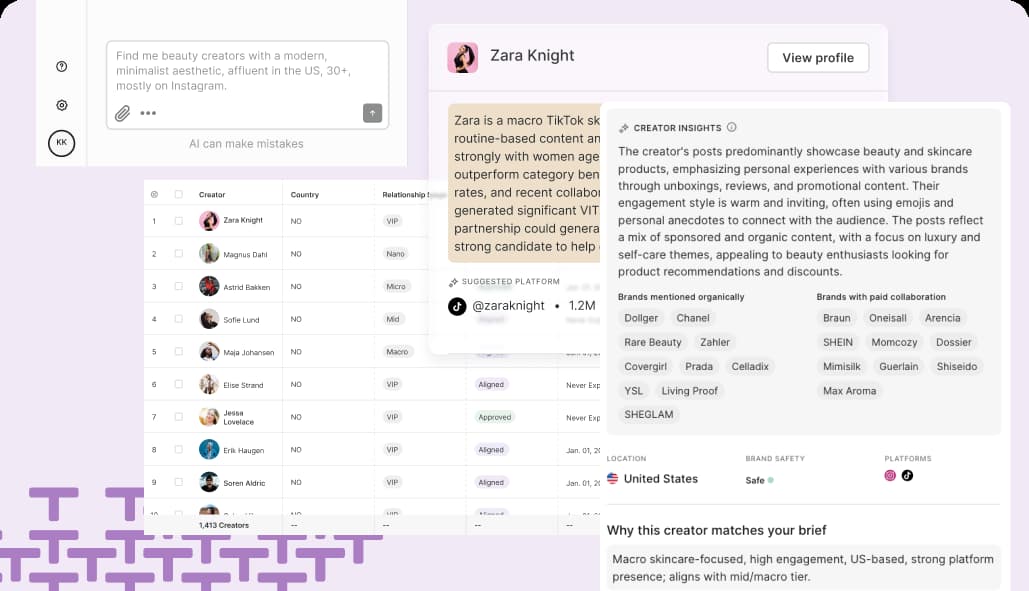
📷 Traackr planning interface supporting creator selection and campaign strategy. Source: vendor website/documentation.
💚 What we like
Strong strategic intelligence, competitive benchmarking and measurement depth.
Discovery includes audience quality, predictive signals and brand-safety analysis.
Designed for large programs operating across many markets.
🟠 What to know
Pricing is sales-led and not publicly disclosed.
The analytics-heavy enterprise approach can be overkill for teams focused mainly on gifting or affiliates.
💡 Why this score: Traackr scores well for strategic intelligence and measurement, especially for global teams. It ranks below commerce-first leaders because ecommerce execution is less central than creator intelligence, planning and benchmarking.
💰 Pricing: Custom quote; Traackr directs buyers to a platform specialist for package and pricing details.
✅ Best fit: Enterprise creator teams that need competitive intelligence, global benchmarking and sophisticated measurement before and after activation.
🚫 Less ideal for: Smaller DTC teams seeking a lightweight Shopify-centric operating tool.
🧩 Key capabilities
Creator intelligence and discovery
Competitive benchmarking
Audience quality and safety
Campaign activation workflows
Global program measurement
AI-assisted planning and reporting
🔎 Official sources: Product · Pricing · Documentation
8️⃣ 8. Captiv8
86/100 · 💰 Enterprise · 🧩 Advanced · 🏢 Mid-market–Enterprise · ⚙️ Guided
🎯 Best for: Creator discovery and campaign management with deep data, measurement and paid amplification
⚡ Choose Captiv8 if you need creator discovery, campaign workflows and advanced analytics in one enterprise suite.
Captiv8 offers a unified influencer marketing suite covering planning, discovery, workflow, amplification, payments and measurement. Discovery includes extensive filtering, first-party data and AI-generated signals, while reporting can connect social performance to commerce metrics through integrations.
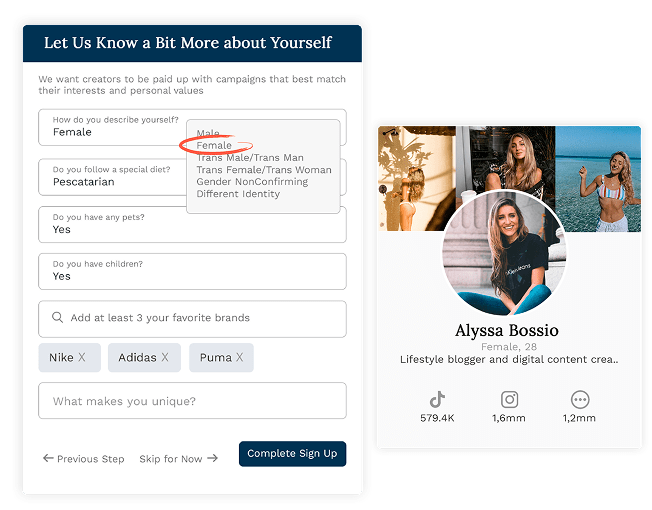
📷 Captiv8 creator profile and first-party data interface used for campaign matching. Source: vendor website/documentation.
💚 What we like
Very broad workflow from discovery through measurement and amplification.
Deep creator data with extensive filters, audience detail and brand-safety signals.
Commerce reporting can integrate Shopify and Refersion data for conversions and commissions.
🟠 What to know
Pricing is not publicly published and generally requires a demo.
Its enterprise feature set is more complex than many ecommerce teams need.
💡 Why this score: Captiv8 scores well for data, discovery and end-to-end campaign management. It sits below the leaders because ecommerce-specific execution and public buying transparency are weaker than the strongest commerce-first options.
💰 Pricing: Custom quote; request a demo for packaging and pricing.
✅ Best fit: Larger brands and agencies needing data-rich discovery, creator workflow, paid amplification and custom reporting.
🚫 Less ideal for: Small brands that mainly want simple gifting, affiliate links and transparent monthly pricing.
🧩 Key capabilities
Creator discovery with 500+ filters
Audience and brand-safety analysis
Campaign workflow management
Paid media amplification
Creator payments
Custom measurement and reporting
🔎 Official sources: Product · Pricing · Documentation
9️⃣ 9. Insense
84/100 · 💰 Mid · 🧩 Easy–Intermediate · 🏢 SMB–Mid-market · ⚙️ No-code
🎯 Best for: UGC and influencer campaigns with a vetted creator marketplace and ad-ready content
⚡ Choose Insense if your priority is sourcing creators and producing UGC or influencer ads quickly.
Insense combines a vetted creator marketplace with campaign briefs, direct communication, content approvals, payments and paid-social creator ad workflows. It is especially strong where influencer marketing overlaps with user-generated content and Meta or TikTok ad production.
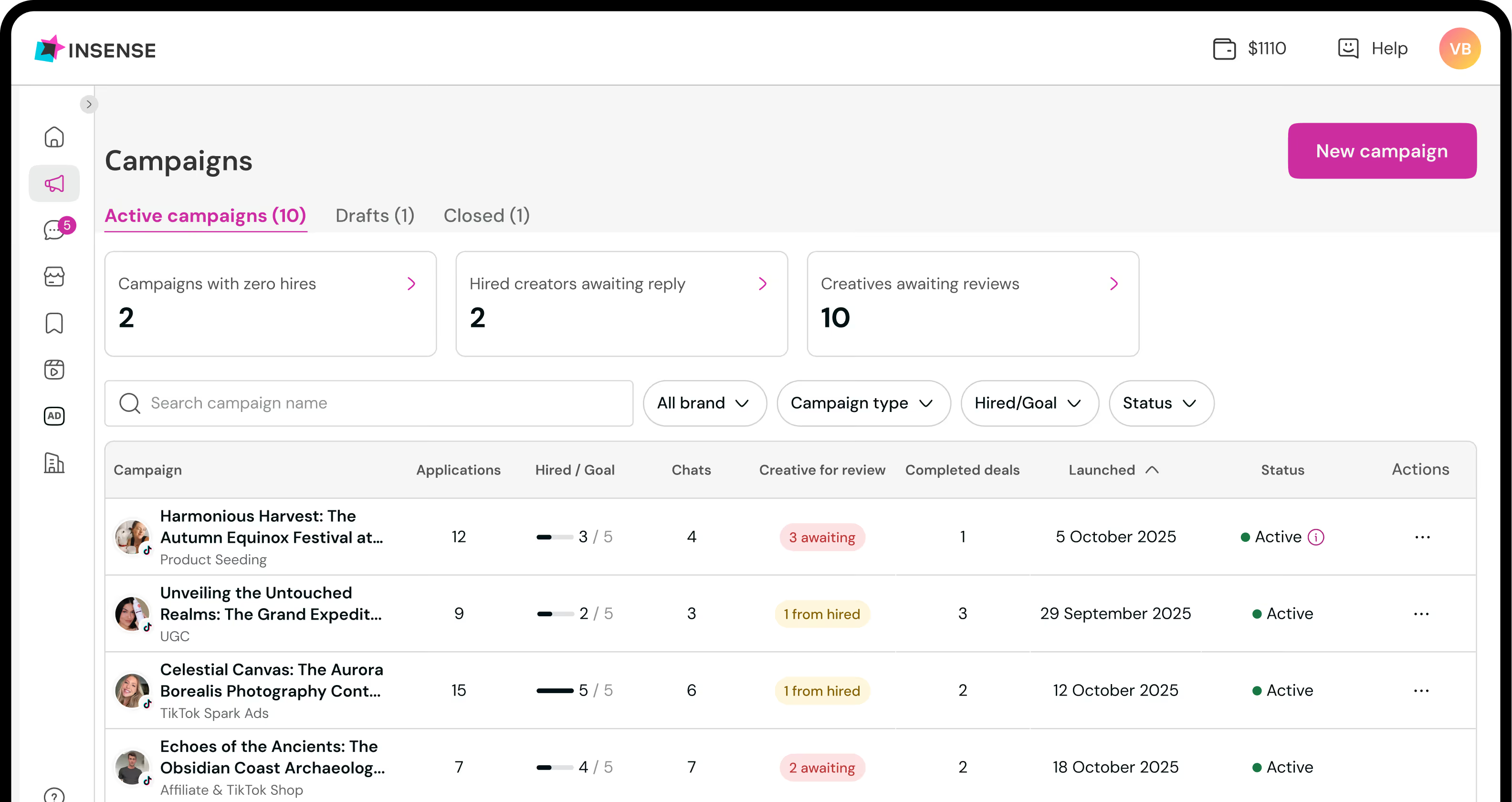
📷 Insense campaign management dashboard for tracking creator applications and deliverables. Source: vendor website/documentation.
💚 What we like
Strong creator marketplace and campaign workflow for content production.
Transparent self-service pricing compared with many enterprise competitors.
Useful fit for brands combining organic creator posts, UGC and paid creator ads.
🟠 What to know
Marketplace and payment fees sit on top of subscription costs.
It is less focused on broad open-web creator intelligence than discovery-first platforms.
💡 Why this score: Insense scores well for practical content and campaign execution, especially when paid creator ads are part of the brief. Fees and a narrower intelligence layer keep it below broader creator operating systems.
💰 Pricing: Brand plan starts at $500/month billed $1,500 quarterly; one-month Trial starts at $650. Brand marketplace fee is 10%; creator payments are separate.
✅ Best fit: DTC brands needing an efficient marketplace for UGC, influencer posts, product seeding and paid creator ad production.
🚫 Less ideal for: Teams whose main need is deep global creator intelligence or enterprise governance.
🧩 Key capabilities
Vetted creator marketplace
Campaign briefs and management
Direct creator chat
Content review and approvals
Meta and TikTok creator ad workflows
Payments and usage rights
🔎 Official sources: Product · Pricing · Documentation
🔟 10. SARAL
82/100 · 💰 Mid · 🧩 Easy–Intermediate · 🏢 SMB–Mid-market · ⚙️ No-code
🎯 Best for: DTC influencer seeding, outreach, creator CRM and affiliate tracking in one system
⚡ Choose SARAL if you run a DTC seeding program and want one workspace for outreach, gifting and affiliate performance.
SARAL is built around DTC creator seeding and relationship workflows. It combines creator discovery, automated outreach, creator CRM, product seeding, affiliate links, content tracking, social listening, payments and Shopify-connected performance analytics in one system.

📷 SARAL influencer seeding workflow showing creator pipeline, performance and conversion data. Source: vendor website/documentation.
💚 What we like
Purpose-built for ecommerce seeding and long-term creator relationship workflows.
Combines outreach, CRM, affiliate tracking, content and performance analytics.
Public annual pricing makes enterprise-style evaluation easier.
🟠 What to know
Entry pricing is materially higher than self-serve tools such as Modash or GRIN Starter.
The product is specialized around DTC workflows rather than broad global enterprise governance.
💡 Why this score: SARAL scores well on practical ecommerce workflows and creator relationship management, but its annual entry price is high relative to smaller self-serve alternatives. It is most compelling when product seeding is already a serious acquisition channel.
💰 Pricing: Starter $12,000/year; Business $15,000/year; Professional $25,000/year. Higher tiers increase creator and seat capacity.
✅ Best fit: DTC brands running systematic seeding, affiliate and creator relationship programs that want to replace spreadsheets and point tools.
🚫 Less ideal for: Very small teams testing influencer marketing for the first time with limited budget.
🧩 Key capabilities
Creator discovery
Automated outreach and follow-ups
Creator relationship management
Product seeding workflows
Affiliate links and commission tracking
Shopify performance analytics
🔎 Official sources: Product · Pricing · Documentation
🎯 Which tools should you actually shortlist?
Start with GRIN if you want a broad commerce-oriented operating system with public pricing and room to scale.
Shortlist Aspire if inbound creator marketplace applications and structured relationship workflows matter most.
Shortlist Modash if Shopify fit, strong discovery and transparent pricing are priorities.
Use Shopify Collabs if you are Shopify-only and want the simplest creator-affiliate starting point.
Evaluate CreatorIQ, Traackr or Captiv8 if governance, global data and enterprise reporting outweigh price transparency.
Compare Insense and SARAL when content production or DTC seeding is the center of the workflow.
🧪 Run this test before you buy
Run the same small creator campaign in two or three shortlisted platforms. Use the same audience criteria, the same ten to twenty creators and the same product offer. Measure not only discovery quality, but also how many manual steps remain from outreach through gifting, content approval, attribution and payment.
Search for the same five creator profiles and compare audience data quality.
Build one new creator list from scratch using identical criteria.
Send or draft ten personalized outreach messages.
Create a campaign brief and approval workflow.
Test product gifting or seeding from your store.
Create affiliate links or discount codes.
Track content automatically where supported.
Record attributed clicks, orders and revenue.
Test creator payment and compliance steps.
Export a stakeholder-ready performance report.
📏 Record the same things for every vendor: time to first usable creator list, creator match quality, manual touches per campaign, gifting setup time, tracking accuracy, payment friction, reporting quality and total expected annual cost.
🧾 10 questions to ask in every demo
Which creator networks and social platforms are covered by discovery?
How fresh are creator and audience data, and which metrics are first-party?
Can creators work with us without creating a new platform account?
How do Shopify or other ecommerce integrations handle products, orders and discount codes?
Can we attribute revenue to creators, links, codes and campaigns?
What payment, marketplace or transaction fees sit on top of subscription cost?
What are the contract minimums, usage limits and overage rules?
How are content rights, approvals and paid amplification handled?
What brand-safety, audience-quality and fraud controls are included?
What data can we export or access through an API?
❓ Frequently asked questions
What is the best influencer marketing platform for ecommerce?
There is no universal best fit. GRIN, Aspire and Modash cover broad ecommerce operating needs in this comparison, while Shopify Collabs is especially attractive for Shopify merchants that want a low-cost native creator affiliate workflow. Enterprise teams should also evaluate CreatorIQ, Traackr and Captiv8.
Which influencer platform is best for Shopify?
Shopify Collabs is the most native option because it lives inside Shopify and connects directly to products, orders, discount codes and commission payments. Modash and GRIN also have strong Shopify-oriented workflows when you need broader creator discovery and campaign management.
How much does influencer marketing software cost?
Pricing ranges from free entry plans to five-figure annual enterprise contracts. Shopify Collabs is free to install with payment processing fees, GRIN starts free with paid plans from $200 per month, Modash starts from $199 per month on annual billing, while many enterprise platforms use custom quotes.
Do these platforms include creator payments?
Many do, but fee structures vary. Shopify Collabs automates commission payouts through Shopify billing, GRIN includes creator payment workflows, Modash supports global payouts, and Upfluence has built-in payment infrastructure. Always model payment or marketplace fees separately from the software subscription.
Can influencer platforms track ecommerce sales?
Yes. Many creator platforms connect influencer activity to ecommerce outcomes through affiliate links, discount codes, store integrations and campaign attribution. The depth varies, so verify whether the platform can track orders, revenue, commissions and creator-level return on investment in your exact commerce stack.
What should I test before signing a contract?
Use the same creator brief across finalists and compare discovery quality, outreach speed, gifting workflow, content tracking, sales attribution, creator payment steps and reporting. Also verify contract term, usage caps, transaction fees and how easily you can export creator and campaign data.
🔍 About this research
MarketMaze researches and scores each tool using its proprietary scoring methodology. Product details and pricing are checked against official vendor sources. Screenshots are from vendor websites, documentation, official demos, or MarketMaze product captures and are used to illustrate the products being reviewed.
Last research check: 25 September 2026.
MarketMaze may use affiliate links where available. Commercial relationships do not determine inclusion or score.
