
MARKETMAZE · ECOMMERCE TOOLS · RESEARCH
10 Best Ad Libraries & Competitor Ad Research Tools (2026)
Research competing ads, identify creative patterns and build a more evidence-backed inspiration library before producing campaigns. We compared ten official transparency libraries and paid intelligence tools on coverage, search depth, historical visibility, workflow, provenance and pricing.
Updated 25 September 2026 · Pricing and product claims checked against official vendor sources.
👋 New to this category?
Ad libraries show the creatives advertisers are running or have recently run. Official transparency libraries such as Meta, TikTok and Google expose first-party platform data, while paid intelligence tools add broader search, monitoring, history and saved-workspace features. Some commercial products also estimate popularity, spend or performance. Treat those estimates as directional signals, not verified profitability. For ecommerce teams, the practical goal is to spot repeated hooks, offers, formats and landing-page patterns, then test your own versions rather than copy competitors blindly.
🧭 Jump to a tool
🏆 The quick answer
🏆 Best overall
Meta Ad Library
🌱 Best for getting started
TikTok Creative Center
💸 Best value
Google Ads Transparency Center
🏢 Best for larger teams / enterprise
Foreplay
🧠 Best for advanced or technical users
Adbeat
🛍️ Best for ecommerce product research
Minea
MarketMaze take
Start with the official library for the channel you actually buy on, then add a paid tool only when history, monitoring, team organization or broader discovery saves enough research time. Meta, TikTok and Google are strongest for provenance. Foreplay is the best workflow layer for repeated creative research. Minea and PiPiADS suit ecommerce product hunting, while Adbeat and Anstrex make more sense for specialist media formats.
📊 Tool comparison & scores
Rank | Tool | Score | Best for | Pricing |
|---|---|---|---|---|
1 | 94/100 | Teams researching live Facebook and Instagram competitor ads from Meta’s own transparency data. | Free | |
2 | 92/100 | Teams studying high-performing TikTok creative patterns, hooks and formats by region, industry and objective. | Free | |
3 | 90/100 | Teams verifying advertiser activity across Google Search, Display, Gmail and YouTube. | Free | |
4 | 89/100 | Teams that want competitor tracking, ad discovery and a collaborative swipe-file workflow in one workspace. | From $59/mo | |
5 | 87/100 | Ecommerce researchers combining ad discovery with product, store and competitor tracking workflows. | From $49/mo | |
6 | 85/100 | Teams researching TikTok and Facebook ads with ecommerce-focused filters, tracking and product discovery. | From $49/mo | |
7 | 82/100 | Teams that value broad platform coverage across social, video, app and ecommerce ad research. | Free; paid from $69/mo | |
8 | 80/100 | Researchers who want deep Facebook and Instagram search filters, comments and demographic signals. | $149/mo | |
9 | 79/100 | Teams researching competitor display, native and video media buys, publishers and landing pages. | From $249/mo | |
10 | 77/100 | Performance marketers researching native, push, pop and related direct-response advertising ecosystems. | Native from $79.99/mo |
Scores reward useful research coverage, trustworthy data provenance and practical workflows. Commercial performance estimates are treated as directional signals, not verified competitor results.
🧠 How the scoring works
This ranking uses MarketMaze proprietary scoring.
Dimension | Weight | What we look for |
|---|---|---|
Core job performance | 30% | Relevant ad discovery, filtering, history, monitoring and creative inspection. |
Ecommerce fit | 20% | Product, store, offer and landing-page context useful to online sellers. |
Workflow & control | 15% | Saved research, tagging, alerts, collaboration, exports and repeatable competitor workflows. |
Integrations & implementation | 15% | Ease of setup, browser workflow, APIs, extensions and team adoption. |
Pricing & value | 10% | Free access, subscription transparency, usage limits and useful depth per dollar. |
Scale & advanced capabilities | 10% | Cross-channel coverage, history, large datasets, governance, alerts and agency-scale research. |
Data provenance matters in this category. First-party platform libraries score well because they can verify that an ad was served, while modeled spend or performance estimates receive less weight than directly observable evidence.
🤔 Do you even need ad research software?
Probably yes ✅
You launch paid creative every week, track multiple competitors, work across several channels or need a repeatable evidence base for briefs, hooks and offer tests.
Maybe 🟡
You run ads regularly but can still answer most competitor questions with Meta, TikTok and Google’s free libraries plus a simple shared inspiration board.
Probably not yet ⏳
Your ad volume is low, you have only a few direct competitors and creative bottlenecks come from production or measurement rather than missing competitive research.
🥇 1. Meta Ad Library
94/100 · 💰 Free · 🧩 Low · 🏢 Any team running Meta · ⚙️ Browser-based
🎯 Best for: Teams researching live Facebook and Instagram competitor ads from Meta’s own transparency data.
⚡ Choose Meta Ad Library if you need the source-of-truth view of what competitors are actively advertising across Meta.
Meta Ad Library is the official repository for ads running across Meta technologies. You can search by advertiser or keyword, filter by country and category, and inspect active creative directly from the platform that serves it. In the European Union and United Kingdom, Meta also retains broader recent ad history, while political and social-issue ads have longer retention. It is best used to verify what is running, not to infer profitability.
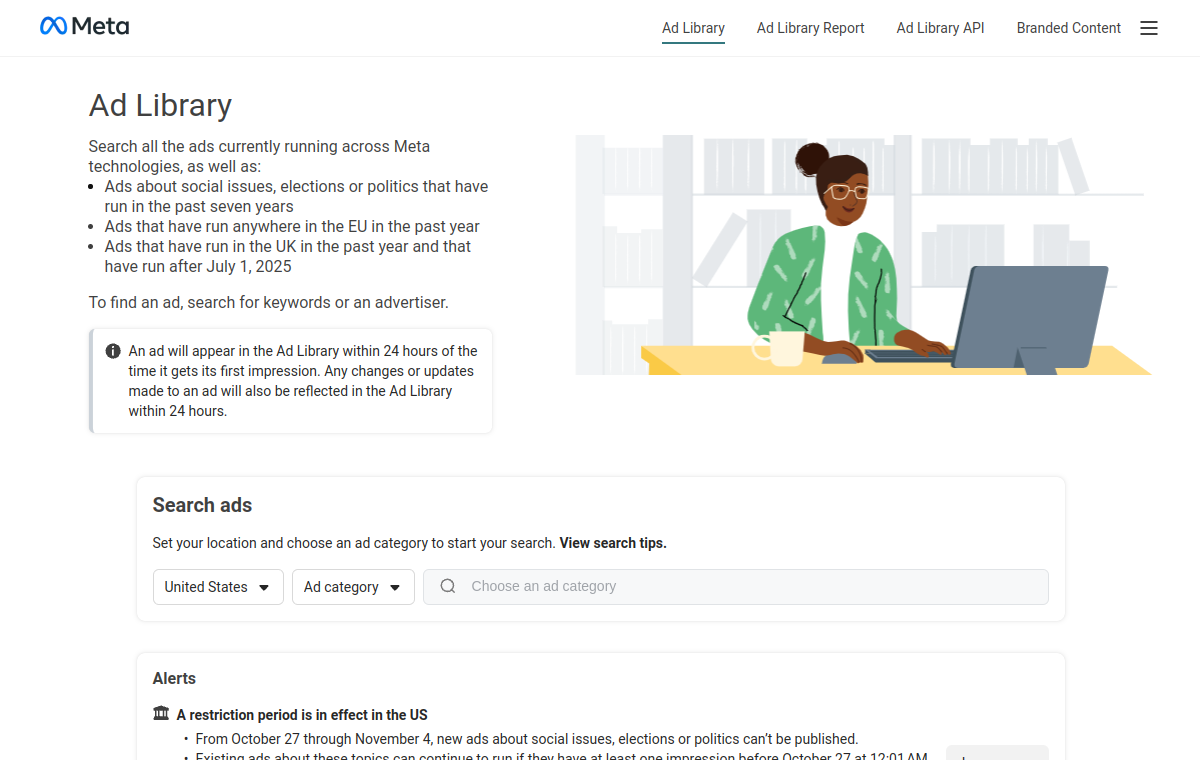
📷 Meta Ad Library shows searchable advertiser creatives and status information directly from Meta’s transparency system. Source: vendor website/documentation.
💚 What we like
First-party Meta data makes it the most defensible source for checking whether a competitor ad is actually running.
Search by advertiser or keyword is fast enough for routine creative reviews without adding another paid subscription.
Regional transparency rules provide extra historical visibility in the European Union and United Kingdom.
🟠 What to know
It does not tell you whether an ad is profitable, and ordinary commercial ads expose limited performance information.
Saved-workspace, tagging and cross-channel research features are much lighter than specialist paid intelligence tools.
💡 Why this score: Meta Ad Library leads because its data provenance is strongest and it is free. It is the best verification layer for Meta competitor research, but it deliberately stops short of profitability claims, deeper team workflows and broad cross-channel intelligence.
💰 Pricing: Free public tool. No software subscription is required to search the Meta Ad Library.
✅ Best fit: Any ecommerce advertiser that spends on Facebook or Instagram and wants a reliable first stop for competitor creative, messaging and offer research.
🚫 Less ideal for: Teams needing cross-channel history, shared swipe-file workflows, estimated spend signals or automated competitor monitoring.
🧩 Key capabilities
Live Meta ad search
Advertiser lookup
Keyword search
Country filtering
Creative inspection
Transparency reporting
🔎 Official sources: Product · Pricing · Documentation
🥈 2. TikTok Creative Center
92/100 · 💰 Free · 🧩 Low · 🏢 TikTok advertisers · ⚙️ Browser-based
🎯 Best for: Teams studying high-performing TikTok creative patterns, hooks and formats by region, industry and objective.
⚡ Choose TikTok Creative Center if you want first-party TikTok inspiration plus frame-level performance signals on authorized Top Ads.
TikTok Creative Center is TikTok’s free public research hub for creative inspiration. Its Top Ads section lets marketers filter authorized high-performing ads by region, industry, objective, date, language and format, then review metrics such as reach, click-through-rate bands and video engagement curves. The important limitation is scope: TikTok states that Top Ads include only ads authorized by advertisers and may not represent every top-performing campaign.
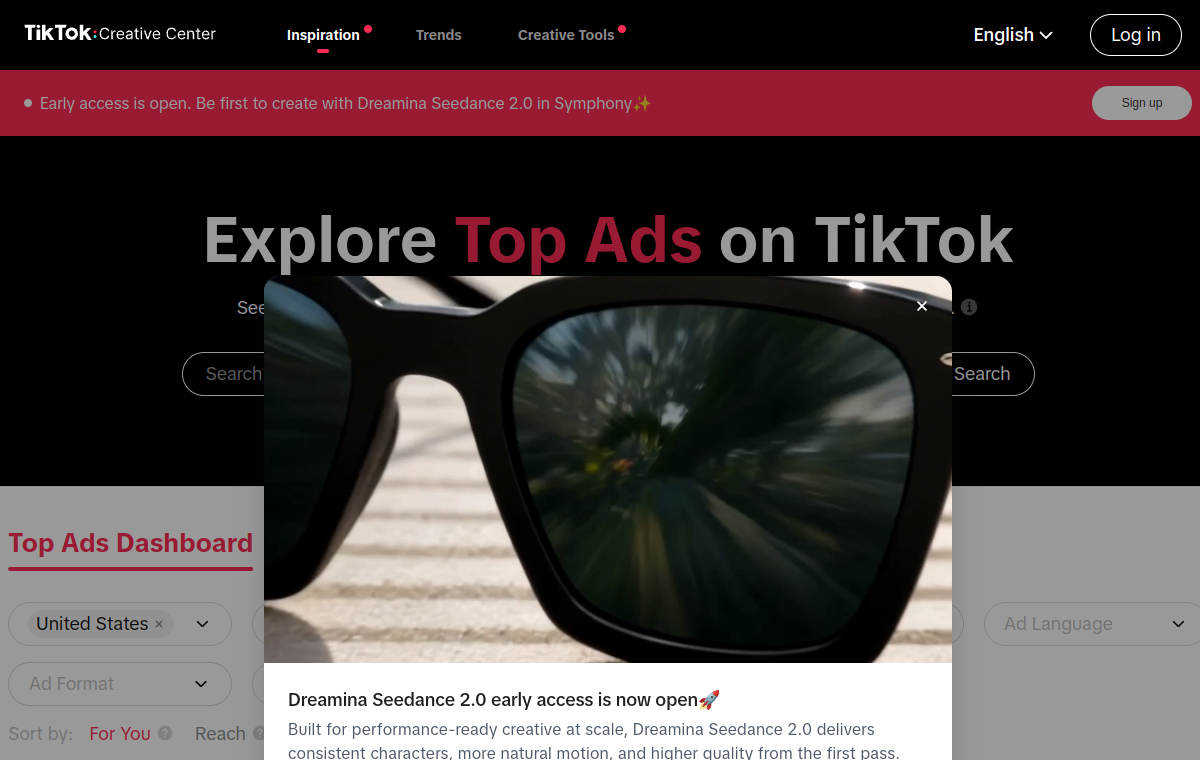
📷 TikTok Top Ads combines region and objective filters with creative cards and performance-oriented analysis views. Source: vendor website/documentation.
💚 What we like
Official TikTok data keeps creative research close to the platform instead of relying only on third-party scraping.
Filters for objective, region, format and timeframe make it useful for building category-specific creative benchmarks.
Frame-level performance views help teams study where attention and conversion signals rise or fall inside a video.
🟠 What to know
Top Ads is curated and authorization-based, so it is not a complete archive of every competitor’s TikTok advertising.
Some deeper browsing requires login, and the tool is designed for inspiration rather than full competitor monitoring.
💡 Why this score: TikTok Creative Center scores highly because it combines trusted first-party creative data with useful performance context at no cost. It is less complete as a competitor archive than dedicated spy tools, but stronger for studying what TikTok itself surfaces as effective creative.
💰 Pricing: Free public resource from TikTok for Business.
✅ Best fit: Ecommerce brands producing frequent TikTok ads and needing evidence-backed references for hooks, pacing, product demos and creative formats.
🚫 Less ideal for: Teams that need exhaustive advertiser histories, cross-platform ad monitoring or persistent shared research workspaces.
🧩 Key capabilities
Top Ads search
Industry filters
Objective filters
CTR ranking
Video key frames
Creative trends
🔎 Official sources: Product · Pricing · Documentation
🥉 3. Google Ads Transparency Center
90/100 · 💰 Free · 🧩 Low · 🏢 Google advertisers · ⚙️ Browser-based
🎯 Best for: Teams verifying advertiser activity across Google Search, Display, Gmail and YouTube.
⚡ Choose Google Ads Transparency Center if you need a first-party record of ads served by verified Google advertisers across major Google surfaces.
Google Ads Transparency Center is Google’s searchable repository for ads served by verified advertisers. You can search by advertiser name or website and filter by details such as date, region and platform. Google covers ads across Search, Display, Gmail and YouTube, with platform filtering available for ads shown from September 4, 2023 onward. Like Meta’s library, it is a transparency tool rather than a performance-estimation product.
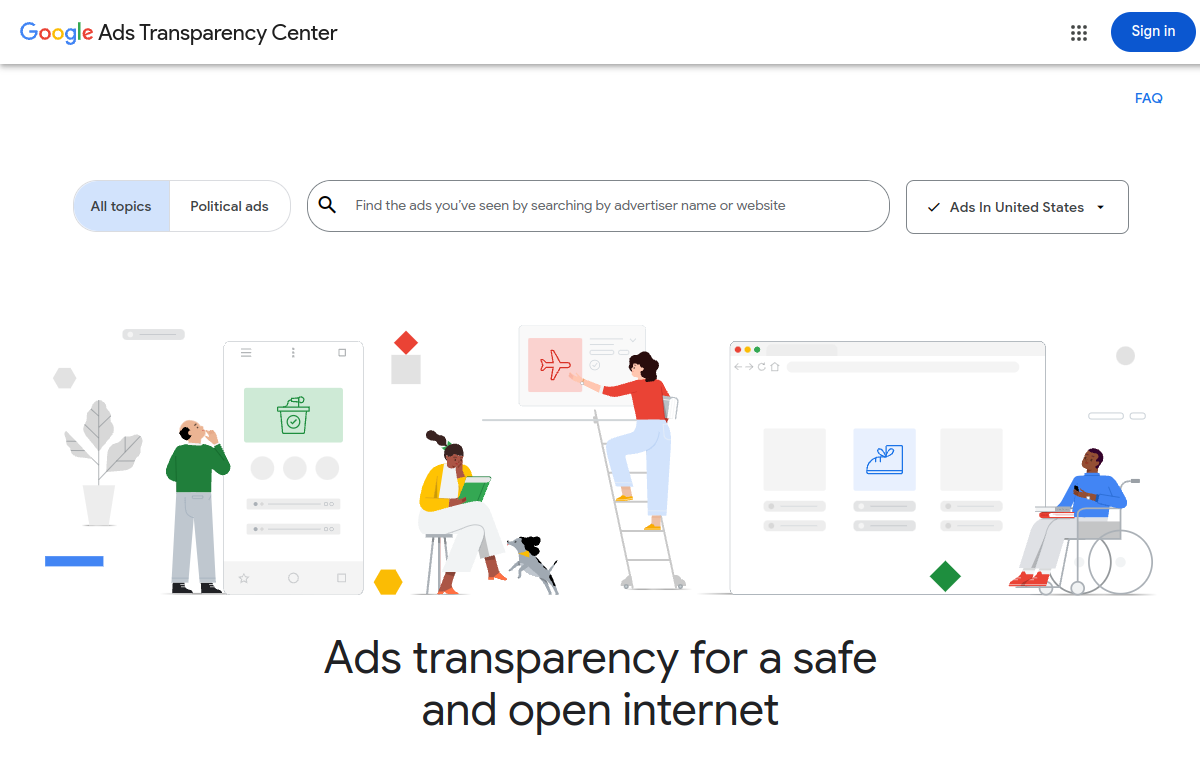
📷 Google Ads Transparency Center lets researchers search verified advertisers and filter visible ads by region and platform. Source: vendor website/documentation.
💚 What we like
First-party advertiser verification and ad records make it a strong source for confirming Google competitor activity.
Search by company or website works well when competitors operate multiple advertiser accounts or destination domains.
Coverage spans Search, Display, Gmail and YouTube rather than forcing separate research tools for each surface.
🟠 What to know
The interface does not provide the spend, return-on-ad-spend or profitability estimates common in commercial intelligence tools.
Historical and platform-filter visibility has policy-defined limits, so it is not a complete lifetime creative archive.
💡 Why this score: Google Ads Transparency Center earns a high score for reliable data provenance, breadth across Google properties and zero cost. It is excellent for verification, but not designed for advanced saved research, team collaboration or inferred competitive performance.
💰 Pricing: Free public tool from Google.
✅ Best fit: Ecommerce teams advertising on Google that need to verify which creatives and formats competitors are actively using by market.
🚫 Less ideal for: Researchers who need estimated media spend, publisher-placement intelligence, alerts or long-term creative libraries.
🧩 Key capabilities
Advertiser search
Website search
Region filters
Date filters
Platform filters
Verified advertiser data
🔎 Official sources: Product · Pricing · Documentation
4️⃣ 4. Foreplay
89/100 · 💰 From $59/mo · 🧩 Medium · 🏢 Creative teams & agencies · ⚙️ Self-serve
🎯 Best for: Teams that want competitor tracking, ad discovery and a collaborative swipe-file workflow in one workspace.
⚡ Choose Foreplay if you want research to flow directly into organized inspiration boards, competitor tracking and creative briefs.
Foreplay combines an ad inspiration library with a structured creative-research workflow. Swipe File saves ads into shared boards, Discovery searches a large community-curated library, and Spyder tracks competitor Meta ads over time with creative tests, timelines and landing-page insights. Lens and Briefs connect research to analysis and production. It is less about claiming exact ad profitability and more about helping teams spot repeated creative patterns and preserve evidence for briefing.

📷 Foreplay connects competitor tracking and creative discovery with saved boards, timelines and reusable ad-research workflows. Source: vendor website/documentation.
💚 What we like
Research, saving, competitor tracking and briefing live in one workflow instead of separate browser tabs and spreadsheets.
Spyder adds historical competitor context, creative timelines and landing-page observations beyond a static ad-library search.
Team boards, tags, comments and briefs make the product particularly useful for agencies and high-output creative teams.
🟠 What to know
Most competitor tracking is strongest around Meta, so teams still need first-party libraries for complete platform verification.
Paid plans add cost relative to free transparency libraries, especially when multiple team seats or brands are required.
💡 Why this score: Foreplay scores highest among paid workflow tools because it turns ad research into a reusable team system rather than just a searchable database. Its biggest limitation is that first-party platform libraries remain necessary for source-of-truth verification.
💰 Pricing: Basic is $59/month, or $49/month on annual billing. Workflow is $175/month and Agency $459/month on monthly billing. A 7-day trial is available.
✅ Best fit: Creative strategy teams and agencies that repeatedly research competitors, save references, brief production and need a shared institutional memory.
🚫 Less ideal for: Solo advertisers who only need occasional checks in free official ad libraries.
🧩 Key capabilities
Swipe-file boards
Ad discovery
Competitor tracking
Creative timelines
Landing-page insights
Creative briefs
🔎 Official sources: Product · Pricing · Documentation
5️⃣ 5. Minea
87/100 · 💰 From $49/mo · 🧩 Medium · 🏢 Ecommerce & dropshipping · ⚙️ Self-serve
🎯 Best for: Ecommerce researchers combining ad discovery with product, store and competitor tracking workflows.
⚡ Choose Minea if you want ad research tied closely to ecommerce products, stores and launch-monitoring workflows.
Minea is built for ecommerce and dropshipping research rather than general brand intelligence. Its workspace combines Meta and TikTok ad discovery with product listings, shop research, brand tracking, saved collections and AI-assisted analysis. That makes it useful when the research question is not only “what ad is running?” but also “what product and storefront sit behind it?” Performance labels and trend signals should still be treated as directional research cues, not audited profit data.

📷 Minea combines ad discovery with ecommerce product and shop research, helping teams trace creative back to the offer. Source: vendor website/documentation.
💚 What we like
Product and shop research add useful ecommerce context around the creative rather than stopping at the ad itself.
Brand tracking and notifications help teams monitor repeated competitor launches instead of running the same searches manually.
Public pricing makes it easier to budget than enterprise intelligence products with sales-led contracts.
🟠 What to know
The product is optimized for ecommerce product hunting, so brand-strategy and enterprise governance features are comparatively lighter.
Performance and trend signals are research proxies and should not be interpreted as verified competitor revenue or profit.
💡 Why this score: Minea scores well because it connects ad discovery with ecommerce product and store context at transparent prices. It is less authoritative than first-party libraries and less collaborative than Foreplay, but stronger for product-led competitive research.
💰 Pricing: Starter is $49/month, Premium $99/month and Business $199/month. Minea also lists lower effective monthly rates on quarterly billing.
✅ Best fit: Ecommerce operators, product researchers and growth teams that want to connect competitor ads with products, stores and launch patterns.
🚫 Less ideal for: Enterprise brand teams needing formal governance, media-spend intelligence or deep cross-channel measurement.
🧩 Key capabilities
Meta ad discovery
TikTok ad discovery
Product research
Shop research
Brand tracking
Saved collections
🔎 Official sources: Product · Pricing · Documentation
6️⃣ 6. PiPiADS
85/100 · 💰 From $49/mo · 🧩 Medium · 🏢 Short-form video teams · ⚙️ Self-serve
🎯 Best for: Teams researching TikTok and Facebook ads with ecommerce-focused filters, tracking and product discovery.
⚡ Choose PiPiADS if you want a large TikTok-focused ad database with Facebook research and ecommerce filters in the same tool.
PiPiADS focuses heavily on TikTok and Facebook advertising research for ecommerce. Its database supports ad search, advertiser analysis, image-based similarity search, ad tracking and product or store research. The platform is useful for finding creative angles and monitoring repeated campaigns, especially in short-form video. As with other commercial ad-intelligence products, engagement or popularity signals are best treated as directional evidence rather than proof of advertiser profitability.

📷 PiPiADS surfaces TikTok and Facebook ads with ecommerce filters, advertiser data and creative research controls. Source: vendor website/documentation.
💚 What we like
Strong TikTok orientation makes it useful when short-form video is a major acquisition channel for the brand.
Image search and similar-ad discovery can uncover creative families that keyword-only research would miss.
Ad trackers and ecommerce filters help move from one-off inspiration toward repeatable competitor monitoring.
🟠 What to know
The credit model means research volume and detail views affect practical monthly usage limits.
Commercial performance signals remain estimates or proxies, so first-party libraries should still verify whether ads are actually running.
💡 Why this score: PiPiADS is a capable short-form and ecommerce research tool with broad filtering and tracking. It ranks below Minea because its credit economics add friction and below official libraries because source provenance is inherently less direct.
💰 Pricing: Basic is currently listed at $49/month, Advanced $99/month, Flexible from $180/month and Enterprise $900/month. A limited free trial with 500 credits is available.
✅ Best fit: Ecommerce media buyers and creative teams running high volumes of TikTok or Facebook research and needing richer filters than official libraries provide.
🚫 Less ideal for: Teams that want unlimited research volume, audited performance data or a primarily display-ad intelligence product.
🧩 Key capabilities
TikTok ad search
Facebook ad search
Image similarity
Advertiser analysis
Ad tracking
Product research
🔎 Official sources: Product · Pricing · Documentation
7️⃣ 7. BigSpy
82/100 · 💰 Free; paid from $69/mo · 🧩 Medium · 🏢 Cross-platform researchers · ⚙️ Self-serve
🎯 Best for: Teams that value broad platform coverage across social, video, app and ecommerce ad research.
⚡ Choose BigSpy if you want one paid database spanning more ad platforms than most ecommerce-focused competitors.
BigSpy is a broad multi-platform ad-intelligence database covering Facebook, Instagram, TikTok, YouTube, Google Ads, X and several additional networks depending on plan. It combines creative discovery with charts, copy research, page and domain analysis, followed entities, external assets and research history. This breadth is useful for teams with diversified acquisition channels, though coverage depth varies by platform and the data should be used as competitive evidence rather than audited campaign results.
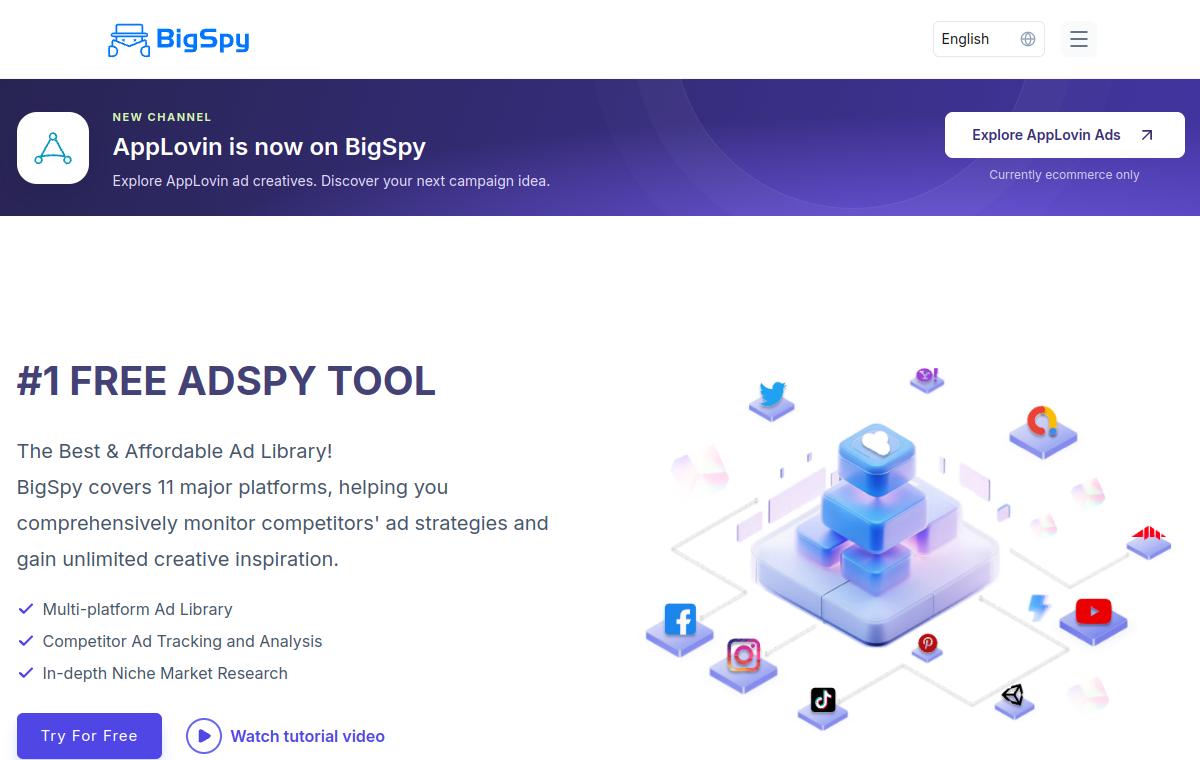
📷 BigSpy’s research workspace spans multiple ad platforms with creative discovery, page analysis and monitoring tools. Source: vendor website/documentation.
💚 What we like
Growth and Ultimate tiers cover a wider mix of major platforms than many single-channel ad-spy products.
Free access makes it possible to test search quality and workflow before moving into a paid subscription.
Followed pages, domains and saved creative workflows support ongoing monitoring beyond one-off competitor searches.
🟠 What to know
The most useful cross-platform coverage begins on higher paid tiers, not the Free or Starter plans.
Depth and freshness can vary by platform, so important findings should be cross-checked against official transparency libraries.
💡 Why this score: BigSpy earns points for breadth, a real free tier and flexible research workflows. It ranks below more focused tools because platform depth is uneven and the strongest multi-channel feature set requires the Growth tier or above.
💰 Pricing: Free plan available. Starter is $69/month, Growth $159/month and Ultimate $499/month, with broader platform coverage and higher download limits on higher tiers.
✅ Best fit: Growth teams or agencies researching competitors across several paid social and video channels rather than only Meta or TikTok.
🚫 Less ideal for: Teams that need first-party provenance, display-specific media-buying intelligence or the deepest TikTok ecommerce specialization.
🧩 Key capabilities
Multi-platform search
Creative charts
Ad copy research
Page analysis
Domain analysis
Followed entities
🔎 Official sources: Product · Pricing · Documentation
8️⃣ 8. AdSpy
80/100 · 💰 $149/mo · 🧩 Medium · 🏢 Meta-focused researchers · ⚙️ Self-serve
🎯 Best for: Researchers who want deep Facebook and Instagram search filters, comments and demographic signals.
⚡ Choose AdSpy if you need unusually granular Meta ad search, including comments, affiliate identifiers and landing-page technology filters.
AdSpy is a long-running Facebook and Instagram intelligence database with a strong search layer. Beyond ad text, advertiser and media type, it supports filters around dates, reactions, demographics, affiliate networks, offer identifiers and landing-page technologies, plus search through comments. AdSpy currently says its index contains more than 211 million ads across 225 countries. It remains powerful for forensic Meta research, although its interface and channel scope are narrower than newer cross-platform tools.

📷 AdSpy provides granular Facebook and Instagram ad search with filters extending into comments, demographics and affiliate data. Source: vendor website/documentation.
💚 What we like
Search-through-comments can reveal customer language and objections that are invisible in the ad creative alone.
Affiliate-network and offer filters make the database useful for performance marketers researching specific promotion ecosystems.
Large international coverage supports market-by-market exploration rather than only United States-focused competitive checks.
🟠 What to know
The product is primarily Facebook and Instagram focused, so it is not a complete cross-channel research stack.
At $149 per month, the value case is harder for teams that can answer most questions with free Meta tools.
💡 Why this score: AdSpy remains one of the deepest Meta-specific databases and its unusual filters are genuinely useful. It ranks lower because channel breadth is limited and its fixed monthly price is significant compared with free official libraries and newer multi-platform alternatives.
💰 Pricing: AdSpy lists virtually unlimited usage for $149/month on its current website.
✅ Best fit: Performance marketers and affiliates who need highly granular Facebook and Instagram search across text, comments, demographics and offer data.
🚫 Less ideal for: Teams focused on TikTok, Google or broad multi-channel creative research with collaborative workflows.
🧩 Key capabilities
Meta ad database
Comment search
Demographic filters
Affiliate filters
Offer-ID search
Landing-page tech
🔎 Official sources: Product · Pricing · Documentation
9️⃣ 9. Adbeat
79/100 · 💰 From $249/mo · 🧩 Advanced · 🏢 Display & media teams · ⚙️ Self-serve / sales
🎯 Best for: Teams researching competitor display, native and video media buys, publishers and landing pages.
⚡ Choose Adbeat if your competitive question is where advertisers buy display media, not only what they post on social feeds.
Adbeat is a display-ad competitive-intelligence platform rather than a social creative library. It tracks advertiser creatives, publishers, ad networks, landing pages and media-buying patterns across desktop and mobile, with support for display, native and higher-tier pre-roll video data. Advanced plans add alerts, comparisons and longer history, while Enterprise includes estimated spend. Those spend figures are modeled estimates and should be treated as directional, not verified advertiser accounts.

📷 Adbeat focuses on display-media intelligence, including creatives, publishers, ad networks, landing pages and competitor comparisons. Source: vendor website/documentation.
💚 What we like
Publisher and ad-network visibility answers media-placement questions that social ad libraries cannot address.
Advanced plans add competitor alerts and side-by-side comparison workflows for regular market monitoring.
Historical depth increases by tier, supporting longer-term analysis of recurring display creative and placement strategies.
🟠 What to know
Entry pricing is high for ecommerce teams whose paid media mix is mostly Meta, TikTok or Google Search.
Estimated spend and campaign intelligence are modeled competitive data, not audited competitor financial records.
💡 Why this score: Adbeat is strong at a different job than most tools here: understanding display and native media strategy. Its specialist value is real, but higher pricing and weaker relevance for social-first ecommerce teams keep it below broader creative research options.
💰 Pricing: Standard is $249/month, Advanced $399/month and Enterprise is custom. Standard includes 90 days of history, Advanced one year and Enterprise three years.
✅ Best fit: Larger advertisers, agencies and media teams with meaningful display or native budgets that need placement, publisher and network intelligence.
🚫 Less ideal for: Social-first ecommerce brands mainly researching Meta or TikTok creative and hooks.
🧩 Key capabilities
Display ad research
Native ad research
Publisher placements
Ad-network analysis
Competitor alerts
Historical comparisons
🔎 Official sources: Product · Pricing · Documentation
🔟 10. Anstrex
77/100 · 💰 Native from $79.99/mo · 🧩 Advanced · 🏢 Native, push & performance · ⚙️ Self-serve
🎯 Best for: Performance marketers researching native, push, pop and related direct-response advertising ecosystems.
⚡ Choose Anstrex if you need specialist intelligence for native or push networks that mainstream social ad libraries do not cover.
Anstrex is a specialist competitive-intelligence suite for native, push, pop and related performance formats, with separate products for different channels. Its Native product advertises coverage across 27-plus native networks and dozens of countries, plus advanced filters, landing-page capture tools and competitor alerts. That makes it useful for direct-response marketers operating outside mainstream social platforms. Because products and pricing are format-specific, buyers should match the subscription to the actual traffic sources they use.

📷 Anstrex Native combines competitor ad search with network coverage, landing-page tools, filters and monitoring. Source: vendor website/documentation.
💚 What we like
Native and push coverage reaches performance-ad ecosystems that Meta, TikTok and Google transparency tools do not address.
Landing-page tools help researchers inspect the full funnel rather than only the ad creative itself.
Competitor alerts and advanced filters support repeatable monitoring for specialized direct-response campaigns.
🟠 What to know
Separate products for native, push, pop and instream research make the overall stack more fragmented than unified competitors.
The tool is specialized and can be irrelevant for mainstream ecommerce teams concentrated on Meta, Google and TikTok.
💡 Why this score: Anstrex is valuable in a narrower specialist segment. It scores lower overall because most ecommerce brands will get more immediate value from mainstream social and Google research tools, but native and push advertisers may find its coverage uniquely useful.
💰 Pricing: Anstrex Native is listed at $79.99/month per user. Push is $89.99/month, Pops $89.99/month and InStream $39.99/month; bundles are available.
✅ Best fit: Affiliate, native and push advertisers that need creative, placement and landing-page intelligence in networks ignored by mainstream transparency libraries.
🚫 Less ideal for: Typical DTC teams whose acquisition is concentrated on Meta, TikTok and Google.
🧩 Key capabilities
Native ad research
Push ad research
Competitor alerts
Landing-page ripper
Advanced filters
Multi-country data
🔎 Official sources: Product · Pricing · Documentation
🎯 Which tools should you actually shortlist?
First-time competitor research: start with Meta Ad Library, TikTok Creative Center and Google Ads Transparency Center before paying for extra data.
High-output creative team: shortlist Foreplay when saved boards, competitor timelines and reusable briefs matter as much as finding the ad itself.
Ecommerce product hunting: compare Minea and PiPiADS when you want products, stores and repeated ad patterns alongside creative search.
Broad paid-social monitoring: BigSpy is worth testing if your team researches several social and video platforms from one database.
Deep Meta forensics: AdSpy is the specialist shortlist when comment search, demographics and affiliate-related filters are central to the research process.
Display, native or push media: compare Adbeat and Anstrex because their strongest intelligence sits outside mainstream social transparency libraries.
🧪 Run this test before you buy
Do not judge an ad-research platform from a curated demo search. Pick the same competitors, markets and date ranges, then run a repeatable research task in every finalist. You are testing coverage, freshness, source clarity and workflow speed. A tool that returns more ads is not automatically better if duplicates, stale records or opaque estimates make it difficult to decide what is real and useful.
Search the same five direct competitors by brand name and destination domain.
Search the same ten product and problem keywords across every supported channel.
Filter to the same country and record how accurately regional ads are isolated.
Compare the last 30 days with older history and note missing or duplicated creatives.
Open ten ads and record whether media, copy, landing page and dates are preserved.
Save the same 20 ads into a research board and test tags, notes and collaboration.
Track one competitor for a week and compare alert speed with the official platform library.
Export or share a competitor review and see how much manual cleanup is required.
Check any spend, popularity or performance estimate against observable first-party evidence.
Time the full workflow from search to a usable creative brief for your production team.
📏 Record the same things for every vendor: relevant ads found, duplicates, freshness, historical depth, channels, filtering accuracy, source transparency, saved-workflow speed, collaboration quality and monthly cost.
🧾 10 questions to ask in every demo
Which data comes directly from ad platforms, which is crawled, and which metrics are modeled estimates?
How often is each supported channel refreshed, and what is the typical delay before a new ad appears?
How much historical data is retained for each platform, country and subscription tier?
Which searches, profile views, exports, downloads or tracked competitors count toward usage limits?
How do you detect duplicates, re-uploads and the same creative running under multiple campaign records?
Can we monitor competitors automatically and control alert frequency, markets and channels?
What collaboration features exist for boards, tags, comments, briefs and sharing with external partners?
Can we export saved ads, metadata and research history if we cancel the subscription?
What application programming interface or integration options exist for our internal creative-research workflow?
What onboarding, support and data-quality escalation process is included at our expected research volume?
❓ Frequently asked questions
What are ad libraries and competitor ad research tools?
Ad libraries let you search advertising creatives associated with brands, keywords, markets or channels. Official libraries are operated by platforms such as Meta, TikTok and Google and expose first-party transparency data. Paid competitor-research tools usually add broader search, historical records, monitoring, saved boards, landing-page context or modeled signals. They are most useful for creative research and competitive pattern detection, not for proving whether a competitor’s campaign is profitable.
What is the difference between an official ad library and an ad-spy tool?
An official ad library is a transparency product run by the advertising platform itself, so its strongest advantage is provenance: it can verify that an ad was served under that platform’s rules. An ad-spy tool is a commercial research database that may collect, index or model data across multiple sources. It can offer better search and workflow features, but its coverage and performance estimates should be validated against official sources when the distinction matters.
What is the best ad research setup for Meta advertisers?
Start with Meta Ad Library because it is free and first-party. Use it to verify active competitor creatives, advertisers and regional visibility. Add Foreplay when your team needs persistent swipe files, competitor tracking, shared boards and creative briefs, or AdSpy when granular Meta-specific search is the priority. A paid layer is most useful when repeated manual research in the official library starts consuming meaningful team time.
How much do competitor ad research tools cost?
Official libraries from Meta, TikTok and Google are free. Paid tools in this comparison start around $49 per month for products such as Foreplay on annual billing, Minea and PiPiADS, while broader or specialist databases can range from roughly $69 to $399 per month before enterprise tiers. Costs can also depend on seats, tracked brands, data history, search credits, exports and channel coverage, so compare practical usage limits rather than only headline price.
How difficult are ad intelligence tools to implement?
Most products here are browser-based and require little technical implementation. The harder work is operational: agreeing which competitors to monitor, how to tag creative patterns, what counts as evidence and how research feeds into briefs and testing. Advanced teams may also use application programming interfaces, exports or browser extensions. If the workflow is not defined, adding a larger database can create more saved ads without improving creative decisions.
Can ad-spy tools tell which competitor ads are profitable?
Not reliably. Official transparency libraries generally show whether ads are running and may expose dates, formats or limited delivery information, but not competitor profit. Commercial intelligence tools can estimate spend, popularity or momentum using their own data and models. Those signals can help prioritize what to inspect, but they are not audited return-on-ad-spend figures. Treat longevity, repetition and estimated performance as hypotheses to test, not proof that an ad is profitable.
🔍 About this research
MarketMaze researches and scores each tool using its proprietary scoring methodology. Product details and pricing are checked against official vendor sources. Screenshots are from vendor websites, documentation, official demos, or MarketMaze product captures and are used to illustrate the products being reviewed.
Last research check: 25 September 2026.
No vendor paid to be included or ranked on this page.

