
MARKETMAZE · ECOMMERCE TOOLS · RESEARCH
10 Best Paid Advertising Management & Optimization Tools for Ecommerce (2026)
Paid advertising management tools help ecommerce teams coordinate campaigns, automate repetitive optimization and control budgets across social, search and retail-media channels. This guide compares ten leading options by channel coverage, workflow depth, ecommerce fit, pricing and the scale of operation they are designed to support.
Updated 25 September 2026 · Pricing and product claims checked against official vendor sources.
👋 New to this category?
Advertising management software sits on top of the ad platforms where your campaigns actually run. It can centralize account views, automate bids and budgets, coordinate creative, apply rules and bring reporting into one workflow. It does not replace your Google, Meta, TikTok, Amazon or retailer ad accounts. The biggest buying mistake is comparing different lanes as if they do the same job: enterprise omnichannel platforms, retail-media tools, Meta automation and PPC management solve overlapping but different operating problems.
🧭 Jump to a tool
🏆 The quick answer
🏆 Best overall
Smartly
🌱 Best for getting started
AdScale
💸 Best value
Bïrch
🏢 Best for larger teams / enterprise
Skai
🧠 Best for advanced or technical users
Optmyzr
🛒 Best for retail media marketplaces
Pacvue
MarketMaze take
Start by choosing the lane, not the logo. Smartly and Skai are enterprise operating layers; Pacvue, Perpetua and Quartile are strongest when retail media is central; AdScale is ecommerce-first for Google and Meta; AdRoll adds programmatic retargeting; Madgicx and Bïrch focus on performance automation; Optmyzr is built for hands-on PPC operations. Compare each shortlist at your real monthly media spend, because several products scale pricing with ad spend.
📊 Tool comparison & scores
Rank | Tool | Score | Best for | Pricing |
|---|---|---|---|---|
1 | 94/100 | Enterprise ecommerce teams unifying creative production, media execution and cross-channel budget optimization. | Custom quote | |
2 | 93/100 | Enterprise teams coordinating paid search, social and retail media across many publishers and retailers. | From $114k/year | |
3 | 91/100 | Brands and agencies centralizing retail-media advertising across Amazon, Walmart and other marketplaces. | Custom quote | |
4 | 89/100 | Amazon-first sellers and brands automating sponsored advertising with explicit budget and efficiency goals. | From $250/month | |
5 | 88/100 | Brands wanting AI-driven retail-media optimization combined with strategic support across commerce advertising channels. | Custom quote | |
6 | 86/100 | Shopify merchants wanting one ecommerce-focused workflow for Google and Meta campaign automation. | From $169/month | |
7 | 84/100 | Ecommerce stores adding retargeting, display, native, video and connected-TV campaigns around existing acquisition. | Free to install | |
8 | 83/100 | Meta-focused ecommerce teams wanting AI recommendations, automation, creative workflows and first-party tracking. | From $99/month | |
9 | 82/100 | Paid-search and shopping teams that want automation, audits, safeguards and portfolio-level control. | Spend-tier pricing | |
10 | 80/100 | Performance teams building granular automated rules across Meta, Google, Snapchat and TikTok. | From $49/month |
Prices are in US dollars where an amount is shown. Advertising media spend is separate from software fees. Several vendors scale software pricing with managed ad spend or use custom contracts, so validate the exact cost at your current and expected spend.
🧠 How the scoring works
This ranking uses MarketMaze proprietary scoring.
Dimension | Weight | What we look for |
|---|---|---|
Core job performance | 30% | Campaign control, budget pacing, optimization depth, bulk actions and useful automation. |
Ecommerce fit | 20% | Product feeds, catalog signals, marketplace data, store integrations and commerce-specific workflows. |
Workflow & control | 15% | Rules, safeguards, approvals, creative operations and visibility into automated decisions. |
Integrations & implementation | 15% | Supported ad channels, account connectivity, data integration and practical onboarding requirements. |
Pricing & value | 10% | Software cost at realistic media spend, transparency and value for the intended buyer. |
Scale & advanced capabilities | 10% | Multi-account governance, retailer breadth, enterprise controls and advanced automation at higher spend. |
Scores are editorial assessments of documented capabilities and buying trade-offs, not measured campaign-performance lifts. We reviewed current official product, pricing and documentation sources. Channel fit is an eligibility question first: a higher score cannot turn a retail-media specialist into a Meta creative suite or a paid-search tool into an Amazon operating system.
🤔 Do you even need ad management software?
Probably yes ✅
You manage several channels, retailers, markets or accounts; meaningful spend is being moved manually; or the team repeatedly rebuilds the same budget, reporting and campaign workflows. A dedicated layer can reduce operational work and add safeguards.
Maybe 🟡
You run one or two mature channels and native tools are still manageable. Test whether external automation materially reduces operator time or improves control before adding another data and billing layer.
Probably not yet ⏳
Your ad spend is small, conversion tracking is not trustworthy, or campaign structure changes constantly. Fix measurement and basic channel execution first; automation scales a process, including a weak one.
🥇 1. Smartly
94/100 · 💰 Custom quote · 🧩 High complexity · 🏢 Enterprise brands & agencies · ⚙️ Guided onboarding
🎯 Best for: Enterprise ecommerce teams unifying creative production, media execution and cross-channel budget optimization.
⚡ Choose Smartly if you need one operating layer for creative and media across major paid channels at enterprise scale.
Smartly combines creative production, campaign management, intelligence and optimization across major advertising platforms. Its current platform coverage spans Meta, Google, TikTok, Pinterest, Snapchat, Reddit, YouTube and other channels, with workflows for campaign launches, creative adaptation and budget decisions. The breadth is the main advantage, but it is built for sophisticated advertisers rather than a small store looking for a lightweight Meta or Google helper.

📷 Smartly’s dashboard brings campaign spend and performance into one cross-channel operating view. Source: vendor website/documentation.
💚 What we like
Broad cross-channel coverage reduces the operational cost of switching between native ad managers.
Creative and media workflows sit in the same platform, which is valuable for high-volume ecommerce teams.
Automation covers campaign creation, optimization and budget allocation rather than only reporting or alerts.
🟠 What to know
Pricing is not publicly posted, so teams need a sales process before they can model total software cost.
The platform’s breadth and enterprise workflow make it heavier than necessary for smaller single-channel advertisers.
💡 Why this score: Smartly scores highest for the combination of channel breadth, creative workflow depth, optimization and enterprise controls. It loses points on buying transparency and accessibility for smaller merchants because public pricing is not disclosed and onboarding is sales-led.
💰 Pricing: Custom quote. Smartly does not publish standard self-service plan prices on its public site.
✅ Best fit: Large ecommerce brands and agencies managing substantial paid media across several social, search and video platforms.
🚫 Less ideal for: Small merchants running one or two ad channels with limited spend and a simple campaign structure.
🧩 Key capabilities
Cross-channel campaign creation and management
Creative templates and scaled asset production
Predictive budget allocation and optimization
Unified reporting and performance intelligence
Multi-account and team workflows
Integrations with major paid-media platforms
🔎 Official sources: Product · Platforms · Documentation
🥈 2. Skai
93/100 · 💰 From $114k/year · 🧩 High complexity · 🏢 Enterprise commerce teams · ⚙️ Guided onboarding
🎯 Best for: Enterprise teams coordinating paid search, social and retail media across many publishers and retailers.
⚡ Choose Skai if your media program spans search, social and retail media and you need enterprise governance in one system.
Skai is an enterprise omnichannel marketing platform covering paid search, paid social and retail media. Its current product positions campaign activation, measurement and optimization across hundreds of channels, with Celeste AI and data-centralization capabilities layered over the operating workflow. Public pricing confirms that Skai is aimed at large advertisers: the entry Standard package is six figures per year, so the value case depends on scale, complexity and operational savings.
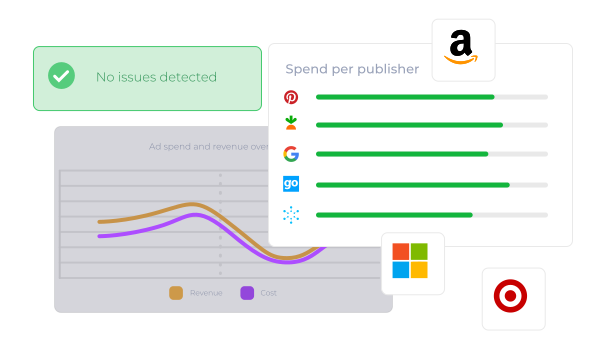
📷 Skai’s omnichannel planning visual shows how publishers and retailers are coordinated through one media workflow. Source: vendor website/documentation.
💚 What we like
Search, social and retail-media workflows can be coordinated inside the same enterprise operating environment.
Public annual pricing makes budget qualification easier than with many enterprise competitors in this category.
Data centralization and AI-assisted workflows support complex programs spread across brands, agencies and regions.
🟠 What to know
The $114,000 annual entry price puts Skai far outside the practical range of most smaller ecommerce operators.
Implementation value depends on having enough channels, accounts and spend to justify a broad enterprise layer.
💡 Why this score: Skai is exceptionally strong on omnichannel breadth, retail-media coverage, data workflows and enterprise controls, with unusually transparent pricing for this tier. It sits just behind Smartly because its scale and six-figure entry point make it less accessible to mid-market ecommerce teams.
💰 Pricing: Standard starts at $114,000/year for up to $4 million in annual ad spend. Advanced starts at $276,000/year; larger tiers scale to enterprise pricing.
✅ Best fit: Large brands, retailers and agencies coordinating many accounts across search, social and retail-media networks.
🚫 Less ideal for: Smaller in-house teams that do not need six-figure software or cross-channel enterprise governance.
🧩 Key capabilities
Paid search campaign management
Paid social campaign management
Retail media activation and optimization
Omnichannel planning and measurement
Centralized marketing data workflows
AI-assisted recommendations and agentic workflows
🥉 3. Pacvue
91/100 · 💰 Custom quote · 🧩 High complexity · 🏢 Retail media brands & agencies · ⚙️ Guided onboarding
🎯 Best for: Brands and agencies centralizing retail-media advertising across Amazon, Walmart and other marketplaces.
⚡ Choose Pacvue if retail media is a core growth channel and you need cross-retailer campaign control tied to commerce signals.
Pacvue is built around commerce media rather than generic paid acquisition. Its retail-media management layer centralizes campaigns across Amazon, Walmart and other marketplaces, while automation can use bids, budgets, inventory, pricing and profitability signals. That makes it especially relevant when marketplace advertising is operationally complex. The trade-off is that Pacvue is a specialized enterprise commerce platform, with pricing handled through sales rather than a simple public subscription.

📷 Pacvue visualizes automated campaign optimization, dayparting and reporting inside a retail-media workflow. Source: vendor website/documentation.
💚 What we like
Retail-media workflows are designed around marketplace signals such as inventory, pricing and buy-box status.
Cross-retailer reporting and budget controls reduce manual work for teams advertising across many commerce networks.
Rules, dayparting and automation provide granular control without forcing every optimization into a black-box model.
🟠 What to know
Public pricing is not disclosed, so total cost has to be validated with Pacvue at your actual retailer mix.
The platform is most compelling for meaningful retail-media programs, not a store focused only on Meta and Google.
💡 Why this score: Pacvue scores highly because its retail-media depth, automation and commerce-data context are difficult for general ad-management suites to match. It ranks below the broader enterprise leaders because the category fit is narrower and public pricing is unavailable.
💰 Pricing: Custom quote. Pacvue does not publish standard subscription prices for its retail-media ad-management platform.
✅ Best fit: Marketplace-heavy brands and agencies managing Amazon, Walmart and other retail-media networks at meaningful scale.
🚫 Less ideal for: Direct-to-consumer brands whose paid acquisition is primarily Meta, Google or TikTok rather than retail media.
🧩 Key capabilities
Cross-retailer campaign management
Rule-based bid and budget automation
Dayparting and keyword harvesting
Inventory and profitability-aware optimization
Cross-retailer reporting and measurement
Amazon, Walmart and marketplace integrations
4. Perpetua
89/100 · 💰 From $250/month · 🧩 Medium complexity · 🏢 Marketplace sellers & brands · ⚙️ Moderate setup
🎯 Best for: Amazon-first sellers and brands automating sponsored advertising with explicit budget and efficiency goals.
⚡ Choose Perpetua if you want goal-based retail-media automation without buying a full omnichannel enterprise advertising suite.
Perpetua focuses on marketplace advertising and is particularly established around Amazon. Merchants set goals such as target advertising cost of sales and daily budgets, while the optimization engine manages bids and campaign activity. Current public pricing starts at $250 per month and scales with managed ad spend and marketplace coverage. That gives marketplace sellers a clearer entry point than many enterprise retail-media platforms, while still supporting increasingly complex programs.

📷 Perpetua’s Amazon advertising workflow centers campaign automation around defined goals, budgets and marketplace performance. Source: vendor website/documentation.
💚 What we like
Goal-based automation translates business targets into ongoing retail-media campaign adjustments.
Published entry pricing gives marketplace sellers a clearer starting point for software-cost planning.
Coverage extends beyond a single campaign type, with support for multiple Amazon ad formats and additional marketplaces.
🟠 What to know
Fees increase with managed spend and marketplace scope, so the effective price should be modeled at growth scenarios.
Its strongest fit is retail media; teams needing broad social creative and omnichannel governance should compare other lanes.
💡 Why this score: Perpetua combines strong marketplace specialization, useful automation and a much more approachable entry price than enterprise retail-media suites. It gives up some points on broad cross-channel coverage and because higher-spend pricing becomes more contract and usage dependent.
💰 Pricing: Starter is $250/month for up to $5,000 monthly ad spend; Growth is $550/month up to $10,000. Higher tiers scale with managed spend and contract terms.
✅ Best fit: Amazon and retail-media sellers that want automated optimization while keeping goals and budgets explicit.
🚫 Less ideal for: Teams looking for one platform to manage broad paid social, search and retail media together.
🧩 Key capabilities
Amazon sponsored ads optimization
Target ACoS and budget goals
Automated bid and campaign adjustments
Multi-marketplace retail-media support
Performance dashboards and reporting
Managed-spend based scaling options
🔎 Official sources: Amazon product · Fees · Help center
5. Quartile
88/100 · 💰 Custom quote · 🧩 Medium complexity · 🏢 Retail media brands · ⚙️ Guided onboarding
🎯 Best for: Brands wanting AI-driven retail-media optimization combined with strategic support across commerce advertising channels.
⚡ Choose Quartile if you want automated marketplace advertising plus a service layer that helps operate and interpret the program.
Quartile combines an AI-driven retail-media optimization platform with strategic support. Its current materials cover Amazon PPC and DSP alongside Google, Meta, Microsoft Ads, Instacart and other commerce channels, making it broader than a pure Amazon automation tool. The company does not publish standard prices, so buyers need a sales process to understand platform and service economics. It fits teams that value managed expertise alongside automation rather than a purely self-serve rules engine.

📷 Quartile’s official platform visual represents the operating layer used for ecommerce advertising optimization. Source: vendor website/documentation.
💚 What we like
Retail-media specialization is paired with strategic support, useful for brands that want software plus operating expertise.
Coverage reaches beyond Amazon into additional commerce and paid-media channels for a more connected view.
Automation is positioned around continuous optimization rather than requiring teams to manually tune every campaign.
🟠 What to know
No standard public pricing means buyers must compare proposals carefully against media spend and included service levels.
Teams wanting complete hands-on control may prefer a more self-serve rules and workflow product.
💡 Why this score: Quartile scores well for retail-media depth, broader channel coverage and its combination of technology with strategic support. It sits below Pacvue and Perpetua because buying transparency is weaker and the managed-service model may not fit teams that want direct operational control.
💰 Pricing: Custom quote. Quartile does not publish standard self-service subscription prices on its public website.
✅ Best fit: Established ecommerce brands that want retail-media automation together with ongoing strategic support.
🚫 Less ideal for: Small sellers wanting a low-cost self-service tool with transparent monthly pricing and minimal sales involvement.
🧩 Key capabilities
Amazon PPC optimization
Amazon DSP support
Google and Meta advertising coverage
Instacart and commerce-channel support
AI-driven bidding and optimization
Strategic account support

6. AdScale
86/100 · 💰 From $169/month · 🧩 Low complexity · 🏢 Shopify SMB & mid-market · ⚙️ Fast setup
🎯 Best for: Shopify merchants wanting one ecommerce-focused workflow for Google and Meta campaign automation.
⚡ Choose AdScale if you run a Shopify store and want Google and Meta automation tied closely to store data.
AdScale is built specifically around ecommerce advertising and has a direct Shopify integration. The current Shopify listing combines Google Search and Performance Max with Facebook and Instagram campaigns, plus AI creative, reporting, audiences and 24/7 optimization. Pricing starts at $169 per month for up to $1,000 in monthly ad spend and rises with spend bands. That makes AdScale accessible, but also means software cost can become material relative to media spend for smaller accounts.

📷 AdScale shows its 24/7 campaign optimization workflow across Meta and Google advertising. Source: vendor website/documentation.
💚 What we like
Shopify connectivity and store data make the onboarding path more ecommerce-native than generic PPC management tools.
Google and Meta campaign workflows are combined with audiences, creative generation, reporting and continuous optimization.
Pricing is publicly visible, so merchants can estimate software cost before starting a trial or sales conversation.
🟠 What to know
Plan limits are tied to monthly ad spend, so software cost steps up quickly as a merchant scales media.
Channel coverage is narrower than enterprise omnichannel platforms and retail-media specialists in the top half of this list.
💡 Why this score: AdScale scores strongly on ecommerce fit, approachable setup and transparent pricing for Shopify teams. It gives up points on channel breadth, enterprise governance and the spend-band economics that can make the subscription expensive relative to smaller advertising budgets.
💰 Pricing: Basic is $169/month for up to $1,000 monthly ad spend; Growth $249 up to $2,000; Elite $329 up to $3,000. A 14-day free trial is listed.
✅ Best fit: Shopify merchants that want to automate Google and Meta advertising without stitching together several specialist tools.
🚫 Less ideal for: Large multibrand advertisers that need retail media, broad social channels, advanced governance or custom data infrastructure.
🧩 Key capabilities
Google Search and Performance Max
Facebook and Instagram campaigns
24/7 bid and budget optimization
AI image and video ad creation
Ecommerce audience segmentation
Unified store and advertising reporting
🔎 Official sources: Shopify listing · Product · Pricing

7. AdRoll
84/100 · 💰 Free to install · 🧩 Low complexity · 🏢 Ecommerce retargeting teams · ⚙️ Fast setup
🎯 Best for: Ecommerce stores adding retargeting, display, native, video and connected-TV campaigns around existing acquisition.
⚡ Choose AdRoll if you want an ecommerce-friendly retargeting and programmatic layer without replacing every native ad platform.
AdRoll remains most distinctive as an ecommerce retargeting and programmatic advertising layer. Its Shopify app can connect store data for audience segmentation and dynamic product ads, while campaigns can run across display, native, video and connected television. The app is free to install with a $5-per-day minimum campaign budget, though media and other charges may apply. It is useful as an additional reach and retargeting layer rather than a full replacement for paid-search or retail-media systems.

📷 AdRoll’s unified reporting view brings connected advertising integrations and campaign performance into one dashboard. Source: vendor website/documentation.
💚 What we like
Shopify integration makes product feeds, dynamic ads and audience setup relatively approachable for ecommerce teams.
Display, native, video and connected-TV inventory adds reach beyond the standard Meta and Google workflow.
The free-to-install model lowers software friction for merchants that want to test retargeting before committing heavily.
🟠 What to know
Media spend and external charges still apply, so free installation should not be read as free advertising.
It is less suitable as a central operating system for complex search, retail-media or enterprise cross-channel management.
💡 Why this score: AdRoll scores well for ecommerce integration, accessible entry and its established retargeting and programmatic use case. It ranks lower on core category breadth because it is better viewed as a complementary advertising layer than a complete cross-channel campaign-management system.
💰 Pricing: Free to install on Shopify. Ad campaigns require a minimum media budget of $5/day; additional charges may apply.
✅ Best fit: Ecommerce brands that want dynamic retargeting and programmatic reach alongside their existing acquisition channels.
🚫 Less ideal for: Teams needing deep paid-search automation, retailer-specific media controls or enterprise planning across many native platforms.
🧩 Key capabilities
Display and native advertising
Video and connected-TV campaigns
Dynamic product retargeting
Shopify audience segmentation
Programmatic bidding and predictions
Cross-channel reporting and attribution
🔎 Official sources: Ecommerce · Shopify listing · Pricing
8. Madgicx
83/100 · 💰 From $99/month · 🧩 Medium complexity · 🏢 Meta-heavy growth teams · ⚙️ Moderate setup
🎯 Best for: Meta-focused ecommerce teams wanting AI recommendations, automation, creative workflows and first-party tracking.
⚡ Choose Madgicx if Meta is your main paid channel and you want an AI operating layer around optimization, creative and tracking.
Madgicx is increasingly focused on agentic Meta advertising. Its current platform brings together AI recommendations, bulk optimization, automated rules, creative workflows, analytics and first-party tracking around Meta campaigns. Pro Complete starts at $99 per month and scales with monthly Meta ad spend, while additional tracking can add cost. The specialization is valuable for Meta-heavy brands, but it is not the best fit if the core requirement is broad search, marketplace or enterprise omnichannel management.
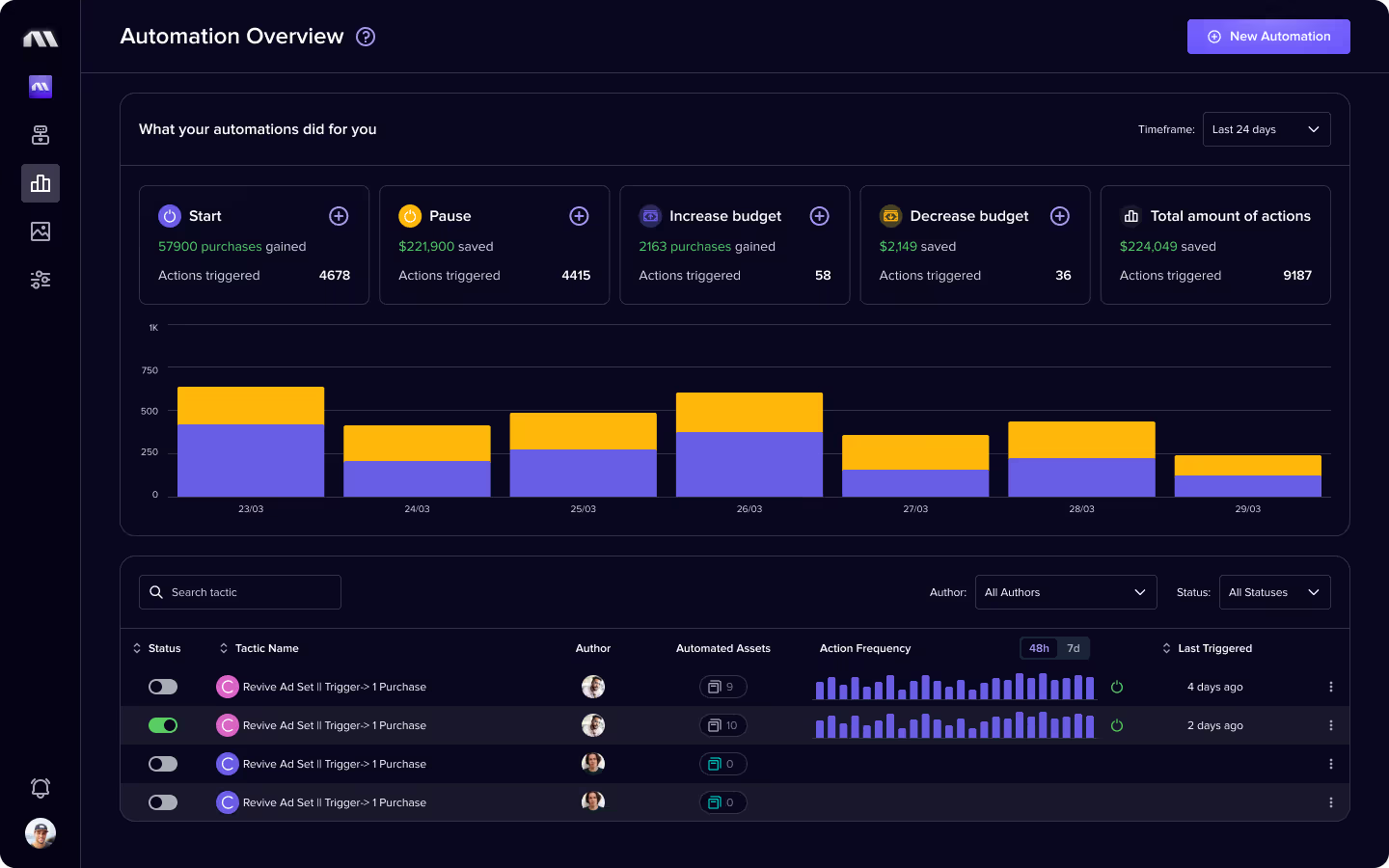
📷 Madgicx illustrates its Meta ad automation layer for rules, monitoring and campaign optimization. Source: vendor website/documentation.
💚 What we like
Deep Meta focus lets the product combine optimization, creative and tracking workflows around one dominant channel.
AI Marketer recommendations and automated rules can reduce repetitive monitoring for in-house growth teams and agencies.
Creative and performance analysis live beside campaign operations instead of being split across unrelated point tools.
🟠 What to know
The platform is intentionally Meta-centric, so buyers with diversified channel mixes may need additional management tools.
Pricing can rise with Meta spend and optional tracking, so compare total cost at current and planned scale.
💡 Why this score: Madgicx earns a strong score for Meta depth, automation, creative tooling and ecommerce relevance. Its narrower channel scope limits the overall category score versus broader platforms, while spend-linked pricing and add-ons require more careful total-cost modeling.
💰 Pricing: Pro Complete starts at $99/month and scales with monthly Meta ad spend. A 7-day free trial is listed; Tracking Pro is a $49/month add-on.
✅ Best fit: Direct-to-consumer brands and agencies where Meta represents a large share of paid acquisition and creative testing.
🚫 Less ideal for: Organizations seeking one operating layer for paid search, retail media and broad social networks together.
🧩 Key capabilities
AI Marketer recommendations
Meta campaign optimization
Automated rules and real-time triggers
Bulk campaign actions
AI creative generation and analysis
First-party Meta tracking
🔎 Official sources: Optimization · Pricing · Academy
9. Optmyzr
82/100 · 💰 Spend-tier pricing · 🧩 Medium-high complexity · 🏢 PPC teams & agencies · ⚙️ Moderate setup
🎯 Best for: Paid-search and shopping teams that want automation, audits, safeguards and portfolio-level control.
⚡ Choose Optmyzr if Google Search, Shopping and Performance Max are operationally complex and you want more control than native automation alone.
Optmyzr is a paid-media management platform with deep roots in Google Search and Shopping, Performance Max and Microsoft Ads, plus growing social and additional channel support. Its strength is operator control: audits, rule engines, budget pacing, campaign automation, dashboards and safeguards sit on top of native ad accounts. Pricing is spend-tiered and public pages dynamically calculate plan amounts, while Enterprise is custom. It is a strong technical choice for teams that manage PPC systematically.

📷 Optmyzr’s paid-media interface brings PPC analysis, optimization and automation controls into one workspace. Source: vendor website/documentation.
💚 What we like
Rule engines and safeguards give experienced media buyers more explicit control over automation and change management.
Budget pacing, audits and multi-account reporting are practical for agencies and in-house teams managing complex portfolios.
Search, Shopping and Performance Max workflows go deeper than ecommerce tools built primarily around Meta automation.
🟠 What to know
The product rewards PPC expertise and can feel more technical than ecommerce-specific tools designed for owner-operators.
Public pricing is spend-tiered and dynamically calculated, so exact cost should be checked at the buyer’s monthly spend.
💡 Why this score: Optmyzr scores strongly on control, paid-search depth, automation and multi-account workflows. It ranks below broader commerce platforms because retail-media depth is lower and the interface is aimed at experienced PPC operators rather than merchants seeking a simple all-in-one acquisition tool.
💰 Pricing: Spend-tier pricing across Essentials, Premium and Enterprise. Enterprise is custom; annual billing currently advertises a 30% discount.
✅ Best fit: Agencies and in-house paid-media teams managing substantial Google, Microsoft and shopping campaign complexity.
🚫 Less ideal for: Small merchants that want a highly guided ecommerce advertising app with minimal PPC knowledge required.
🧩 Key capabilities
Google Search and Shopping optimization
Performance Max management
Microsoft Ads workflows
Rule Engine automations
Budget pacing and safeguards
Cross-account dashboards and reporting
10. Bïrch
80/100 · 💰 From $49/month · 🧩 Medium complexity · 🏢 Performance marketers · ⚙️ Moderate setup
🎯 Best for: Performance teams building granular automated rules across Meta, Google, Snapchat and TikTok.
⚡ Choose Bïrch if you want transparent rule-based automation and budget guardrails without buying a large enterprise media suite.
Bïrch, formerly Revealbot, is a focused advertising automation platform for Meta, Google, Snapchat and TikTok. Its core strength is configurable automated rules: teams can start or pause campaigns, change bids and budgets, duplicate assets and combine nested conditions. Current pricing starts at $49 per month at the displayed $10,000 monthly connected-ad-spend tier, with Pro at $99. That makes it an accessible option for performance marketers who want explicit automation logic and safeguards.

📷 Bïrch shows an automation workflow for moving creative assets into paid-social campaign execution. Source: vendor website/documentation.
💚 What we like
Rules can automate concrete actions such as pausing, scaling budgets, duplicating and responding to performance thresholds.
Pricing is public and considerably easier to trial than enterprise cross-channel suites in this category.
Support for Meta, Google, Snapchat and TikTok covers a useful mix for performance-focused direct-to-consumer teams.
🟠 What to know
It is an automation layer rather than a full creative-production, retail-media and enterprise planning operating system.
Subscription cost scales with connected account spend, so growing advertisers should model the next pricing bands too.
💡 Why this score: Bïrch scores well for accessible pricing, transparent rule automation and practical support across major performance channels. It ranks lower overall because its scope is intentionally narrower than platforms combining creative, retail media, measurement and enterprise omnichannel governance.
💰 Pricing: Essential starts at $49/month and Pro at $99/month at the displayed $10,000 monthly connected-ad-spend tier. Annual billing advertises 20% savings.
✅ Best fit: Hands-on performance marketers that want custom rules and budget controls across several major ad platforms.
🚫 Less ideal for: Enterprise brands needing comprehensive creative operations, retail-media management, data infrastructure and global governance in one suite.
🧩 Key capabilities
Automated performance rules
Budget and bid adjustments
Campaign start, pause and duplication actions
Meta, Google, Snapchat and TikTok support
Nested conditions and rule scheduling
Automation history and performance monitoring
🔎 Official sources: Product · Pricing · Documentation
🎯 Which tools should you actually shortlist?
Cross-channel enterprise brand: start with Smartly and Skai when paid media spans many platforms, regions, teams and approval layers.
Retail media across Amazon, Walmart and other marketplaces: compare Pacvue, Perpetua and Quartile around retailer coverage, operating model and fees.
Shopify merchant running Google and Meta: AdScale offers the most ecommerce-specific entry path in this list.
Retargeting and programmatic reach: evaluate AdRoll as an additional layer around your existing acquisition channels rather than a full replacement.
Meta-heavy performance operation: compare Madgicx and Bïrch on AI recommendations versus explicit rule automation and spend-linked pricing.
Paid search, Shopping and Performance Max operations: Optmyzr is the specialist shortlist for teams that want audits, rules, pacing and safeguards.
🧪 Run this test before you buy
Do not evaluate these platforms from a polished demo alone. Use one representative account, campaign or marketplace and ask each vendor to run the same operating workflow. The goal is to see how much work moves out of spreadsheets and native ad managers, what control you retain, and what the software costs when applied to your real spend.
Connect or mirror one representative ad account with a realistic campaign structure.
Import the relevant product feed, store or marketplace data when the platform supports it.
Recreate one live campaign or campaign template without vendor shortcuts.
Build one budget rule with a hard safeguard and a clear rollback condition.
Apply a bulk change across at least twenty campaigns, ad groups or products.
Run one creative refresh, duplication or localization workflow end to end.
Inspect budget pacing, anomalies, attribution inputs and reporting latency.
Simulate an overspend, stockout or performance-threshold event and inspect the response.
Measure weekly operator time, approval steps and actions that still require native platforms.
Calculate software cost at current media spend and again at twice that spend.
📏 Record the same things for every vendor: supported channels and accounts, time to first live workflow, weekly operator minutes, rule coverage, bulk-edit speed, budget safeguards, creative refresh steps, reporting lag, permissions, and monthly software cost at current and doubled spend.
🧾 10 questions to ask in every demo
Which exact channels and campaign types can the platform create or edit, versus only read and report?
Which optimization decisions are fully automated, recommended for approval, or unavailable?
How does the software fee change when our monthly ad spend increases or temporarily spikes?
Is media spend billed directly by the ad platform, through you, or in a mixed model?
What budget guardrails, approval controls, audit logs and rollback options exist for automation?
Which product-feed, inventory, margin or marketplace signals can influence campaign decisions?
How are multiple brands, regions, agencies and user permissions separated and governed?
Which attribution or measurement inputs affect optimization, and which are reporting-only?
What work is required to migrate our current campaigns, rules, naming and reporting structure?
What data, reports, rules and campaign assets can we export if we leave the platform?
❓ Frequently asked questions
What is paid advertising management software for ecommerce?
It is software that sits above or alongside native advertising platforms to help teams manage campaigns, budgets, creative, rules, reporting and optimization. Ecommerce-focused products may also connect product feeds, store data, inventory, marketplace signals or profitability metrics. The category spans several lanes, so the right shortlist depends on where your advertising actually runs.
Do these tools replace Google Ads, Meta Ads or Amazon advertising accounts?
No. The underlying campaigns still run in the native ad platforms and are subject to their auctions, billing, policies and account structures. Management software connects to those accounts and adds another workflow layer. Before buying, confirm which objects a vendor can create or edit and which data it can only read.
Which tools are designed for Amazon and retail media?
Pacvue, Perpetua and Quartile are the most retail-media-oriented products in this set, with documented workflows around Amazon and additional marketplaces or retailers. Skai also includes retail media inside a broader omnichannel enterprise platform. Compare exact retailer coverage because support can differ by country, ad format and the actions the platform can take.
How much do ecommerce ad-management tools cost?
The range is extremely wide. Bïrch starts at $49 per month at its displayed spend tier, AdScale starts at $169 and Perpetua at $250, while Skai starts at $114,000 per year. Several vendors use custom quotes. Always model platform fees at your current spend and at a realistic growth scenario because many plans scale with connected media spend.
When should I stay with native ad managers instead?
Native tools are often enough when you have limited spend, one or two channels, a small number of campaigns and an operator who can manage them comfortably. Adding software makes more sense when repetitive work, cross-account coordination, budget control, reporting or governance becomes a real bottleneck. Fix measurement first so automation is acting on trustworthy inputs.
How should I evaluate advertising automation safely?
Start with a bounded account or campaign, add hard spend limits, define exactly which actions the software may take and review its audit trail. Test failure cases such as overspend, stockouts and sudden conversion changes. Automation should reduce repetitive work without removing human visibility into why budgets, bids, campaigns or creatives were changed.
🔍 About this research
MarketMaze researches and scores each tool using its proprietary scoring methodology. Product details and pricing are checked against official vendor sources. Screenshots are from vendor websites, documentation, official demos, vendor-maintained app listings, or MarketMaze product captures and are used to illustrate the products being reviewed.
Last research check: 25 September 2026.
This page is editorial research. Vendor links are included as primary sources; rankings are based on the documented capabilities, ecommerce fit and buying trade-offs described above.
