
MARKETMAZE · ECOMMERCE TOOLS · RESEARCH
10 Best Amazon Product Research & Seller Intelligence Tools (2026)
Amazon product research tools help sellers evaluate product opportunities, demand signals, keywords, competitors and sourcing choices before they commit inventory or launch resources. The important distinction is between useful directional evidence and vendor-modeled estimates that should never be mistaken for certified Amazon sales facts.
Updated 26 September 2026 · Pricing and product claims checked against official vendor sources.
👋 New to this category?
Most Amazon research platforms estimate sales, revenue or demand from marketplace signals rather than receiving a certified sales ledger from Amazon. An Amazon Standard Identification Number (ASIN) identifies a catalog item, while Fulfillment by Amazon (FBA) is Amazon’s fulfillment service. Keyword tools estimate how shoppers search; product databases help screen price, competition and category conditions; historical tools show whether today’s snapshot is normal or temporary. For example, a strong-looking kitchen product becomes much less attractive if its price collapses every quarter, search demand is seasonal and the top results are controlled by a few entrenched brands.
🧭 Jump to a tool
🏆 The quick answer
🏆 Best overall
Helium 10
🧭 Best structured validation
Jungle Scout
🏢 Best category & brand intelligence
SmartScout
🔑 Best keyword-led validation
Data Dive
💸 Best value for broad research
SellerSprite
📦 Best for reseller sourcing
SellerAmp
MarketMaze take
The category splits by research job, not by who has the longest feature list. Private-label teams need product, keyword and competitor evidence; agencies may care more about category and brand structure; resellers need sourcing and profitability filters; every seller benefits from historical context. Run the same candidate products through each shortlist tool, record where its estimates come from, and judge whether the workflow makes you more disciplined. A precise-looking revenue number is still an estimate.
📊 Tool comparison & scores
Rank | Tool | Score | Best for | Pricing |
|---|---|---|---|---|
1 | 94/100 | Private-label sellers wanting the broadest Amazon research workflow in one suite | From $129/mo | |
2 | 92/100 | Structured Amazon product validation with clear opportunity filters and seller-oriented workflows | From $49/mo | |
3 | 91/100 | Brand, category and competitive intelligence across the Amazon marketplace | From $49/mo | |
4 | 89/100 | Keyword-led private-label validation and structured competitor research | From $39/mo | |
5 | 88/100 | Broad Amazon product and keyword intelligence at relatively accessible public prices | From $39/mo | |
6 | 87/100 | Beginner-friendly Amazon product discovery with extension-based validation | $59.99 1 month | |
7 | 86/100 | Amazon product research that can sit beside a broader seller analytics workflow | From $29.99/mo | |
8 | 84/100 | Niche discovery and lightweight validation for growing Amazon private-label sellers | Researcher $49/mo | |
9 | 83/100 | Online arbitrage, wholesale and reseller sourcing decisions on Amazon | From $19.95/mo | |
10 | 82/100 | Amazon price history, offer tracking and historical product evidence | €29/mo* |
*Keepa’s subscription page is client-rendered; confirm the live price before purchase.
🧠 How the scoring works
This ranking uses MarketMaze proprietary scoring.
Company-fit tags use small and medium-sized business (SMB) where relevant.
Dimension | Weight | What matters in this category |
|---|---|---|
Core job performance | 30% | Product discovery, keyword and competitor research, sourcing usefulness, historical evidence and decision quality. |
Ecommerce fit | 20% | Amazon marketplace coverage, ASIN workflows, FBA context, seller use cases and relevance to real sourcing or launch decisions. |
Workflow & control | 15% | Filters, saved research, tracking, comparison, collaboration and the ability to move from exploration to a defensible shortlist. |
Integrations & implementation | 15% | Account connectivity, browser extensions, exports, application programming interface (API) access and setup effort. |
Pricing & value | 10% | Public pricing, useful entry tiers, limits and cost relative to the depth of research a seller can actually perform. |
Scale & advanced capabilities | 10% | Historical depth, multi-market coverage, team workflows, advanced datasets, programmatic access and larger-catalog use. |
🤔 Do you even need Amazon product research software?
Probably yes ✅
You repeatedly evaluate products, keywords or suppliers and need a faster, more consistent way to compare demand, competition, price history and opportunity signals.
Maybe 🟡
You sell only a few products and can still validate ideas with Amazon data, spreadsheets and manual competitor checks, but research time is becoming a bottleneck.
Probably not yet ⏳
You have not defined the marketplace, sourcing economics or product constraints. Software will accelerate research, but it cannot replace a viable margin model or supplier reality.
1. Helium 10
94/100 · 💰 Mid · 🧩 Intermediate · 🏢 SMB–Mid-market · ⚙️ Specialist-led
🎯 Best for: Private-label sellers wanting the broadest Amazon research workflow in one suite
⚡ Choose Helium 10 if you want product discovery, keyword research, competitor checks and validation tools under one subscription.
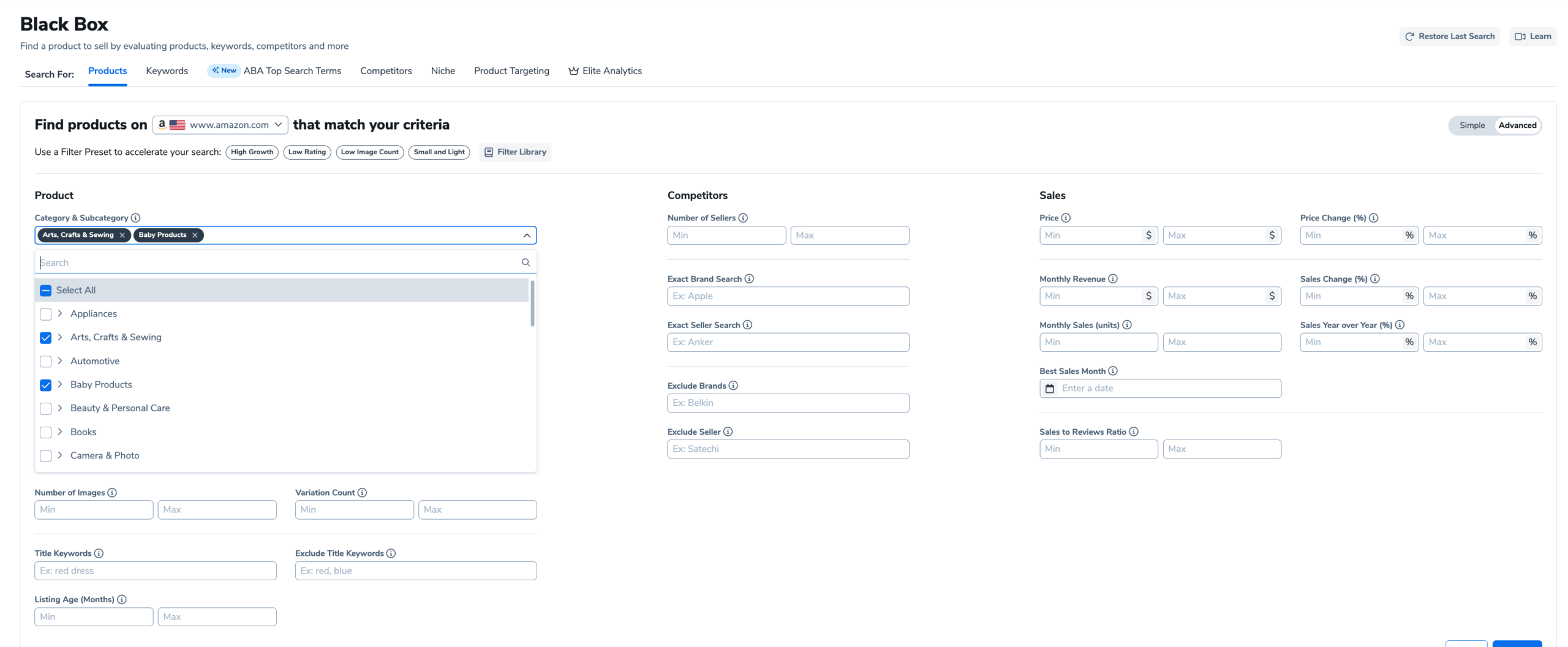
Helium 10 is a broad Amazon seller suite whose research stack centers on Black Box for product discovery and tools for keyword, competitor and niche analysis. Operators can filter opportunities by marketplace, category, price, competition and estimated revenue, then move into keyword validation without changing platforms. That breadth makes it especially useful for private-label teams that want one research workspace rather than a collection of narrow point tools.
📷 Black Box exposes product filters and modeled opportunity signals so sellers can narrow a large Amazon catalog into research candidates. Source: official vendor website/documentation.
💚 What we like
Broad product, keyword and competitor research can live in one operating workflow.
Black Box offers detailed marketplace, category, price, competition and revenue-estimate filters.
Documentation clearly separates simple and advanced research modes, useful as teams mature.
🟠 What to know
The headline demand and revenue figures are vendor estimates, not Amazon-certified sales facts.
The most useful research breadth sits on paid plans, so sellers should test actual usage limits before committing annually.
💡 Why this score: Helium 10 leads because it combines strong product discovery, Amazon-specific keyword depth, flexible workflow controls and mature seller tooling. Its price is meaningful but still accessible to serious operators. The score stops short of perfect because modeled demand data must be treated as directional and the suite can feel dense for beginners.
💰 Pricing: Platinum $129/month or $99/month billed yearly; Diamond $359/month or $279/month billed yearly
✅ Best fit: Private-label sellers, agencies and small or mid-sized Amazon businesses running recurring product and keyword research.
🚫 Less ideal for: Very small sellers who only need one narrow sourcing check or who will not use the wider research suite.
🧩 Key capabilities
Black Box product research
Keyword research and reverse-ASIN analysis
Competitor and niche discovery
Marketplace/category filtering
Historical and trend-oriented research views
Research presets and workflow filters
🔎 Official sources: Product · Pricing · Documentation
2. Jungle Scout
92/100 · 💰 Budget · 🧩 Intermediate · 🏢 SMB–Mid-market · ⚙️ Specialist-led
🎯 Best for: Structured Amazon product validation with clear opportunity filters and seller-oriented workflows
⚡ Choose Jungle Scout if you want a guided path from niche discovery to product tracking and competitive validation.
Jungle Scout remains one of the clearest Amazon-native research environments for sellers who want a structured validation process. Opportunity Finder can narrow niches using units, price, search volume, competition, seasonality and trend filters, while Product Tracker and the browser extension help sellers follow specific candidates. It is less sprawling than some all-in-one suites, which can make the core research job easier to standardize across a small team.
📷 Opportunity Finder combines niche filters, trend signals and competition criteria in a seller-focused research workspace. Source: official vendor website/documentation.
💚 What we like
Opportunity Finder makes the initial niche-screening process easy to explain and repeat.
Product Tracker and extension workflows let teams validate shortlisted products rather than stopping at one search result.
Pricing is public across seller tiers, which makes early budget comparisons straightforward.
🟠 What to know
Search volume, sales and opportunity metrics are modeled signals and should be cross-checked with real marketplace evidence.
Higher-value competitive intelligence sits on the more expensive Brand Owner tier.
💡 Why this score: Jungle Scout scores highly for Amazon fit, clear research workflow and strong product-validation tools. It is particularly good at turning broad exploration into a repeatable shortlist process. Helium 10 edges it on suite breadth and advanced scale, while Jungle Scout remains easier to operationalize for many seller teams.
💰 Pricing: Starter $49/month or $348/year; Growth Accelerator $79/month or $588/year; Brand Owner + Competitive Intelligence $149/month or $1,548/year
✅ Best fit: Private-label sellers and seller teams that want a disciplined product-research process with accessible public pricing.
🚫 Less ideal for: Teams needing the deepest enterprise market mapping or a highly customizable research stack spanning many specialized workflows.
🧩 Key capabilities
Opportunity Finder niche research
Product Tracker monitoring
Browser extension validation
Keyword and search-volume research
Competition and seasonality filters
Marketplace-specific product intelligence
🔎 Official sources: Product · Pricing · Documentation
3. SmartScout
91/100 · 💰 Mid · 🧩 Intermediate · 🏢 Mid-market · ⚙️ No-code
🎯 Best for: Brand, category and competitive intelligence across the Amazon marketplace
⚡ Choose SmartScout if your research starts with categories, brands and competitive landscapes rather than one product idea.
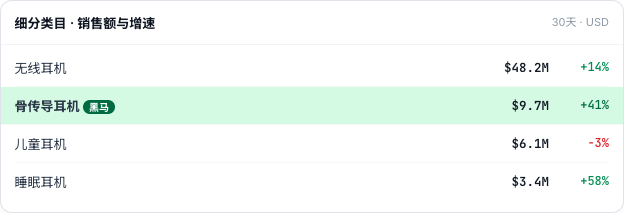
SmartScout is built for sellers and agencies that want to map Amazon markets before choosing a product. Its category, brand, seller and product databases make it easier to see who controls a niche, how categories break down and where competitive concentration sits. That perspective is especially useful for portfolio planning and agency work, where the research question is often broader than “can this single ASIN make money?”
📷 SmartScout’s subcategory research view helps sellers explore category structure and commercial signals before drilling into individual products. Source: official vendor website/documentation.
💚 What we like
Category and brand views are unusually useful for market mapping before individual product selection.
Research spans products, brands, sellers and subcategories instead of forcing every question through one product database.
Business and enterprise tiers support larger research workloads and more advanced operating use.
🟠 What to know
The most distinctive intelligence becomes more valuable as the team learns to interpret category and brand structure.
The primary pricing page differs from an alternate vendor pricing URL, so this handoff freezes the main /pricing page as source of truth.
💡 Why this score: SmartScout earns its position through excellent Amazon market mapping and competitive intelligence. Its category and brand lenses are more strategic than a conventional product finder, which lifts ecommerce fit and scale. It is slightly less beginner-friendly and less price-efficient than simpler research tools, especially when teams need the deeper tiers.
💰 Pricing: Basic $49/month; Essentials $119/month; Business $299/month; Enterprise custom. Annual billing lowers the effective monthly rate.
✅ Best fit: Brands, agencies and established seller teams evaluating categories, competitors, sellers and portfolio opportunities.
🚫 Less ideal for: First-time sellers who mainly need a guided low-cost product finder and basic keyword validation.
🧩 Key capabilities
Category and subcategory research
Brand intelligence
Seller intelligence
Product database
Product history and marketplace views
Competitive landscape analysis
🔎 Official sources: Product · Pricing · Documentation
4. Data Dive
89/100 · 💰 Mid · 🧩 Advanced · 🏢 SMB–Mid-market · ⚙️ Specialist-led
🎯 Best for: Keyword-led private-label validation and structured competitor research
⚡ Choose Data Dive if your product research depends on building a rigorous keyword and competitor model before launch.
Data Dive turns Amazon research into a structured validation workflow built around competitor selection, keyword sets, product scorecards and profitability checks. It is particularly strong for private-label operators who already understand Amazon search mechanics and want to turn that expertise into a repeatable process. The interface and terminology reward specialist knowledge, but the payoff is a tighter connection between competitor research, keyword opportunity and the product concept being evaluated.
📷 The validation scorecard brings competitor, keyword and product signals together for a structured go-or-no-go research decision. Source: official vendor website/documentation.
💚 What we like
The VALIDATE workflow forces research into a repeatable sequence rather than ad hoc browsing.
Competitor selection and master keyword-list building are tightly connected to product validation.
Scorecards and profitability views help teams document why a product idea survives or fails research.
🟠 What to know
This is a specialist workflow; beginners may need more Amazon keyword knowledge before the product becomes intuitive.
Standard is the practical middle tier for heavier research, making Data Dive more expensive than beginner-oriented alternatives.
💡 Why this score: Data Dive scores strongly on core research quality and ecommerce fit because it links keywords, competitors and product validation into one disciplined workflow. It loses points on beginner accessibility and price relative to lighter tools. For experienced private-label operators, however, the specialist control can matter more than broad suite breadth.
💰 Pricing: Starter $39/month; Standard $149/month; Enterprise $490/month. Annual billing shows lower effective monthly rates.
✅ Best fit: Experienced private-label operators, aggregators and agencies with disciplined keyword and competitor research practices.
🚫 Less ideal for: Casual sellers looking for a simple low-cost product database with minimal learning curve.
🧩 Key capabilities
Competitor selection workflows
Master keyword lists
Product validation scorecards
Profitability analysis
Chrome extension research support
AI-assisted product brief workflow
🔎 Official sources: Product · Pricing · Documentation
5. SellerSprite
88/100 · 💰 Budget · 🧩 Intermediate · 🏢 SMB–Mid-market · ⚙️ No-code
🎯 Best for: Broad Amazon product and keyword intelligence at relatively accessible public prices
⚡ Choose SellerSprite if you want extensive Amazon product, keyword and competitor research without premium-suite pricing.
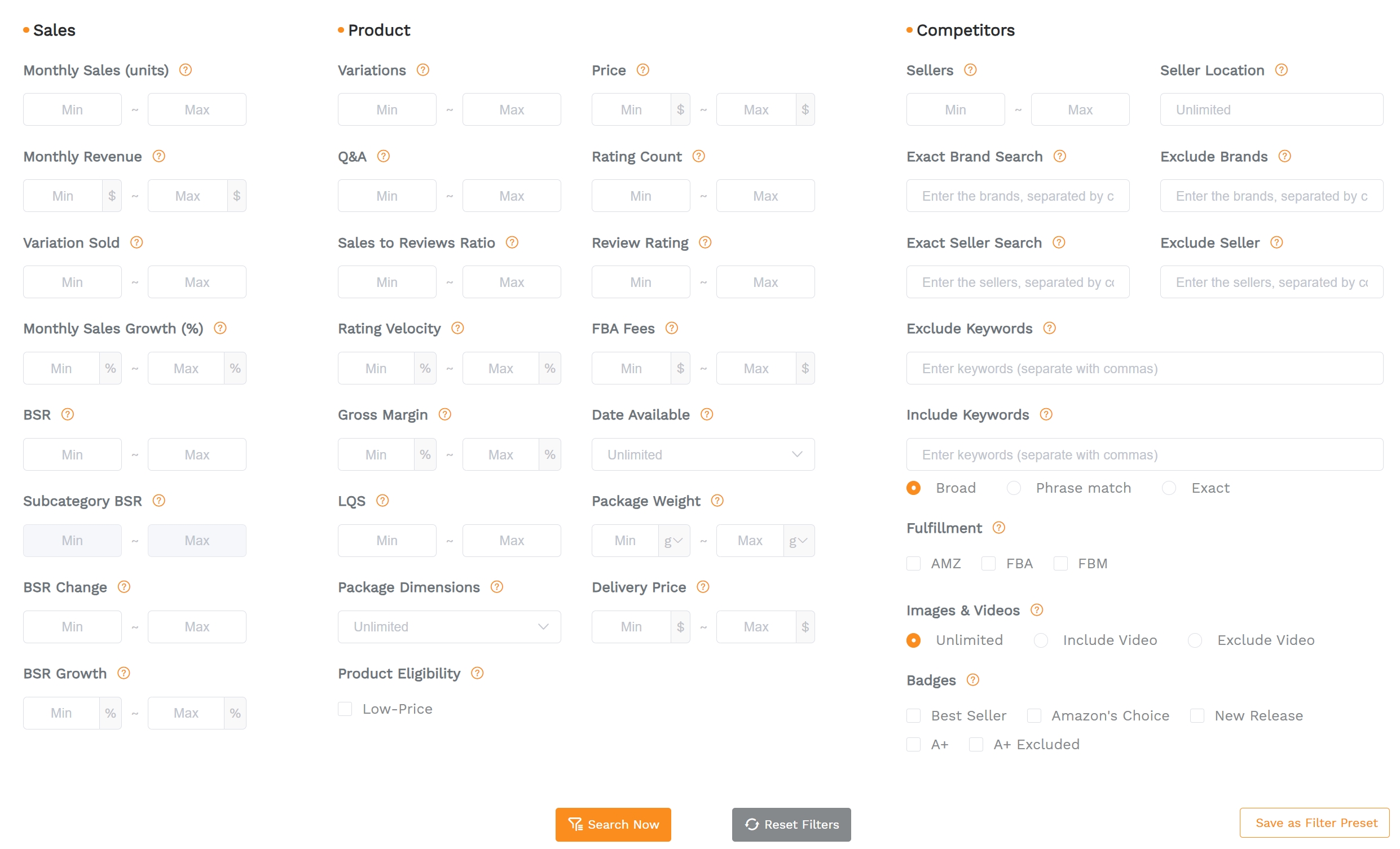
SellerSprite combines product research, keyword discovery, reverse-ASIN research, category insights and competitor tools in a relatively affordable package. It offers enough breadth to support both product selection and listing-oriented keyword work, which makes it attractive for sellers that want one research subscription without paying for a larger seller operating suite. The product can feel dense, but the amount of Amazon-specific data available for the price is difficult to ignore.
📷 SellerSprite’s Product Research view provides detailed filters for narrowing products, categories and competitive conditions. Source: official vendor website/documentation.
💚 What we like
Wide product, keyword, category and competitor coverage at transparent public prices.
Reverse-ASIN and keyword opportunity tools make product research useful beyond the first sourcing decision.
Annual plans are simple to compare and effectively include two months versus monthly billing.
🟠 What to know
The breadth of filters can create a learning curve for sellers who do not yet have a clear research method.
As with other third-party Amazon intelligence products, demand metrics should be treated as estimates and triangulated.
💡 Why this score: SellerSprite combines strong Amazon specificity with unusually good price-to-feature breadth. It scores slightly below the top specialists because workflow polish and ecosystem depth are not as strong as the category leaders. For cost-conscious sellers who still want serious product and keyword intelligence, the value case is compelling.
💰 Pricing: Basic $39/month; Standard $79/month; Advanced $129/month; VIP $189/month. Annual plans are $390, $790, $1,290 and $1,890 respectively.
✅ Best fit: Small and mid-sized Amazon sellers that want broad research coverage with transparent pricing.
🚫 Less ideal for: Teams prioritizing the strongest enterprise support, governance or cross-functional portfolio analytics.
🧩 Key capabilities
Product Research
Keyword Research
Reverse-ASIN analysis
Category Insights
ABA opportunity research
Competitor and traffic comparison
🔎 Official sources: Product · Pricing · Documentation
6. AMZScout
87/100 · 💰 Budget · 🧩 Beginner · 🏢 SMB · ⚙️ No-code
🎯 Best for: Beginner-friendly Amazon product discovery with extension-based validation
⚡ Choose AMZScout if you want an approachable product database and browser extension without a complex operating stack.
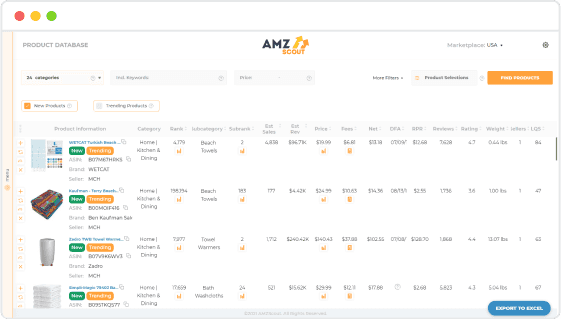
AMZScout focuses on the classic Amazon product-research journey: search a product database, narrow ideas with filters, then inspect candidates directly on Amazon using its PRO AI Extension. It also offers tracking, keyword and competitor-oriented tools, but the product remains approachable for first-time private-label research. Current pricing is packaged as an AI Bundle, making the entry decision simple, although promotional presentation means buyers should confirm the live checkout before paying.
📷 The Product Database gives new sellers a filter-led way to screen Amazon opportunities before deeper validation. Source: official vendor website/documentation.
💚 What we like
Product Database plus browser extension creates a simple discover-then-validate workflow.
The interface is approachable for first-time sellers compared with more specialist research systems.
Current bundle pricing is public and offers monthly, three-month and annual choices.
🟠 What to know
The current pricing presentation is a bundle offer and can change, so annual budgeting should use the checkout price at purchase time.
Advanced portfolio and market-mapping workflows are lighter than tools built for larger seller organizations.
💡 Why this score: AMZScout scores well because it covers the main product-discovery job with a low learning curve and accessible pricing. Its Amazon fit is strong, but advanced workflow control, large-team scale and strategic market intelligence are lighter than higher-ranked products. It is a sensible starting point when simplicity matters more than maximum depth.
💰 Pricing: AI Bundle $59.99 for 1 month, $169.99 for 3 months, or $399.99 for 12 months on the current official offer
✅ Best fit: New and smaller Amazon private-label sellers that want guided product discovery and browser-based validation.
🚫 Less ideal for: Larger brands and agencies needing deep category mapping, governance or advanced team workflows.
🧩 Key capabilities
Product Database
PRO AI browser extension
Product tracking
Keyword research
Competitor research
Profit and opportunity estimation
🔎 Official sources: Product · Pricing · Documentation

7. SellerApp
86/100 · 💰 Budget · 🧩 Intermediate · 🏢 SMB–Mid-market · ⚙️ Specialist-led
🎯 Best for: Amazon product research that can sit beside a broader seller analytics workflow
⚡ Choose SellerApp if you want product research, keyword intelligence and seller analytics from the same Amazon-focused platform.
SellerApp’s product research tools combine filters, opportunity scoring, fee context and estimated sales or revenue signals with broader keyword and seller analytics. That makes it useful for operators who want research to sit near the rest of their Amazon decision-making rather than in a standalone database. The workflow is capable, though the pricing page presents multiple billing views and the research experience is less category-defining than the top specialists.
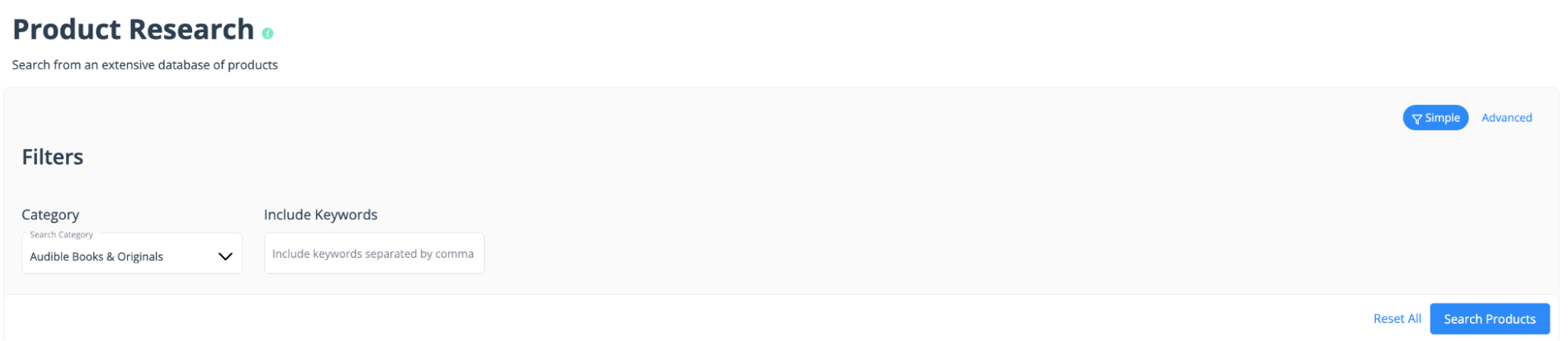
📷 SellerApp Product Research exposes commercial filters and opportunity signals for screening products before deeper analysis. Source: official vendor website/documentation.
💚 What we like
Product filters include ratings, price, category and commercial signals relevant to Amazon sourcing decisions.
Research connects naturally to keyword and seller analytics elsewhere in the platform.
Public tiers provide an accessible entry point before a sales-led Business plan.
🟠 What to know
The pricing page can display different effective rates depending on billing selection, so teams should confirm the selected term.
Opportunity, order and revenue figures are estimates and should not be presented as direct Amazon sales records.
💡 Why this score: SellerApp earns a solid score for Amazon fit and for connecting product research to a wider seller analytics toolkit. Its integration profile and public pricing are good, but the core product-research workflow is less differentiated than the category leaders. Pricing presentation also requires care when comparing monthly versus annual effective rates.
💰 Pricing: Starter from $29.99/month; Essential $49.99/month; Pro $79.99/month; Business contact sales
✅ Best fit: Seller teams that want product discovery and keyword or operational analytics from one Amazon-focused vendor.
🚫 Less ideal for: Buyers whose main need is either beginner-simple product discovery or highly specialized market and keyword modeling.
🧩 Key capabilities
Product Research filters
Opportunity scoring
Keyword research
Competitor intelligence
Fee and profitability context
Product Intelligence analysis
🔎 Official sources: Product · Pricing · Documentation

8. ZonGuru
84/100 · 💰 Budget · 🧩 Intermediate · 🏢 SMB–Mid-market · ⚙️ Specialist-led
🎯 Best for: Niche discovery and lightweight validation for growing Amazon private-label sellers
⚡ Choose ZonGuru if you want a dedicated research tier plus a path into wider seller workflows as your catalog grows.
ZonGuru’s Researcher plan centers on Niche Finder and related validation tools, giving sellers a dedicated entry point before they need the platform’s broader seller operating features. Niche Finder helps surface product opportunities, while Chrome Extension, Niche Rater and Sales Spy support deeper validation and seasonality checks. It is a practical mid-tier choice for private-label teams that want structured research without adopting the largest all-in-one suites.
📷 ZonGuru’s research interface provides Amazon product and competitor signals for deeper validation. Source: official vendor website/documentation.
💚 What we like
A dedicated Researcher plan keeps product discovery separate from full seller-suite pricing.
Niche Finder, extension research and Sales Spy cover discovery, validation and historical checks.
Seller pricing scales by active SKU count, giving growing catalogs a visible upgrade path.
🟠 What to know
Niche Finder data and browser-extension data can refresh on different schedules, so buyers should understand which view is current.
Research session allowances vary by plan, making usage limits important for teams doing high-volume exploration.
💡 Why this score: ZonGuru is a capable Amazon-specific research option with sensible workflow coverage and a dedicated research plan. It trails higher-ranked tools on breadth, advanced control and scale, but remains useful for growing private-label sellers who value a focused niche-discovery process and a clear path into wider seller tooling.
💰 Pricing: Researcher $49/month or $29/month billed annually. Seller plans start at $79/month or $49/month billed annually for 1–20 active SKUs.
✅ Best fit: Growing private-label sellers that want niche research now and may add broader seller workflows later.
🚫 Less ideal for: Enterprise research teams or specialists requiring the deepest category, keyword or reseller-sourcing intelligence.
🧩 Key capabilities
Niche Finder
Niche Rater extension
Sales Spy historical checks
Product opportunity filters
Keyword-oriented research
SKU-based seller plan path
🔎 Official sources: Product · Pricing · Documentation
9. SellerAmp
83/100 · 💰 Budget · 🧩 Intermediate · 🏢 SMB · ⚙️ No-code
🎯 Best for: Online arbitrage, wholesale and reseller sourcing decisions on Amazon
⚡ Choose SellerAmp if your “product research” means sourcing profitable resale opportunities rather than inventing a private-label product.
SellerAmp is the outlier in this list because it is built around sourcing and profitability checks for resellers. Its current Advanced Search can filter Amazon opportunities across more than 200 criteria, including rank, price, offers, brand, category, out-of-stock state and seller details. For online arbitrage and wholesale workflows, that focus is a strength. Private-label teams, however, will find less strategic keyword and category modeling than in the tools above.
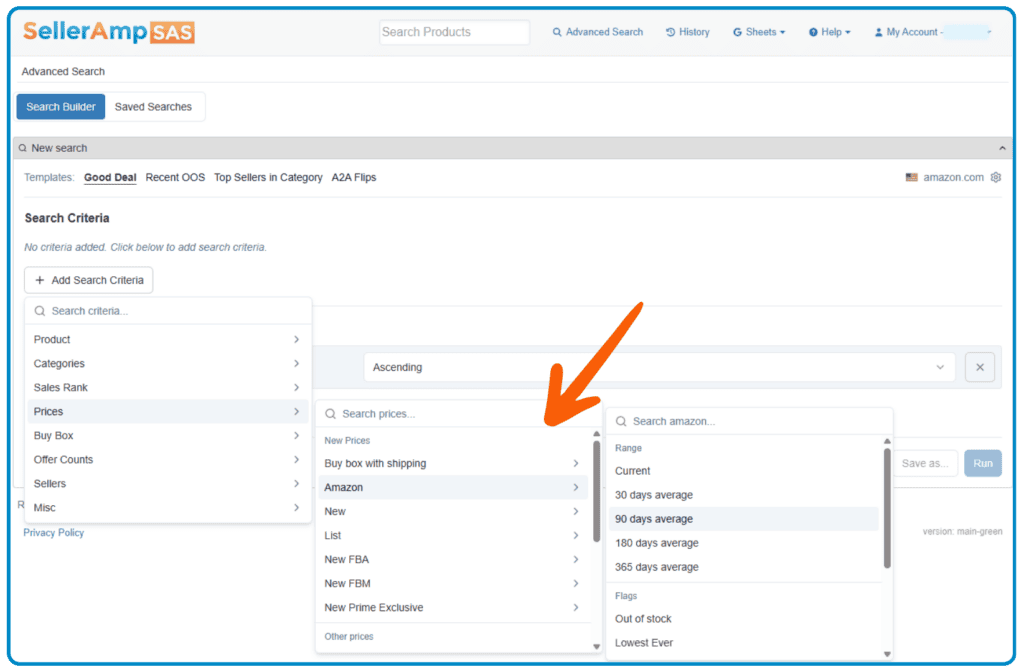
📷 Advanced Search gives resellers a dense sourcing filter set for narrowing Amazon opportunities before a profitability check. Source: official vendor website/documentation.
💚 What we like
Advanced Search supports more than 200 sourcing criteria for reseller-style opportunity discovery.
Pricing is transparent and inexpensive relative to broader Amazon intelligence suites.
Saved searches, custom views and export options support repeatable sourcing routines.
🟠 What to know
Its core job is resale sourcing, not private-label niche creation, so its fit depends heavily on business model.
Advanced team-sharing features sit on higher plans, and strategic keyword research is not the product’s main strength.
💡 Why this score: SellerAmp scores very well on ecommerce fit for resellers, workflow control and value, but lower on the broader core job defined for this page. It is excellent when the research question is “should I source this product?” and much less complete when the question is “which private-label market should we enter?”
💰 Pricing: Getting Started $19.95/month or $199.50/year; Getting Serious $29.95/month or $299.50/year; Going Pro $49.95/month or $499.50/year
✅ Best fit: Online arbitrage, retail arbitrage and wholesale sellers evaluating resale opportunities and profitability.
🚫 Less ideal for: Private-label brands that need deep keyword demand, category strategy and product-concept validation.
🧩 Key capabilities
Advanced sourcing search
Rank and price filters
Offer-count analysis
Seller and brand filters
Saved searches and templates
Custom views and export
🔎 Official sources: Product · Pricing · Documentation
10. Keepa
82/100 · 💰 Budget · 🧩 Advanced · 🏢 All sizes · ⚙️ Specialist-led
🎯 Best for: Amazon price history, offer tracking and historical product evidence
⚡ Choose Keepa if historical price and offer behavior matters more than an all-in-one product and keyword research suite.
Keepa is a specialist research layer built around Amazon price history, product tracking and historical marketplace data. Its charts are widely useful when a seller needs to understand whether a current price, offer pattern or rank signal is typical or temporary. Product Finder and its application programming interface add deeper research capability, but Keepa is not a full private-label keyword suite. It works best as evidence alongside another discovery tool rather than as the only research system.

📷 Keepa’s price-history chart makes changes in Amazon and marketplace offers visible across a selected time window. Source: official vendor website/documentation.
💚 What we like
Historical price charts add evidence that point-in-time product databases cannot provide.
Product Finder and API access support deeper filtering and data-driven workflows for advanced users.
Low subscription cost makes Keepa easy to add alongside a broader research platform.
🟠 What to know
The subscription screen is client-rendered and its price is not exposed in the static official crawl, so buyers should confirm the live amount.
Keepa is stronger on price and history than on keyword-led private-label opportunity modeling.
💡 Why this score: Keepa earns excellent Amazon fit, value and historical depth, but this page scores the full seller-intelligence job rather than price history alone. Its specialist charts and data access are outstanding evidence layers. The lower core and workflow scores reflect narrower product-discovery and keyword functionality compared with broader research suites.
💰 Pricing: Data Access is currently €29/month or €290/year; confirm the live amount in Keepa’s client-rendered subscription screen
✅ Best fit: Any Amazon seller that needs historical price evidence, product tracking or programmatic research alongside another discovery workflow.
🚫 Less ideal for: Teams looking for one beginner-friendly system to cover product discovery, keyword research, sourcing and competitive strategy end to end.
🧩 Key capabilities
Price-history charts
Product tracking
Product Finder
Deals and bestseller data
Seller and offer information
Application programming interface access
🔎 Official sources: Product · Pricing · Documentation
🎯 Which tools should you actually shortlist?
Broad private-label research: Compare Helium 10 and Jungle Scout when you want product, keyword and competitor research to live in one repeatable seller workflow.
Brand or category strategy: Put SmartScout first when your question starts with who owns a market, how a category is structured and where competitive whitespace may exist.
Keyword-heavy validation: Compare Data Dive and SellerSprite when product viability depends on building a rigorous keyword and competitor view before launch.
Beginner or budget-conscious discovery: AMZScout gives a simpler route into database and extension research; SellerApp is worth adding if you want research beside broader seller analytics.
Reseller sourcing: SellerAmp is the specialist choice when you buy existing products for resale and need sourcing filters rather than private-label concept research.
Historical evidence: Add Keepa when price and offer history can invalidate a point-in-time opportunity; consider ZonGuru when you want a focused niche workflow plus a path into broader seller tools.
🧪 Run this test before you buy
Do not compare vendors by opening ten dashboards and admiring their filters. Build one small research pack and force every shortlisted tool to answer the same questions. Use products you already understand, include at least one seasonal item and one unattractive control case, and separate data the vendor observes from numbers it estimates. The objective is not to find identical answers; it is to learn which tool produces the most defensible decision with the least manual reconstruction.
Choose five known ASINs: one winner, one weak product, one seasonal product, one crowded niche and one reseller-style sourcing candidate.
Run the same product-discovery filters in every tool: marketplace, category, price band, demand threshold, competition and review or seller constraints where available.
Record each tool’s estimated sales, revenue, search volume and opportunity metrics, including any explanation of methodology or confidence.
Build the same competitor set for one private-label candidate and compare how quickly the tool exposes related products, brands, sellers and keywords.
Research ten commercially important keywords and note search-volume estimates, trend history, reverse-ASIN coverage and export limits.
Check the seasonal ASIN across historical views and verify whether each tool makes temporary price or demand spikes obvious.
For the reseller candidate, calculate fees, price history, offer competition and margin using the same cost assumptions in every tool that supports it.
Repeat the workflow in a second Amazon marketplace to reveal coverage gaps, different limits or weaker data outside the primary market.
Export or share the shortlist with another operator and measure how much context survives without a live screen-share.
Model the annual subscription cost at your expected searches, tracked products, seats, marketplaces and API usage, then identify the first limit likely to force an upgrade.
📏 Record the same things for every vendor: marketplace coverage, time to first shortlist, estimate variance, historical depth, keyword usefulness, competitor clarity, sourcing usefulness, exportability, usage limits and annual cost at your real research volume.
🧾 10 questions to ask in every demo
Which metrics come directly from Amazon-accessible data and which are your own modeled estimates?
How often are sales, search-volume, rank, offer and category datasets refreshed for the marketplaces we use?
Which Amazon marketplaces receive full product and keyword coverage, and where is functionality materially reduced?
What are the monthly limits for product searches, keyword lookups, tracked ASINs, exports, seats and browser-extension usage?
How far back does historical data go for price, rank, search trends and competitor changes on the plan we are considering?
Can we save and share research criteria so two analysts evaluating the same niche use the same rules?
Which workflows require a connected Amazon seller account, browser extension, application programming interface or separate add-on?
What data can we export, at what granularity, and do we retain those exports if we cancel the subscription?
How does pricing change when we add marketplaces, users, tracked products or higher-volume API access?
If we leave, which research history, saved searches, tracked products and collaborative work can we recover or export?
❓ Frequently asked questions
What is Amazon product research software?
Amazon product research software helps sellers screen product opportunities using catalog, keyword, competitor, pricing and historical marketplace signals. The best tools make it faster to compare many candidates consistently. They do not replace supplier quotes, real unit economics or judgment, and their sales or demand estimates should be treated as directional evidence rather than certified Amazon transaction data.
How accurate are Amazon sales and revenue estimates?
Accuracy varies by tool, marketplace, category and time period because third-party platforms generally model demand from observable marketplace signals. A useful workflow is to compare estimates across known ASINs, inspect historical patterns and make decisions from ranges rather than one exact number. If a vendor presents methodology or confidence information, record it during the demo and test it against products whose real performance you already know.
Do I still need research software if I use Amazon Brand Analytics?
Brand Analytics can be extremely valuable for eligible brands because it provides Amazon-originated search and customer insights, but it does not cover every discovery, competitor, sourcing or workflow need in this list. Third-party tools can add product databases, historical tracking, reseller sourcing logic, cross-candidate comparison and specialized research workflows. The overlap depends on your brand eligibility and operating model.
How much should Amazon product research software cost?
This shortlist ranges from roughly €29 or $19.95 per month for specialist or reseller tools to more than $100 per month for broader or deeper research platforms. The cheapest plan is not automatically the best value. Compare the plan that supports your actual marketplaces, search volume, tracked products, seats, exports and historical depth, then calculate the annual cost at that level.
How hard is it to implement these tools?
Most tools are browser-based and technically easy to start. The real implementation work is methodological: deciding which filters matter, how you validate estimates, who owns tracked products, and how research becomes a sourcing or launch decision. Browser extensions add convenience; application programming interface access and larger-team workflows can require more technical or process ownership.
How is product research different from repricing or profit analytics?
Product research is about deciding what to sell, source or investigate using demand, keyword, competitor and historical signals. Repricing software changes live offer prices according to rules, while profit analytics reconciles revenue, fees, advertising and costs after the business is operating. Those are separate jobs, which is why this page intentionally excludes repricing execution and profit-reporting platforms.
🔍 About this research
MarketMaze researches and scores each tool using its proprietary scoring methodology. Product details, pricing and feature claims were checked against official vendor sources on the research date. Screenshots are vendor-hosted product interfaces or official documentation/feature imagery and were visually checked for login walls, cookie overlays, broken pages, generic stock imagery and unusable crops. Third-party review ratings were not used as scoring inputs.
Keepa pricing deserves one caveat: the official subscription screen is client-rendered and did not expose its amount in the static crawl, so the visible price is marked for live confirmation rather than presented as a static official-page quote.
Last research check: 26 September 2026.
